- July 11, 2026

-
-
Loading
Loading
Big projects are on the horizon in the next couple of years on the barrier island of Longboat Key, including the installation of an underwater sewage pipeline, which Town Manager Howard Tipton describes as “the most complicated project the town has ever taken on.”
Expected to break ground in the coming months, the installation of a 20-inch-wide plastic pipe from Longboat Key, under Sarasota Bay to the mainland is No. 1 on the town’s list of priorities. It’s expected to cost $42 million, though the town hopes the bill comes in lower.
“We are in the midst of negotiating those costs downward where we can,” Assistant Town Manager Isaac Brownman said.
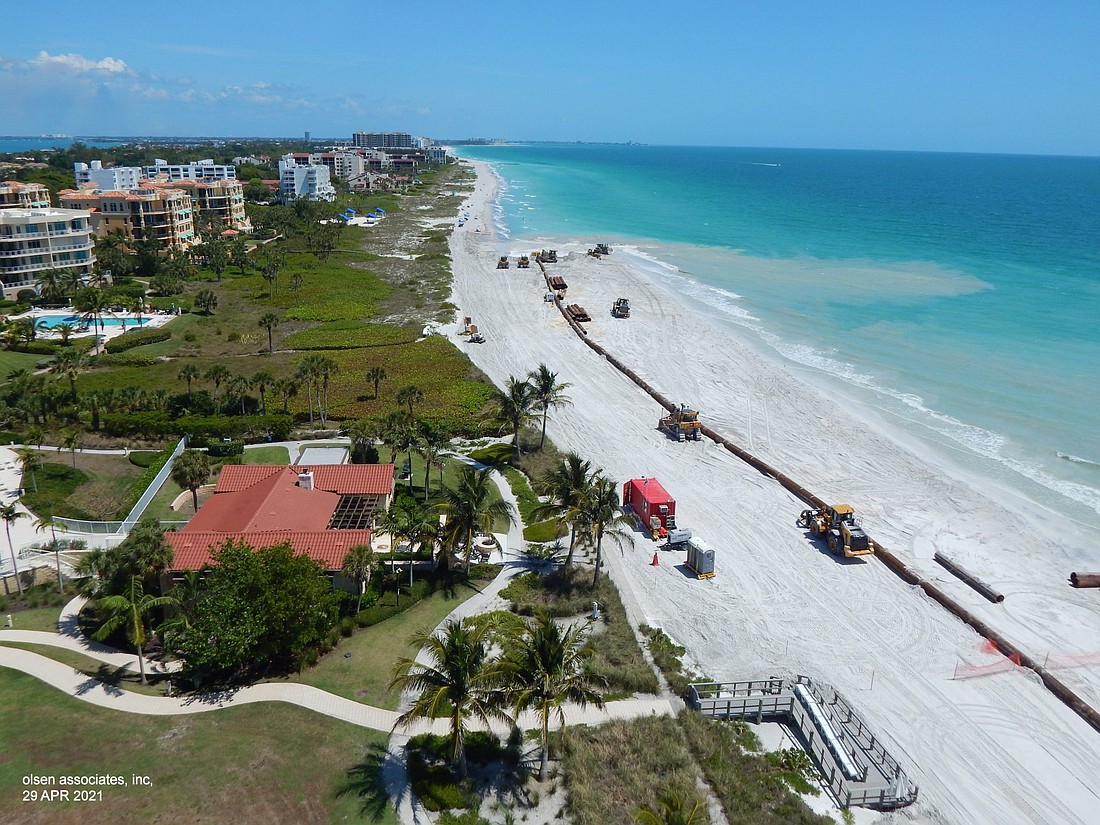
The next fiscal year, another project with an eight-figure price tag will get underway. An 800,000-cubic-yard beach renourishment effort is expected to cost $32.9 million and start in late 2027 or early 2028.
And if a $7.2 million groin field is permitted to be built on the Gulfside Road area of the beach, $40.1 million would be spent in fiscal years 2027 and 2028 for beach renourishment and erosion stabilization. That would mean three projects in two years would take up half of the town’s total capital improvement budget, which includes well over 100 projects.
With back-to-back substantial projects planned in two years, the town relies on contractors and consultants to manage the heavy lifts.
“We have a really excellent team with a lot of great experience, and at the same time we also work very hard to hire trusted advisors like our engineers, architects and contractors on a very high-quality basis by qualifications to help us execute these projects,” Brownman said. “Especially these engineers and architects, they work as an extension of the town, and on certain projects, we bring in our contractors early to work in a partnership.”
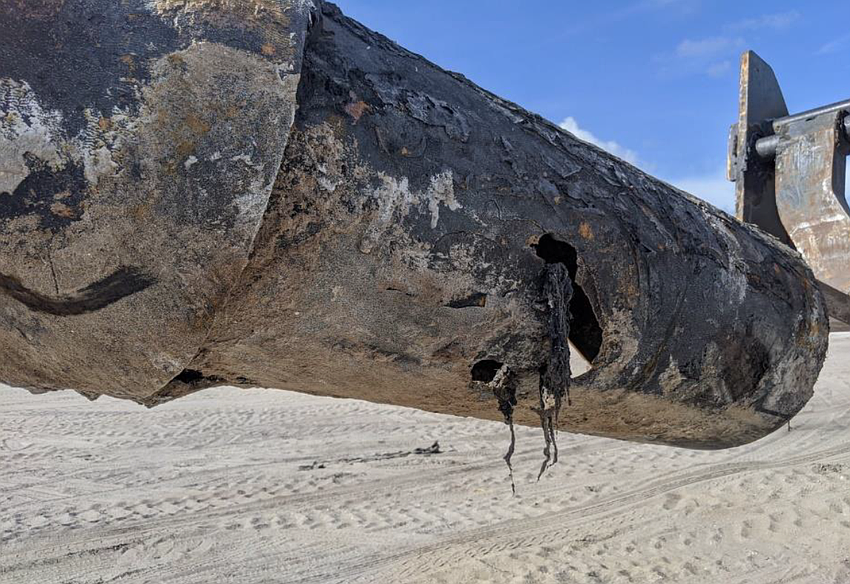
Longboat Key’s sewage is sent to a wastewater treatment facility in Manatee County via iron pipe that tunnels under Sarasota Bay and to the mainland.
Installed in 1973 and put into service in 1975, discussion surrounding the eventual replacement of the 50-plus year-old pipe began years ago. Brownman said the town continuously evaluates the expected lifespan and state of infrastructure throughout the town. In 2016, the town performed a condition reassessment report that concluded the pipe was in fairly good condition, Brownman said.
With that promising report, the town began to plan a long-term replacement strategy for the pipe over the next 10-15 years.
Then, in 2020, the wastewater pipe ruptured near the mangrove fringe on the mainland, spilling 11 million gallons or more of sewage before it was repaired. Long-term planning then became “as soon as possible” planning.
Despite the urgency, the project planning has progressed while price estimates have risen. Preliminary cost estimates for the subaqueous replacement line were $21.9 million, then $30 million. Now, the town is budgeting $42 million for the project in the five-year capital improvement plan. Brownman described the previous cost estimates as “stop gap” as they gave the town a rough estimate before final engineering plans were completed and environmental permit mitigation requirements were known.
Paying for the costly but necessary project will come from a variety of sources. Town Finance Director Susan Smith said the town expects to bring in $3 million via a U.S. Environmental Protection Agency grant and $1 million from EPA appropriation. Florida Department of Environmental Protection will appropriate $1.5 million, and $9.6 million will come from a State Revolving Fund grant.
Loans would make up the difference, whether that is $26.9 million (with a $42 million project cost) or less. The town is eligible for a $9.6 million zero-interest loan from the State Revolving Fund. Longboat voters overwhelmingly approved borrowing the money to pay for the project.
“We have the option to issue up to $13 million in bonds under a previous referendum and per our charter, we can issue up to $7,388,425 in revenue bonds without a referendum for this utility fund,” Smith said in an email.
Paying back those zero-interest loans would be done over 20 years via the utility fund, which is replenished by revenue from utility bills.
The beach is the main draw of Longboat Key, and it’s not cheap to maintain.
Beach renourishment happens on a seven-to-eight-year recurring schedule, and it’s the most expensive ongoing project the town performs. In fiscal year 2028, $32 million is earmarked for beach renourishment.
That doesn’t include $10.8 million that could be spent in fiscal year 2027 in preparation for the project. The possible Gulfside Road groin field makes up a majority of that cost.
There is also a $340,000 effort to determine the best source of sand to be placed on the beach.
“Being able to find viable sand that is of the quality by which we at Longboat Key like our sand, those sources are dwindling,” Mopps said at a recent budget meeting. “One of the major tasks that we asked Dr. Al (Browder) and the gang to do is go find more, so that’s what they’re doing.”
That search involves picking up sand from the sea floor to evaluate the quality, including color, shell content, grain size and more. When a suitable source is found, a dredging machine would then take that sand and route it to the beach during the beach renourishment scheduled in fiscal year 2028.
There are two funding paths the town can take, depending on whether $10.6 million in state of Florida Storm Funds are received by the town. If the town does not receive those funds, the town would pay $12.8 million, according to the town’s Capital Improvement Plan. The town share of the cost would be $5.2 million if it receives the storm funds.
The town has “low to mid” confidence it would receive the storm funds, but has high confidence it will receive $12.2 million from the Federal Emergency Management Agency, $2 million from the Florida Department of Environmental Management and $5 million from the Florida Department of Environmental Protection.
Without storm funds, the town is set to front 40% of the cost of the renourishment. In the beach fund is $8.7 million, and the remaining $3.5 million would likely come from a loan, or less sand will be placed on the beach, Smith said.
Of the top 20 items on the wish-list of projects planned by Longboat Key in the next five years, neighborhood resiliency efforts make up the majority of line items, totaling $34.3 million.
Efforts to reduce continual flooding in neighborhoods such as Sleepy Lagoon, the Village and Buttonwood Harbor have been an ongoing discussion for years, with engineers tasked with drawing plans for projects at several neighborhoods and gathering public input through various meetings.
But despite those meetings where plans were presented to neighbors, many of those projects are still more than 18 months out at least, including in the Buttonwood neighborhood. The town has earmarked $3.7 million for phase 1 of Buttonwood improvements, but not until fiscal year 2028. Brownman said the Buttonwood project was moved back a year because with a delay in FEMA grant reimbursements, the streets fund would be in the negative.
“If we left it in fiscal year 27, fiscal year 27 could not be adopted as a balanced budget,” Brownman said. “It would put the entire fiscal year 27 streets fund in the negative.”
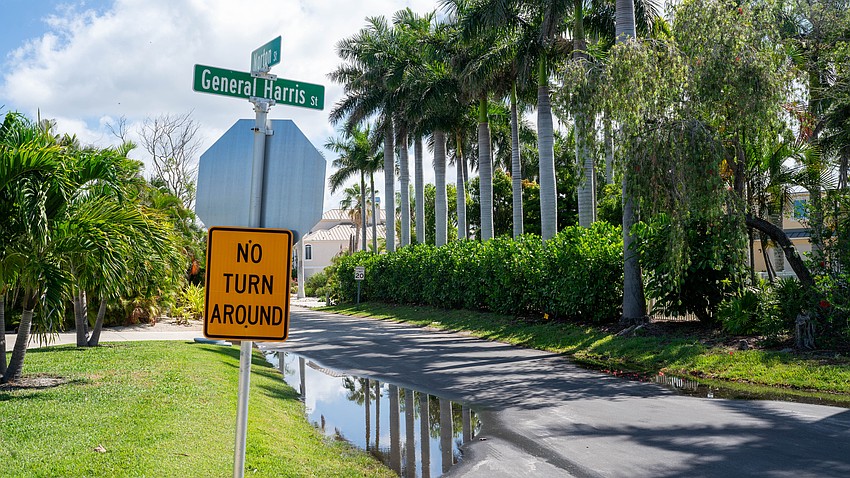
Norton Street residents will have less of a wait for improvements, with $2.7 million budgeted for fiscal year 2027, which begins this fall.
All neighborhood resiliency projects are almost entirely dependent on FEMA. The town is applying for $23.4 million in Hazard Mitigation Grants from the federal agency that has seen shutdowns and extended delays in grant disbursements.