- July 8, 2026

-
-
Loading
Loading
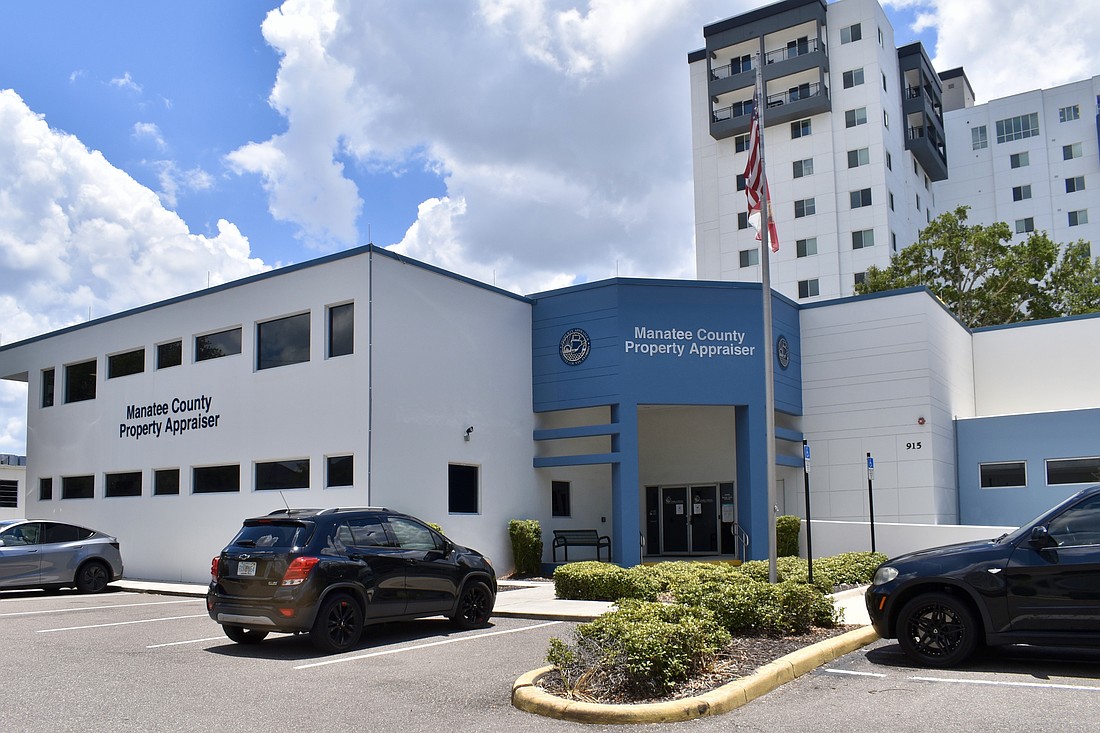
Every year, each of Manatee County’s approximately 236,000 real estate parcels receives a valuation. Sometimes it goes up. Sometimes it goes down.
Most importantly, this appraisal of valuation is the basis of that property owner’s tax bill, which makes it an essential process for the county.
So just how does Charles Hackney, Manatee County’s elected property appraiser since 1992, get that work completed each and every year?
Hackney said conducting that many appraisals is a constant, year-round process that takes a team effort by all 65 staff members in his office.
The process is similar to a real estate appraisal in that it’s market-driven. But because of the volume of parcels, the Property Appraiser’s Office also relies heavily on modeling and statistics.
Of the 65 staff members, only 12 appraisers are in the field. A dozen people simply can’t visit 236,000 parcels in a year, so the Property Appraiser’s Office uses aerial photos to survey the parcels to check for improvements or changes.

The cost of filming everything from a plane is shared by both the Property Appraiser’s Office and other Manatee County departments because those aerial photos have several uses within the county.
The photos must be completed before Jan. 1 each year because that is considered the assessment date.
The images are captured by manned planes that have high-resolution cameras affixed to the wings. Manatee County hires the company Eagleview to do the work, and its planes typically fly at altitudes between 5,000 and 10,000 feet. The cameras can capture orthogonal (straight down) or oblique (side-angled) views.
By state statute, every parcel also has to be physically inspected at least once every five years. However, Florida Statute Section 193.023 reads, “Where geographically suitable, and at the discretion of the property appraiser, the property appraiser may use image technology in lieu of physical inspection to ensure that the tax roll meets all the requirements of law.”
Permits often can lead to an inspection within that timeframe. For example, perhaps a pool or a porch was added, which can then be verified with an aerial photo.
Tracy West, director of appraisal services, said the staff works through “thousands and thousands” of permits each year. Currently, there are about 17,000 active permits.
However, if nothing has changed in five years, those properties are grouped together so appraisers can look at the aerial photos to see if anything was added or deleted without a permit.
West said sales that seem “outside the norm for what properties in that neighborhood are selling for” would also cause an inspection. Those inspections can be done by using the aerial photographs or by an in-person visit.
When a county appraiser visits a property, he or she always knocks on the door first to give the owner a business card and explain the visit. For the most part, the appraisers are only looking at the outside of the home or building.
“If only normal things are happening with the property — you’ve added something on or you’ve taken something off — we’re not coming inside for that,” West said. “When people are telling us, ‘I think my property is overvalued because it’s not in good condition,’ we will occasionally make an appointment with a homeowner to inspect the inside of a house to ascertain the condition of the house.”
Appraisers also visit properties that have recently been issued certificates of occupancy. The appraisers verify that what was built matches the previously submitted plans.
In 2025, nearly 6,000 new homes were added to the tax roll in Manatee County.
Because so few inspections are done in-person, eight of the 65 staff members are in the IT department.
“One of them does nothing but GIS, which is geographical mapping,” said Scott Tussing, director of communications and community relations. “They’re also highly involved in the tax roll because they transmit to the Department of Revenue.”
The tax roll is the registry of all properties subject to property taxes in Manatee County. It includes the properties’ assessed values and the amount of taxes owed.
The Department of Revenue is the oversight organization for the Property Appraiser’s Office. The Department of Revenue audits the tax roll every year.
“It’s studied for tests of fairness, and there are certain ratios that we have to maintain for our tax roll to pass,” West said. “We’re constrained by the Florida statutes to maintain a certain relationship between our values and what the market is doing. That’s why those values go up when the market goes up, and they go down when the market goes down, as well.”
Specific ratios aren’t published. Trends of what the market is doing over 12 months will influence the ratios whether the market is trending upward or downward. Time adjustment factors are applied to the sales depending on when they happened throughout the year.
The Department of Revenue studies all the sales within a year and issues those factors to the Property Appraiser’s Office.
“After COVID, we thought everything was going to tank, and it took off like crazy,” West said.
In general, West noted that the value is going to be lower than the sales price.
Tussing said that most people are used to fee appraisals that are performed on an individual basis, but the Property Appraiser’s Office uses mass appraisals, which involves statistics that analyze sales and comparisons of an entire neighborhood.
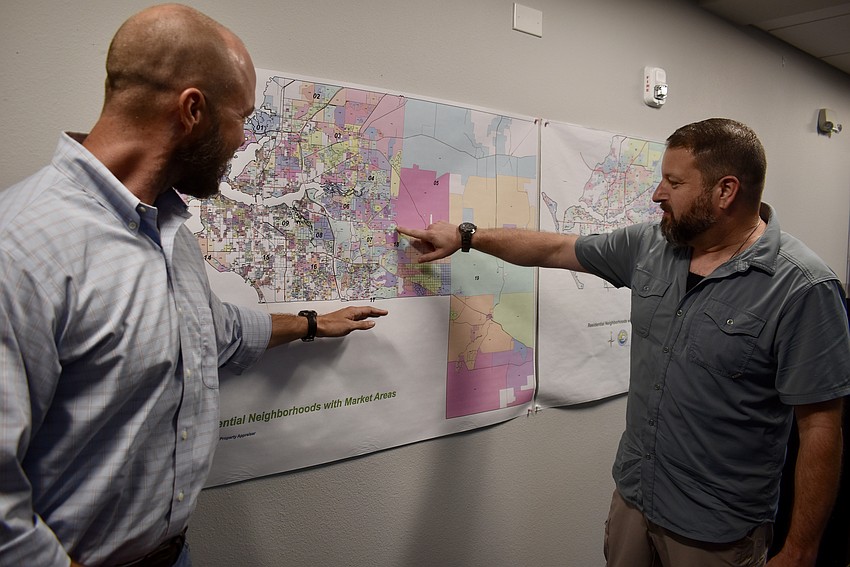
The office uses a Computer-aided Mass Appraisal System. A base model is built into the system, so when all the components of a new home are inputted, the system will factor up or down based on the quality and different materials that were used.
The statistics include coefficient dispersion, which is past standard deviation. Appraisers are also doing vertical and horizontal integration onto how different price points are behaving.
West noted, “It’s not party talk.”
It’s also not “throwing darts at a dartboard.” If a buyer pays too low or high of a price, the value will come out somewhere in the middle because of the statistics. The highest and lowest sales are thrown out.
Additionally, each category of residential, commercial and industrial are all treated differently. Within residential, condos and mobile homes are different statistical groups, as well. The DOR is reviewing every one for compliance to be sure nothing is valued haphazardly.
Although timing can sometimes make the process appear haphazard.
“Because of that Jan. 1 assessment date, we can’t look forward and predict what the markets are going to do,” West said. “We look back at the prior year and use that as the basis for our adjustments. Going up, it’s great because we’re always a year behind what the market’s doing. But going down, people might feel we’re not going down fast enough, but we’re going down as fast as we’re allowed by statute (which dictates the ratios between values and sales).”
West encourages residents to call the office with questions, especially if they’re contemplating changes to the property. Staff members can let owners know ahead of time how those changes will affect their tax bill.
All property owners have seen the stamp. “This is not a bill” is typed in bold lettering across the top of Truth in Millage notices.
TRIM notices provide notice of the proposed taxes on a property and are mailed during the second week in August. Property owners have 25 days to file a petition with the Value Adjustment Board with objections.
“The homeowner needs to be studying that document,” Tussing said.
The document is not a bill. It’s noted as such because people used to send checks to the tax collector before the office could collect the tax, then the tax collector would have to return the checks.
The new problem is that people tend to toss those notices aside once they see it’s not a bill.
August should be the busiest time of the year after TRIM notices are sent out, but Tussing said that’s the second busiest time of year.
The first busiest time of year is 10 days after the bills are sent around Nov. 1, when it’s too late for anything discretionary to be adjusted. Only errors can be fixed at that point.
If an owner feels their property value went up or down too much, August is the time to object.
There were about 1,500 petitions in 2025. Of those 1,500, about 800 were residential petitions.
But Hackney noted that it’s typically not “Fred and Ethel” filing an appeal, it’s corporations that own hundreds of houses and hire professionals to file the appeals to save tax money. Those professionals work on commission.
“Quite frankly, we win most of the time,” Hackney said. “If there’s something wrong, we’re going to fix it before it goes across the street to the Value Adjustment Board. Most of the time, the special magistrate will rule that we followed the procedures, did what we were supposed to do and that our assessment is reasonable, and therefore they will uphold it. Appraising is an estimate based on facts. You do certain things with those facts, but ultimately what you come up with is an estimate of market value.”