- July 8, 2026

-
-
Loading
Loading
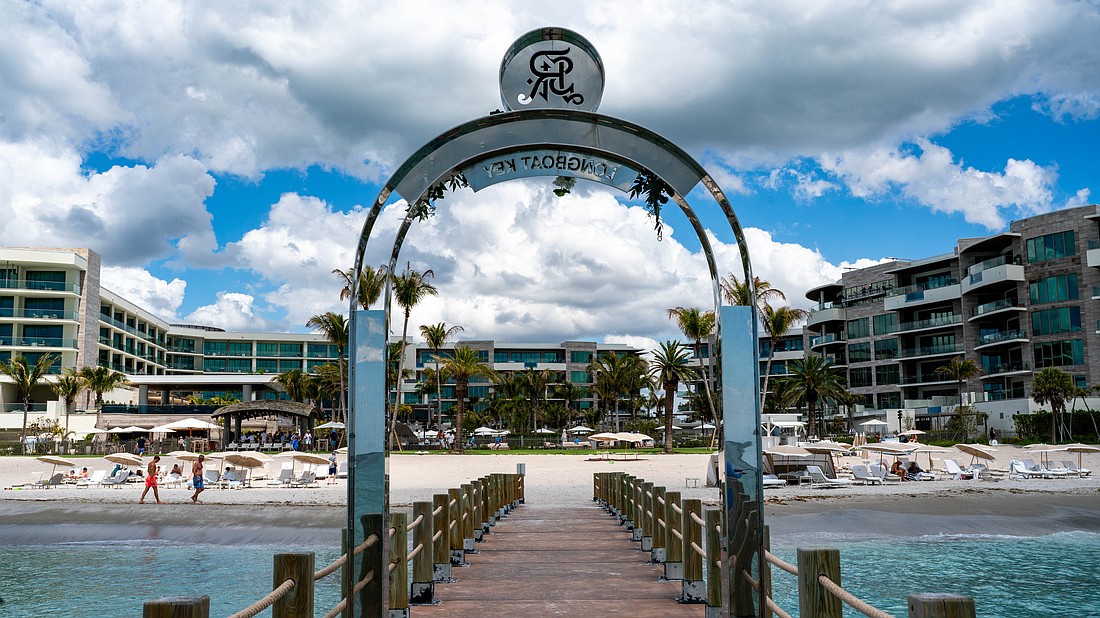
Now that a suit was filed by the town of Longboat Key against the developers of the St. Regis Longboat Key Resort, the resort owner’s lawyers responded to the town’s claims, and a court date was set.
Lawyers Morgan Bentley and Brian Goodrich, who have been retained by Chuck Whittall and Unicorp Developments, Inc. on behalf of SR LBK and SR LBK II LLC, filed an answer to the town’s lawsuit over a metal arch the town claims violates its sign code. The answer, signed by Goodrich, denies a majority of the 62 claims made by the town and explains six “affirmative defenses” that state the metal arched sign placed on a groin behind the resort was legally installed and should not be removed.
The first affirmative defense listed in the answer claims the town does not have jurisdiction over the arch as it is outside of the town’s boundaries. It goes on to claim that even if the arch were within the town’s boundaries, the town “has not enacted regulation to implement its jurisdiction over the arch and sign.”
The defendant’s filed answer includes a list from No. 1 to No. 62 where each claim made by the town in its suit is responded to. Many of the responses are identical and simply say “denied” or “admitted.”
A field permit is mentioned in nine of those responses, referring to a permit issued by the Florida Department of Environmental Protection the state agency issued “to install post, rope and sign” on the groin. The answer cites state statute, which says that a permit is required from FDEP for “any coastal construction or reconstruction or change of existing structures” including groins or jetties “upon state sovereignty lands below the mean high-water line of and tidal water of the state.”
St. Regis’ attorneys also mention the town’s code of ordinances do not mention the words jetties or groins and there is no ordinance that states a permit is required for the construction on or change to existing structures on groins.
The answer to the suit also argues that where the arch is constructed is not included in a zoning lot and is not on a parcel of land. The third passage in Longboat Key’s sign code is also cited, which states “A sign placed on land or on a building for the purpose of identification, protection, or directing persons to a use conducted therein shall be deemed to be an integral but accessory and subordinate part of the principal use of land or building.” It also claims that anything in town code 156.07 is inapplicable because the scope defined in the code is for permanent signs in a list of zoning districts.
“Since the Gulf does not lie within a Zoning District, the criteria of section 156.07 does not apply to the groin, arch or sign,” the answer to the suit reads.
The response by St. Regis’ lawyers concludes by citing case law (Rinker Materials Corporation v. City of North Miami) where the court’s decision stated that “words used in a zoning ordinance should be given their broadest meaning when there is no definition or clear intent to the contrary and the ordinance should be interpreted in favor of the property owner.”
A court date for the non-jury trial is set for Jan. 14, 2028, according to the Sarasota County Clerk of Court website.