- July 20, 2026

-
-
Loading
Loading
Floridians are angry about property taxes. They should be.
Over the last decade, home values have surged, tax bills have climbed and many families feel like they are paying rent to the government on homes they own.
The frustration is real.
The affordability crisis is real.
The desire for meaningful tax relief is real.
But anger is not a fiscal plan.
Our legislators need to think hard in this week’s special session on property taxes and do the right thing for the right reasons.
Gov. DeSantis’ plan is not it.
What the Legislature was expected to do this week, reminds me of a professor in college who would listen to students passionately advocate for a solution. Then, he would lean back in his chair and ask a simple question: “And then what happens?”
No matter the issue, he always came back to that question. Not because he opposed change, but because he understood that good policy requires thinking one step beyond the headline and one step beyond the applause.
That question has been stuck in my head as Florida debates one of the most significant changes to its tax system in modern history.
Property taxes deserve reform. They may even deserve replacement. But before we blow up the system that funds local government, we should ask the same question:
And then what happens?
Florida is not debating a tax cut. Florida is debating a fundamental redesign of how local government is financed.
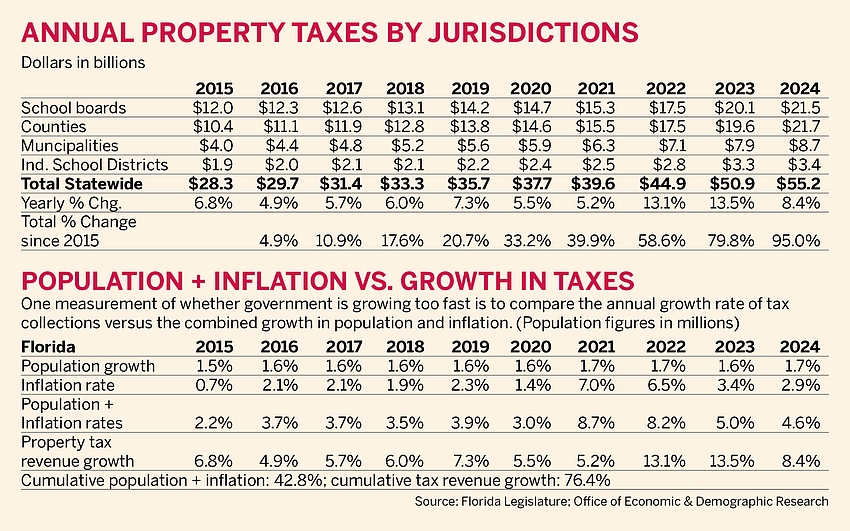
Florida’s property tax system generates $52 billion each year for local governments. Replacing that revenue is not a bookkeeping exercise. It is a redesign of the state’s fiscal architecture.
Property taxes fund much of the basic operating system of local government: police, fire protection, roads, parks, emergency services and debt on infrastructure taxpayers have already approved.
You may believe local governments spend too much. But believing there is waste in government is not the same thing as having a plan to replace billions of dollars in revenue.
Every serious reform proposal should answer four basic questions:
Those are not arguments against tax relief. They are the questions responsible adults ask before making permanent changes to a system that affects every homeowner, renter, business, city and county in Florida.
The most important question may not be about taxes at all. It may be about governance.
For generations, Florida has operated on a simple principle: Local governments raise local revenue and answer to local voters. If a city council or county commission spends too much, voters can replace them. The accountability is direct.
The emerging alternative moves Florida toward something very different. Local governments would become increasingly dependent on state support and state-controlled trust funds to maintain core services.
Consider small counties like Liberty, Lafayette or Glades. These are proud Florida communities with strong local identities but small populations and limited tax bases. Under this model, some counties could become increasingly dependent on state trust fund dollars to fund deputies, firefighters, road maintenance and other core services.
Independent local government means paying your own bills.
Once a county becomes dependent on Tallahassee to fund basic services, local self-government is eroded. Decisions that once belonged primarily to local voters become increasingly subject to state appropriations, state priorities and state politics. Local officials spend less time answering to residents and more time lobbying the state for funding.
And then what happens?
What happens during a recession when state revenues decline? What happens if multiple counties need assistance at the same time? What happens if the trust fund cannot meet every request? Who decides which communities receive funding and which are told to wait?
History offers another warning. Big structural reforms are easiest to adopt during good times and hardest to sustain during bad times. Florida’s economy is strong today. But recessions still happen. Housing markets cool. Sales tax collections decline.
The real test of a tax system is not how it performs when the economy is booming. It is how it performs when the economy is under stress.
Those questions become even more important when viewed against Florida’s long-term budget outlook. State economists are already projecting structural deficits in the years ahead. If the state itself is facing fiscal pressure, it is reasonable to ask whether it can permanently assume a larger role in financing local government.
None of this means reform should stop. Quite the opposite. Florida should absolutely pursue property tax reform. We should challenge wasteful spending, examine larger homestead protections and explore alternatives.
But reforms this large should be approached with humility.
Reforms this large should be tested, measured and evaluated before they become permanent. That is why any proposal of this magnitude should include a sunset provision. If the reform works, extend it. If it creates unintended consequences, fix it. The larger the experiment, the more important the safety valve. Most important, we should be honest about what may happen next.
Government has only a handful of ways to collect revenue. Property taxes, sales taxes, fees, assessments, utility taxes and state transfers all come from taxpayers.
Nearly one in three Floridians rents their home. If this proposal simply shifts the burden from property taxes to fees, assessments, sales taxes or other revenue sources, renters will not be spared. They will receive the bill in a different form.
If local governments replace lost property tax revenue with other taxes, fees or state transfers, taxpayers may discover they did not eliminate the bill. They simply moved it.
That is the question at the heart of this debate. Is this a tax cut, or is it a tax shift?
The choice before Florida is not between tax relief and the status quo. It is between thoughtful reform and blind faith.
Floridians deserve tax relief. They also deserve honest answers.
The irony is hard to miss.
The Boston Tea Party was a revolt against distant government making decisions for local communities.
I am arguing against distant government making decisions for local communities.
Read that twice.
Before we redesign the financial foundation of local government; before we trade local accountability for state dependency; and before we replace a system we know with one we have not fully modeled, we should ask the question my professor asked all those years ago:
And then what happens?
Jeff Brandes served in the Florida House and Senate from 2010 to 2022. He is president and founder of the Florida Policy Project (floridapolicyproject.com).