- August 2, 2026

-
-
Loading
Loading
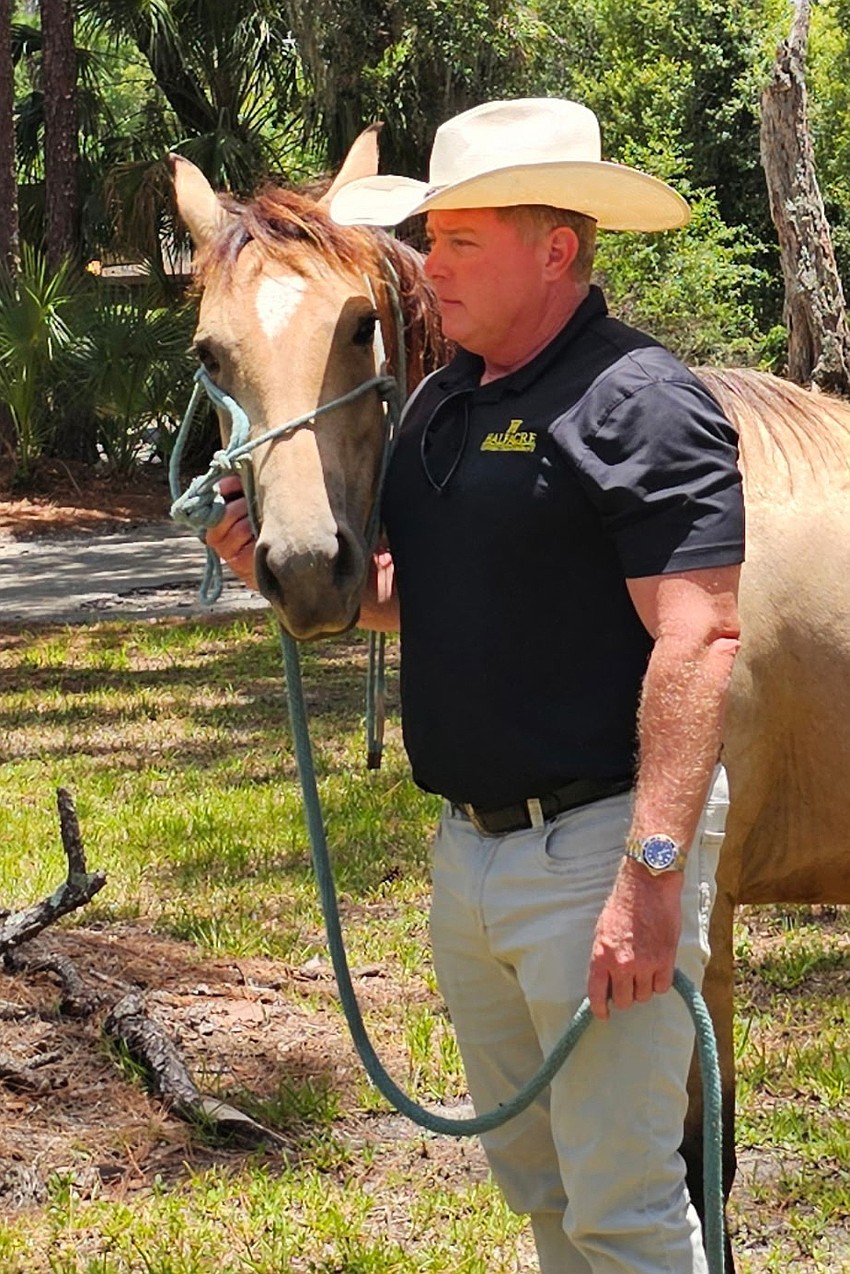
For nearly 30 years, John and Jack Cox, father-son owners of the longtime Sarasota construction firm, Halfacre Construction Co., sat on 43 mostly undeveloped acres a mile north of Fruitville Road on the east side of Lorraine Road.
For about 20 of those 30 years, John and wife Cameron lived on 10 acres of their property in a 4,600-square-foot home with a barn and swimming pool. They had moved from Siesta Key to enjoy their retirement years on a farm. The elder Cox switched from building buildings to raising horses — about 20 Appaloosas at a time.
The Coxes always viewed their rural acreage as a long-term investment. They figured one day they likely would sell the property because they knew it would be in the path of Sarasota County’s northeastern growth. It didn’t take a genius to see the future.
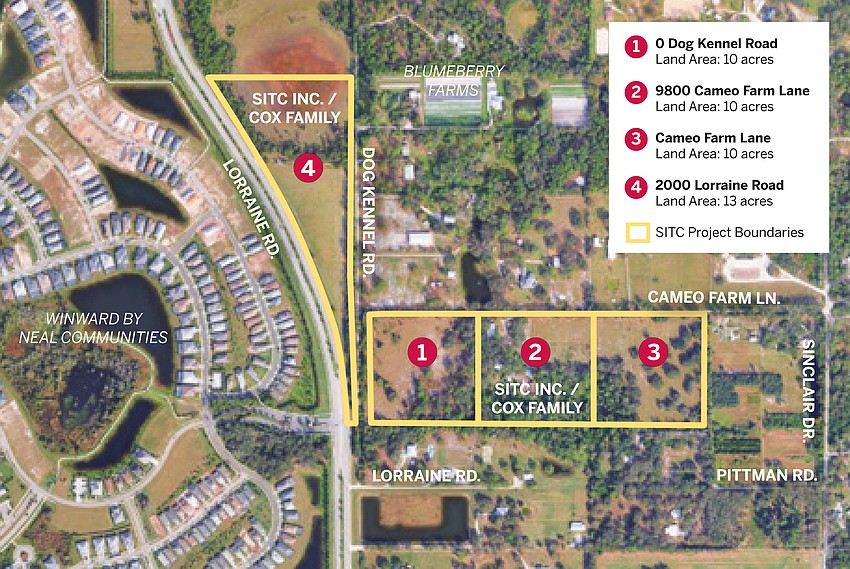
And indeed, in February 2020 Neal Communities, the big West Coast Florida homebuilder, broke ground on its Windward development, what is to become 900 single-family homes and villas. Windward, it just so happens, is directly across the street on Lorraine Road from the Cox family’s acreage.
Jack Cox decided it was time. His father had died in 2008, and with Neal’s development approved, Cox decided in October 2020 to develop the family property.
With Sarasota land-use attorney Bill Merrill, Cox filed a petition with Sarasota County to convert his and other neighboring properties to a conservation subdivision — a zoning category that already existed east of the Cox property.
The change would have allowed Cox to build two residential units per acre instead of the one per five acres under the property’s existing Open Use Estate zoning — up to 86 homes were envisioned.
But, alas, as these stories go in Sarasota County, that’s when Cox encountered the mighty, bureaucratic forces of Sarasota County’s planning staff and the populist politicians on the County Commission.
Over the past five and a half years, the county has rejected Cox’s lawful petitions three times. The latest — by far the most egregious — came this past April.
That did it. Cox had enough. After all these years of writing checks to engineers and lawyers — a total exceeding $1 million of family money — Cox sued each of the county commissioners May 20.
“I can’t believe this is happening here,” Cox told us. “It’s beyond belief. This is something that happens in Palm Beach. This is a Carl Hiaasen type of story.
“I’m willing to go to the Supreme Court if we need to,” Cox said.
For Cox, the most outrageous part of his long saga is what has occurred since December 2025 and so far this year. The details of the denials and what can be proven as duplicitous treatment from the county planning staff between 2020 and 2024 are an outrageous saga in themselves — that is, if you believe in property rights and equal treatment under the law.
But what has occurred since the end of 2025 and through May of this year, we will show, is as Cox said: “beyond belief.”
This is the crux of the story: Affordable, workforce housing; a power struggle; an intransigent, manipulative bureaucrat; and a property owner who is punished even while following the rules.
The players:
These same commissioners will all say they want more affordable housing. “I don’t think any of us is against affordable housing,” said Commissioner Tom Knight at a March 24 commission meeting. “I’m certainly not.”
But they all will say in the next breath, as Commissioner Mark Smith did at an April 7 commission meeting: “I would rather be on the side of our citizens than on the side of the development community on this to protect our neighborhoods and to protect our places out east.”
Or as Knight also said: “These are people’s livelihoods in their homes where most of their wealth is, and they’re worried about the compatibility of what’s going in near them. Our community looks at the five of us to protect them from the government.”
All of which is code for: The anti-development mobs take precedence over individual property rights. They can have their homes, but you can’t have yours.
In other words, denied.
You would have to have been living on Mars for the past decade not to know the lack of affordable, workforce housing is and has been the most pressing economic issue in Sarasota and Manatee counties, and indeed, in all of Florida.
State data show there is a deficit of 99,134 affordable apartment units in Sarasota and Manatee counties. The deficit in the Tampa MSA: 444,927.
Everybody knows the problem. Solving it is another matter.
Dozens of economic development and chambers of commerce conferences in the region over the years have focused on the shortage. Advocates have made some progress, persuading local governments to adopt density-bonus incentives for apartment builders to include a percentage of below-market-rate units in their projects. But as the data show, this has done little to make a dent.
NIMBYism continues to be pervasive.
Just read the news. Practically every week, some neighborhood group protests or a populist politician pontificates that development needs to be stopped, or they rant against the newest development project that surfaces.
The NIMBYs are effective. Two years ago at the Florida Housing Summit in St. Petersburg, M. Nolan Gray, research director of California YIMBY (Yes in My Back Yard), cautioned policy makers that Florida was well on its way to mirroring California’s horrible housing market. “You have already adopted all the same rules as California,” he said.
Indeed, cities and counties all over Florida — including here — have adopted impenetrable mazes of zoning regulations that constrict the supply and drive up the costs of housing. Adrian Moore, an Observer columnist, is vice president of the Reason Foundation, a think tank that specializes in housing policies nationwide. He has written repeatedly in the Observer how regulations are at the top of why housing is unaffordable.
And yet, Commissioners Knight and Smith call this “protecting our citizens” from the development community.
Which brings us to the increasingly controversial Live Local Act.
In 2023, recognizing the housing affordability crisis and that local government zoning laws are chief impediments to increasing workforce housing, the Legislature essentially said: “Get out of the way. We’re now in charge.” It adopted the landmark Live Local Act.
The act stripped local governments of their power over multifamily developments and expanded where these developments can be allowed without local government interference.
Since revised three times, Live Local requires counties and cities to allow multifamily and mixed-use developments in areas zoned for commercial, industrial or mixed use if at least 40% of the units are offered at affordable rates for 30 years minimum.
If a project meets the state’s requirements, it also allows the projects to skip the local planning and zoning approval process. The projects automatically must receive administrative approval — no public hearings required where NIMBY neighbors can pack planning board and commission meetings and skuttle developments. (See box for additional provisions.)
In late summer 2025, Cox began looking into whether he could develop under the Live Local Act. For two weeks, Merrill tested whether Cox’s properties would qualify. Conclusion: They were convinced, unequivocally, they fit every criterion.
In September, they met with the county planning staff for feedback. Cox remembers the reaction: “You could feel that they didn’t want to do it, but they knew because of the state statute that they would have to do it.”
Three months later, on Dec. 4, 2025, Cox and Merrill submitted the application to develop 500 multifamily apartments on his 43 acres under the Live Local Act.
Finally, after five and a half years of rejection and bureaucratic wrangling, they felt they had found a path forward.
“[My project] is not low-income housing,” Cox told us. “It’s workforce housing. It’s for deputies, first responders, teachers, construction people. I have 65 employees at Halfacre, and most of them live in Charlotte County and have to commute up here. I mean the fuel cost is crazy.”
Their confidence was short lived.
The application entered the fortress of bureaucratic processes — the Sarasota County Planning and Development Services Department. Its director, Osterhoudt, is like the troll in the “Three Billy Goats Gruff.” Try to get your project across his bridge, and he’ll likely devour it in red tape.
Here’s one example:
According to state statutes, each county is required to have a streamlined process for Live Local applications to get them to approval quickly — administratively approved without quasi-judicial or public hearings.
For standard development applications, it’s a two-step process: A developer submits a site development plan, and then, if approved, would obtain a building permit. Slam-bam.
But just before Cox submitted his Live Local application and weeks after he had already discussed his plans with the county staff, to his and Merrill’s surprise, the planning staff informed them the county changed its application rules.
The county now required a mandatory five-step process for Live Local projects — clearly lengthening and delaying approvals and contrary to the Legislature’s intent for quick administrative approvals.
They objected. The explanation for the change, according to Merrill: “Staff indicated that the process was continuing to evolve as they explored so-called ‘best practices.’”
“You could tell the tone was getting more difficult,” Cox recalls. “Matt started talking about commissioners were having a different view or a different understanding of the ordinance. What we took from that meeting is they were going to try to change the legislation up in Tallahassee.”
Added Cox: “I was starting to feel like my clock was running out on Live Local, and they were trying to run the clock out.”
December flowed to January; January to February — no approval.
“We were constantly talking with them,” recalls Merrill, “and they were constantly throwing up delays.”
Finally, on March 13, four months after submitting their application, the county staff issued its Development Review Coordination comments on whether Cox’s proposal qualified for approval. This was the third step in the process.
Still no approval.
The report said, among other things, the project needed more entrances and needed to address issues with water flow counts and utilities. Cox referred the requests to engineers the next week.
But during that week the real reasons for the delays, stalls and “slow-walking” came to light.
At the March 24 County Commission meeting, without prior public notice, Commissioner Knight proposed a convoluted motion to “direct the county attorney and county administrator collaboratively to provide a written opinion regarding the applicability of the Live Local Act to partial zone RE-1 and OUE, including whether those districts satisfy the statutory requirement that commercial, industrial, mixed-use development be allowed…”
Commissioners voted 5-0 in favor of getting the opinion from County Attorney Josh Moye. Cox was unaware of that vote for two weeks.
A week prior, the Legislature approved HB/SB 1389, which would exclude properties zoned OUE (including areas intended to be open space and farms) from Live Local, retroactive to 2024.
That bill was presented to the governor Monday for signing. Although it would exclude properties zoned OUE from Live Local, the legislation still permits their application to be considered, or grandfathered in.
With that legislation, Cox says he understood why his project was being stalled.
Even with the passing of SB 1389, commissioners forged ahead.
On April 7, after having received Moye’s opinion, commissioners again discussed Live Local at the end of the regular meeting.
Knight led the discussion by telling commissioners other counties and cities around Florida were challenging Live Local, asking for declaratory judgments against the state law.
“There’s a lot of anxiety in our communities that we’re hearing from,” he told his fellow commissioners.
He lamented again not having power. “We’re not going to have input on as an elected board, and we’re not going to have the ability to represent our community on these type of developments.”
At the previous meeting, Knight stoked the fire when he said:
“The way I’m reading it in my research, we could see dense four-story apartments, complexes, go up on vacant properties anywhere, even in Cherokee Park, Oyster Bay, Westbrook Drive in Sarasota. Anybody could have commercial businesses. They could have a tutoring company, piano lessons, attorneys working out of their homes in those neighborhoods.
“My research was also that even residential estates would be on Siesta Key, west of Midnight Pass, where you could put any type of commercial building business.”
At the April 7 meeting, Knight’s talk of lawsuits to stop Live Local stoked the commissioners again.
“I just wanted to make sure that we got the document there to show that communities are challenging the law, and they are going to [declaratory] actions, and they are prevailing in the best interest of the community.”
The drumbeat was increasing to outlaw Live Local in OUE and RE-1.
But wait. County Attorney Moye issued a caution.
“It was in our office memo 1901 that the property zones RE-1 and OUE have to be treated as qualifying districts under the Live Local Act definitions.”
But immediately after saying that, he added: “The board could adopt a good faith policy interpretation that RE-1 and OUE districts do not qualify for development under the Live Local Act, and then that would give the developer the opportunity or the applicant the opportunity to then do a [declaratory judgment] act against us, because you have to have somebody to sue to do a declaratory action.”
Moye then also added this crucial, cautionary qualifier:
“Just know that if the board does go down that policy interpretation, that RE-1 and OUE districts do not qualify, it is an uphill battle, because it does go against the strict language of the statute, and it does go against the legislative history, and the local act provides for attorney fee costs up to $250,000 to a prevailing party, which the county would be subject to each time it’s found to be in violation of the Live Local Act.”
County Administrator Jonathan Lewis also cautioned commissioners that if they defied state statutes, they could lose its sovereign immunity in lawsuits.
Neither Moye nor Lewis’ warnings mattered.
Commissioner Neunder, like the charged-up rabble-rouser at a hanging, urged for a motion requiring the county not to wait to be sued, but to sue first.
“You file legal action immediately,” he urged. “Do not pass go. I mean, you pass go, do it, and make sure that you get a judge’s determination on a declaratory action for these zoning determinations on these products.”
Commissioner Smith, taking it all in, the proposed: “I’d like to make a motion to have a policy direction to staff that OUE and RE-1 not be qualifying districts under the Live Local Act.
“I know there’s a certain amount of danger involved here,” Smith continued, “but I believe that I would rather be on the side of our citizens than on the side of the development community … to protect our neighborhoods and to protect our places out east. And so I’m wholeheartedly in favor of this … And we’ll see how it goes.
Without any prior public notice, and in spite of their lawyers’ cautions, the commissioners voted 5-0 to defy state law and declare a new policy that all properties in Sarasota County that are in the OUE and RE-1 zoning categories are ineligible for the Live Loca process.
Once again, the county squashed Cox’s development.
He wasn’t there to witness it. He found out a day later. “We were floored,” Cox said. “It’s hard to believe it wasn’t noticed. They’re not following state statutes, and they’re willing to use taxpayers’ money to defend this. That’s just unbelievable.”
Not to Knight. The day after the vote, he posted on Facebook:
“Despite the county attorney’s written opinion that these projects WOULD qualify under the law, I am happy to report that with the additional urging of Commissioner Neunder, our commission voted to exclude residential, rural and open use properties from qualification.”
On May 20, Miami lawyer Chris Oprison, partner in the national law firm of DLA Piper LLC, filed a 66-page lawsuit against Sarasota County and each of the five county commissioners on behalf of Cox’s company, SITC Inc.
The charges: Unlawful denial of SITC’s development application; unlawful moratorium for refusing to accept Live Local applications in OUE districts; and the commission violated Florida’s Sunshine Law requiring adequate public notice.
Cox chose the Miami law firm because it doesn’t have any ties to Sarasota commissioners, and it has appellate and Supreme Court lawyers.
And so it goes in Sarasota County. As always, no good deed goes unpunished.
Cox wants to use his property and risk his family money to fill a critical social, economic and community need. But because county commissioners are in a snit with legislators over the loss of their power, they scotched the construction of 500 sorely needed workforce housing units.
Everyone loses here:
Editor’s note: A spokesman for the county (to include Commissioners Knight and Neunder and Planning Services Director Osterhoudt) said: “Sarasota County does not comment on pending or active litigation.” His response included a May 28, two-page memo from County Attorney Moye, which concluded: “Our office will defend the lawsuit.”
You know the cliché: The road to hell is paved with good intentions.
You can say that’s certainly the case in Florida. The state’s legislators and all of Florida’s county and city commissioners either are on or about drive onto the Live Local Expressway, aka Road to hell.
It’s going to be hell. For some, it is already. And it’s going to get worse.
If you pay any attention to state and local government news, you probably have heard of the Live Local Act. It came about three years ago when then-Senate President Kathleen Passidomo, R-Naples, spearheaded efforts to help alleviate Florida’s workforce housing crisis.
The impetus for the legislation were the state’s local governments. They weren’t addressing the problem effectively. Rather, they were the problem, with their layers of regulations and caving in to neighborhood NIMBYs.
Passidomo and her colleagues decided: If local governments won’t fix the problem, we will.
Among a multitude of funding programs, they crafted a package of incentives that, to be blunt, stripped local governments of their home rule powers to control multi-family development.
Specifically, Live Local pre-empted counties and cities on zoning, density and height for multi-family rental developments in commercial, industrial and mixed-use areas. It required local governments to authorize such projects in those areas if at least 40% of the units will be affordable for at least 30 years and serve incomes up to 120% average median income.
Local governments also were required to approve the projects administratively — no public hearings or rezoning approvals required.
Hallelujah — a way to fast-track the construction of affordable, workforce housing.
But not much happened.
Over the next three sessions, the Legislature modified Live Local, relaxing additional local requirements. In the most recent session, the law became even more explicit on what qualifies. It listed specifics on what is considered commercial, industrial or mixed use — essentially casting a wider net for where Live Local projects could be developed.
The intent for every step all along has been to spur the development of workforce housing with attractive incentives and less government interference.
But as we also know, good intentions have unintended consequences.
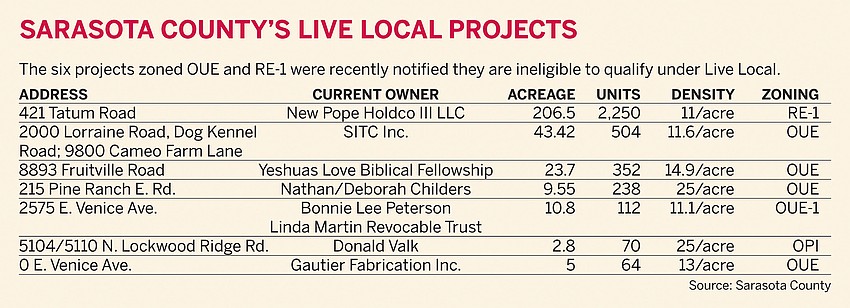
County and city elected officials really, really dislike Live Local. Not only has the Sarasota County Commission thwarted the SITC Inc./Jack Cox family Live Local development. After adopting a new policy in April to exempt the OUE and RE-1 zoning categories from Live Local, the county planning staff sent emails to the owners of five other Live Local projects stating they “were ineligible consistent with the Sarasota County Commission’s policy direction.” The county said they were not denied, just ineligible. Be real: denied.
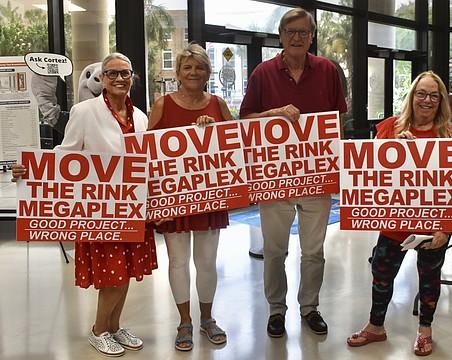
Elsewhere, county and city governments in Pasco and Hillsborough counties and the city of Hollywood, to name a few, also are challenging the law in the courts. And in each case, commissioners chafe over the Legislature pre-empting their home rule.
Meanwhile, citizen groups have organized to fight the law as well. stayTru, a registered not-for-profit in Sarasota, has amassed 1,000 members over the past year to stop New Pope Holdco III LLC from turning the 206-acre Tatum Ridge Golf Links in northeast Sarasota County into a multifamily development with 2,250 apartments. stayTru hired lawyers from Tampa.
President Matt Procaccini, a resident of the Legends in Tatum Ridge, said stayTru formed originally to protect the open space of the golf course. But over the past year, “We’ve attracted folks who are also fighting Live Local attempts in other parts of Sarasota,” he said.
“I’ve also been been contacted by other communities that have been hit with this Live Local stuff,” Procaccini said. “They’re looking to us for guidance.
“I don’t know where we’ll go over the long term, but one thing the board of stayTru has agreed on: The notion that the state and its attack on home rule is a very important conversation.”
Live Local + the property tax amendment. State rule versus home rule. Welcome, elected officials, onto Florida’s road to hell.