- July 21, 2026

-
-
Loading
Loading
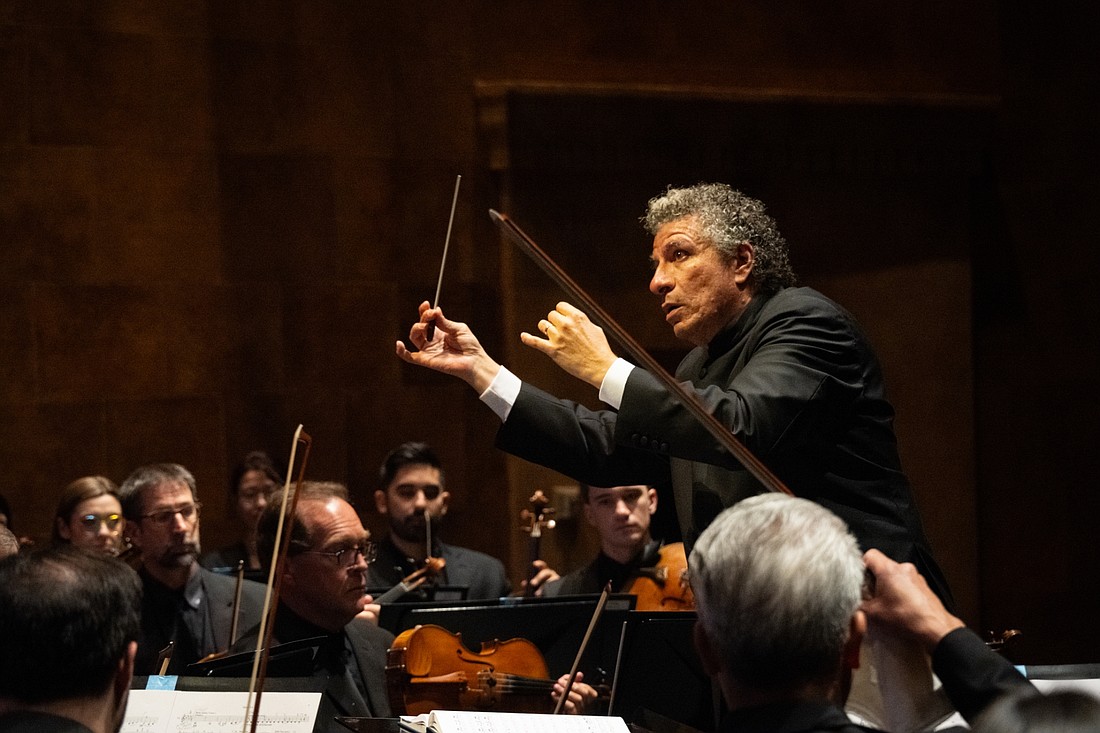
In a program that moved from intellectual musing to emotional release, the Sarasota Orchestra closed its Masterworks series with music by Leonard Bernstein and Gustav Mahler — two composers who, in very different ways, explore what it means to be human.
Under the direction of Giancarlo Guerrero, and featuring violinist Chee-Yun, the evening offered both refinement and power, culminating in a performance that left the audience audibly exhilarated.
Bernstein’s "Serenade after Plato’s Symposium" opened the program with elegance and intention. From the outset, Chee-Yun’s violin entered with an understated, almost distant voice, setting a tone of thoughtful restraint.
As the opening movement unfolded, the musical conversation gained energy, the orchestra responding with admirable unanimity. At times, that cohesion created a richly blended sound that tipped the balance away from the solo line, which could have shone with greater ease and presence.
Each movement brought its own character, though the distinctions between them did not always register with complete clarity. The third movement, Eryximachus, stood out for its exhilarating, kinetic energy — precise, vibrant and fully engaged across the ensemble. By contrast, Agathon offered a more delicate palette, its light textures and finely etched lines rendered with grace and sensitivity.
The final movement, Socrates–Alcibiades, provided the work’s most compelling moments. Here, the music took on a more declarative voice, grounded and authoritative, with a particularly engaging exchange between Chee-Yun and principal cellist Natalie Helm.
A jazz-inflected bass line, deftly handled by principal John Miller, added a sense of immediacy and modern flair. The movement built toward a satisfying and energetic conclusion.
Chee-Yun’s playing throughout was technically assured and beautifully shaped, her tone consistently refined. One sensed a preference for purity of line and control. At times a broader range of color and contrast — more light and shadow — might have further illuminated Bernstein’s shifting perspectives. The performance was accomplished and often engaging, though the larger arc of the work felt somewhat episodic rather than fully cumulative.
If Bernstein’s work invites contemplation, Mahler’s Symphony No. 5 demands immersion. From the first trumpet call — rich in tone and striking in presence from guest principal Diana Lopez —the orchestra established a sound world of depth and intention.
The antiphonal violin placement, with sections divided on either side of the stage, allowed Mahler’s intricate textures to unfold with clarity, inner voices emerging with unusual definition.
The opening movements moved forward with a sense of inevitability, juxtaposing somber procession with surging intensity. In the second movement, the orchestra navigated Mahler’s shifting terrain — fragmented motifs, layered textures — with impressive cohesion. The brass, in particular, brought a burnished, commanding sound that spoke to the ensemble’s continued growth and confidence.
The Scherzo, the symphony’s pivot point, was both expansive and controlled. The horn obbligato provided by principal Joshua Horne soared above the texture, while Guerrero shaped the movement’s many contrasting elements into a coherent whole. What might easily feel unwieldy instead unfolded with purpose and clarity.
The Adagietto offered a moment of stillness — strings and harp in a serene, sustained arc. Guerrero’s tempo allowed the music to breathe naturally, creating a sense of quiet introspection that held the hall in rapt attention.
From that calm, the finale emerged with renewed vitality. Lines were cleanly articulated, rhythms were buoyant and the Orchestra’s full force was brought to bear without sacrificing detail. The closing pages arrived with a sense of earned triumph, met by an enthusiastic response from the audience.
Taken together, the evening traced a journey from reflection to affirmation. If the Bernstein piece invited thought, the Mahler delivered experience — immediate, powerful and deeply felt. It was a remarkable conclusion to a season that continues to reveal the Sarasota Orchestra’s growing artistry.