
- July 9, 2026

-
-
Loading
Loading
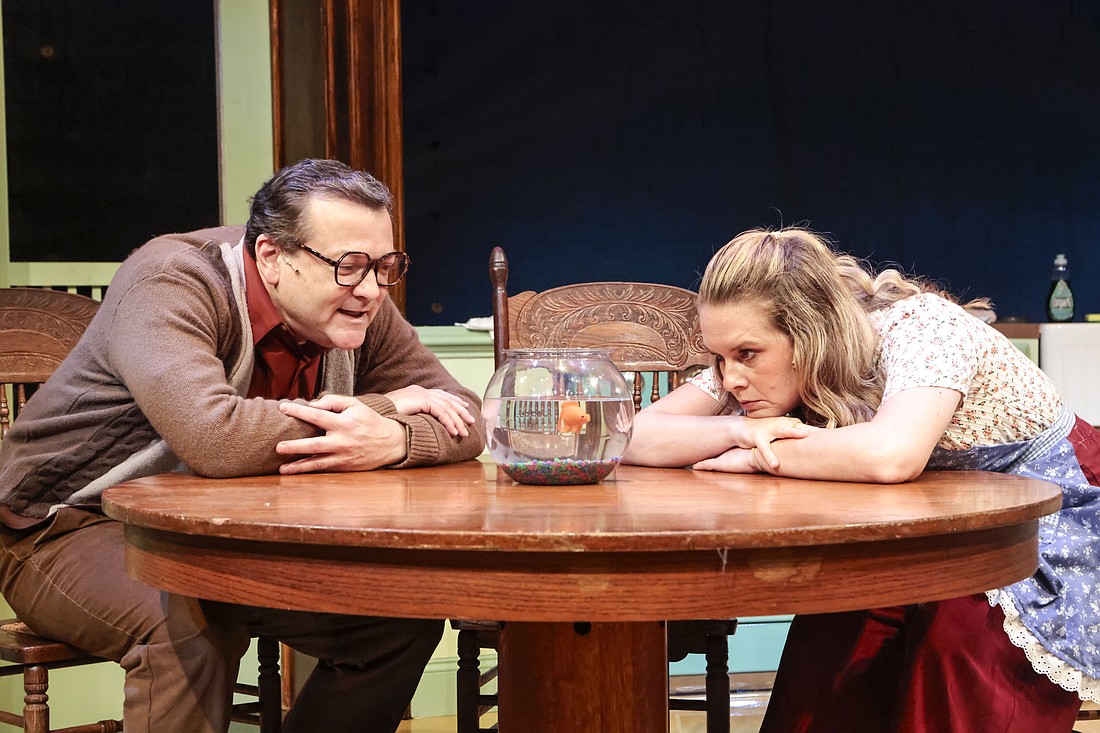
They say it’s your birthday? It's Ernestine's birthday too, yeah, in Noah Haidle's "Birthday Candles," now on stage at Florida Studio Theatre. Actually it's a lot of birthdays for Ernestine, all in one play.
Haidle’s play has a magical-realist vibe, sure. But aside from its inventive, clip-show structure, there’s nothing magical about it. It’s entirely realistic — a celebration of daily life. The only magic is life itself. And that’s enough.
The play opens on Ernestine's 17th birthday. The precocious teen (Rachel Moulton) has a bad case of existential dread. Her mother, Alice (Susan Haefner), comforts her with a cosmic birthday cake.
She insists that its ingredients aren’t just sugar, eggs and flour. The recipe includes “stardust, the machinery of the cosmos” and “atoms left over from creation.” Ernestine rallies. But a “ding” interrupts the scene. Time fast-forwards to Ernestine’s 18th birthday.
More “dings” ensue, sometimes skipping years, sometimes decades. Each “ding” marks another birthday, another cake. These scenes unfold like a clip show of Ernestine’s life.
“Birthday Candles” feels like the mutant love child of Harold Pinter’s “Betrayal” and Frank Capra’s “It’s a Wonderful Life.” Its key difference? Time only goes forward — and Ernestine never steps outside of time.
Her multiple identities include daughter, mother, friend, aunt, mother-in-law, wife, widow, second wife, grandmother and great-grandmother. The play’s strange changes resist tidy plot summary. It’s more like a series of motifs …
• The birthday cake itself. (Mother Alice’s recipe. An assertion of tradition and continuity in the churn of life.) In case you were wondering, Moulton bakes a real cake on stage.
• “I am a rebel against the universe. I will wage war with the everyday. I’m going to surprise God.” (Ernestine’s battle cry from her 17th birthday.)
• Atman, the goldfish — a gift from Kenneth (Rod Brogan), the next-door nerd. He has a 3-second memory and a 3-year lifespan. (The goldfish, not Kenneth.) He has 103 incarnations throughout the play.
That's just a sampler. These motifs, insults and catch-phrases are fixed points in the temporal carnival whizzing around you. As Joni Mitchell observed, “We’re captives on the carousel of time.”
The play spins at a velocity of 90 years in 90 minutes. Its scenes move at the speed of life — and never seem rushed.
Kate Alexander’s direction honors that rhythm. She makes time’s passage feel organic — you barely notice as decades slip by. You stop caring about the age on Ernestine’s driver’s license.
Moulton’s Ernestine burns brightly with a fire within. Her vivacious character shifts from incandescent adolescent to aging child prodigy. She remains the same person through all the passages of life. Moulton conveys a lifetime of change with no prosthetics, just acting. Brava!
A shapeshifting cast fills in for the supporting characters in Ernestine’s life story. Aside from Brogan, they play a platoon of sons, daughters and lovers. We’ll stick with their main roles.
Haefner begins as Ernestine’s mother, Alice, then morphs into her troubled, gifted daughter and then her great-granddaughter. Without a program, you’d never know Haefner plays all these parts.
Brogan’s Kenneth is the lovable oddball who’s carried a torch for Ernestine from the instant he could feel. His comedic performance reminds me of a Stephen Root’s “Office Space” character. He always gets a laugh.
Freddie Lee Bennett appears as Billy, Ernestine’s headstrong son, at various ages. He’s a struggling musician who (after years of struggle) finally gets good at it.
Peter Kendall plays Matt — Ernestine’s first husband — a confident athlete and casually unfaithful. He did a bad, bad thing, but he’s not a bad guy. In the end, his body lets him down. Kendall also plays Ernestine's grandson, William.
Sarah Colt is equally great as Joan, Ernestine's socially awkward daughter-in-law, and in other roles.
The play spans 90 years. When to when? Haidle never nails down its time frame. You don’t see Nixon resigning or George W. Bush on an aircraft carrier with a “Mission Accomplished” banner behind him. Madison Queen’s costumes suggest the passage of time — but they’re not tied to any era.
Isabel and Moriah Curley-Clay’s stunning set offers some clue. Their kitchen’s turquoise appliances evoke the 1950s. Best bet: “Birthday Candles” starts in the mid-20th century. Ernestine lives to 107 — and she’s still on her feet. So, it’s safe to assume the last scene is sometime in the mid-21st century. Outside the kitchen, lighting designer Andrew Gray’s starry, starry night sky evokes a timeless sense of wonder.
Cosmic dreams aside, the play’s not all happy-happy. Over the course of a lifetime, Ernestine experiences her share of tragedy and loss — and maybe more than her share. But life's not fair.
“Birthday Candles” is funny, tragic, warm, philosophical, paradoxical, surprising and yet full of beautiful patterns. Simply put, it’s like life itself.