- July 21, 2026

-
-
Loading
Loading
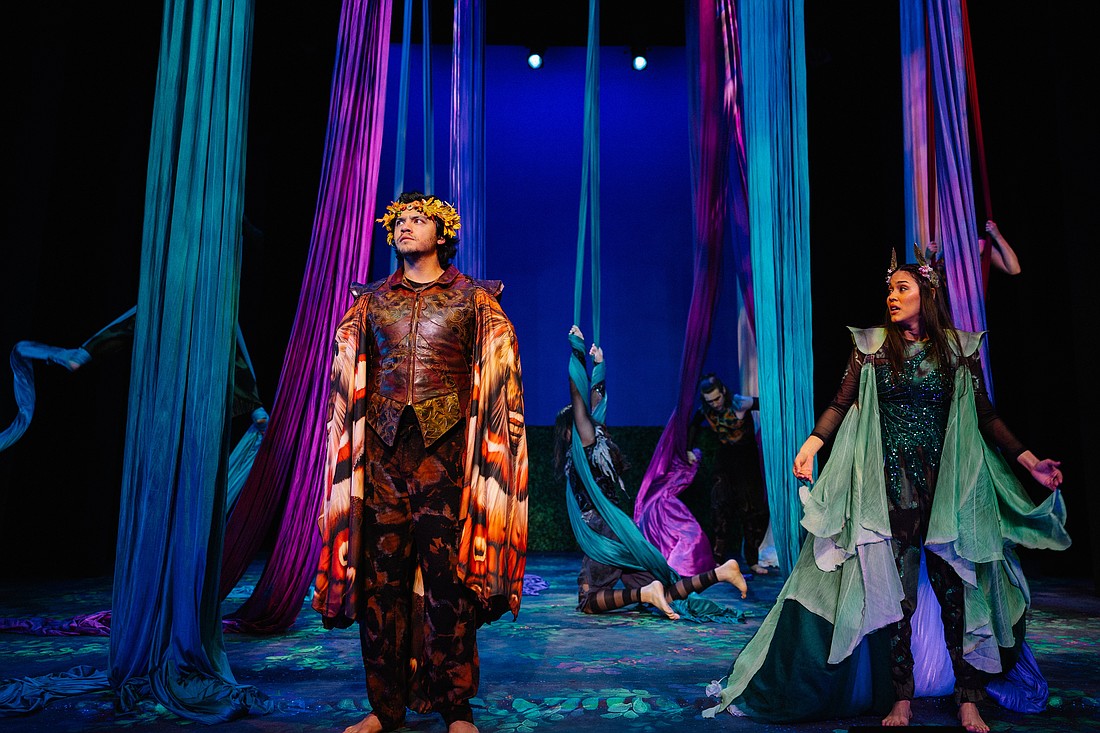
It’s only spring, but FSU/Asolo Conservatory has drifted into “A Midsummer Night’s Dream.” But what’s a dream and what’s reality? Good question. I’ll let you know when I figure it out. But here’s what I know about Shakespeare’s dreamy play …
In the Bard’s multiverse, there’s a sane world and a mad world. The city (Athens) is the daytime realm of reason. Its rulers, Duke Theseus and Hippolyta, are about to get married. A working-class amateur theater troupe will perform “Pyramus and Thisbe” at their wedding. (They’re the worst actors ever.) There are also two sets of mismatched lovers. Blame Athenian law and adolescent folly.
The forest is the magical land of night. Here, logic, good manners and modesty don’t apply. Oberon and Titania, the realm’s fairy rulers, have a lovers' spat over a problematic changeling.
Their gambols and gambits impact the mortal world. It could all go terribly wrong. By happy accident it all goes terribly right. The mismatched lovers are sorted out with the right matches.
The cast is comprised of second- and third-year acting students from tFSU/Asolo Conservatory. This play runs on the duality of night and day. Fittingly, most actors have double roles. Brandon Billings’ Duke Theseus is a cool philosopher king; his Oberon has the cocksure smirk of a rock star.
Katriana Vélez’ Hippolyta is buttoned-down; her Titania is fiercely independent and won’t bow to Oberon’s whims.
Austin Ridley’s Bottom is convinced he’s at the top of his game. He wants to play every part in the play-within-a-play. He’s an ass — and hilarious, when Puck temporarily turns him into an ass.
Alan Kim’s Egeus is a comically stubborn old man; his crowd-pleasing Puck is suitably puckish — a prankster, but never malicious. Sure, he uses a magic flower to make Titania fall in love with the donkey-headed Bottom. But he’s just doing his job — and sets everything right.
Angelie Mishon, Ashley Raymond, Edgardo Solorio, Jacquelyn Morales alternate as fairies, star-crossed lovers and lousy actors. Props to Mishon, whose Helena wraps her legs in silks and inches closer to the ceiling. The scene aptly captures her character’s ambivalence. It’s athletically and aesthetically impressive.
Director/adapter Jonathan Epstein is the perfect guide for Mr. Shakespeare’s Wild Ride. The Bard’s word play trips and flips over puns, malapropisms and double entendres.
“A Midsummer Night’s Dream” is tipsy with language; Epstein distills every intoxicating drop. He takes you up, he brings you down, he puts your feet back firmly on the ground.
Dance choreographers Morales and Raymond and aerial choreographer Mishon electrify the stage with magical physicality. It’s the perfect counterpoint to Shakespeare’s spellbinding words.
Chris McVicker’s forest grows from ribbons of colored silks hanging down like cloth stalactites. It’s an ideal space for somersaults, slapstick, dance and aerial acrobatics. The fairies leap about on them — and Titania nestles to sleep in one like a butterfly in a cocoon. Puck even rolls across the stage like a human ball.
Jordan Jeffers’ costumes are suitably regal in the daytime world. In the land of night, his fairy finery has a cyberpunk feel. The costumes are stitched with threads of LED lights— and make these spirits seem like bioluminescent beings. It’s a beautiful fantasy. But it’s only fantasy.,
Or is it?
Shakespeare goes out of his way to assure you that his play isn’t real. At one point, Bottom ridiculously explains that the lion in his play-within-a-play isn't real and the swords won't hurt anybody. At the end of the play, Puck begs the audience …
“If we shadows have offended, think but this, and all is mended: that you have but slumber’d here while these visions did appear; and this weak and idle theme, no more yielding but a dream.”
In case there’s any doubt, the title — “A Midsummer Night’s Dream” — might as well be “The Imaginary Make-Believe Play that Didn’t Really Happen.”
Methinks the Bard doth protest too much.
“A Midsummer Night’s Dream” is a dream — but only in the sense that every play is a dream. Within the play’s universe, the supernatural events really happen.
Thanks to fairy magic, Helena winds up with Demetrius and Hermia winds up with Lysander. That doesn’t go away with the light of day. QED: Shakespeare’s dreamy play isn’t a dream. It’s imaginative fiction.
Cool idea. If it scares you, forget it.
Just keep telling yourself …
It’s only a dream.