- July 23, 2026

-
-
Loading
Loading
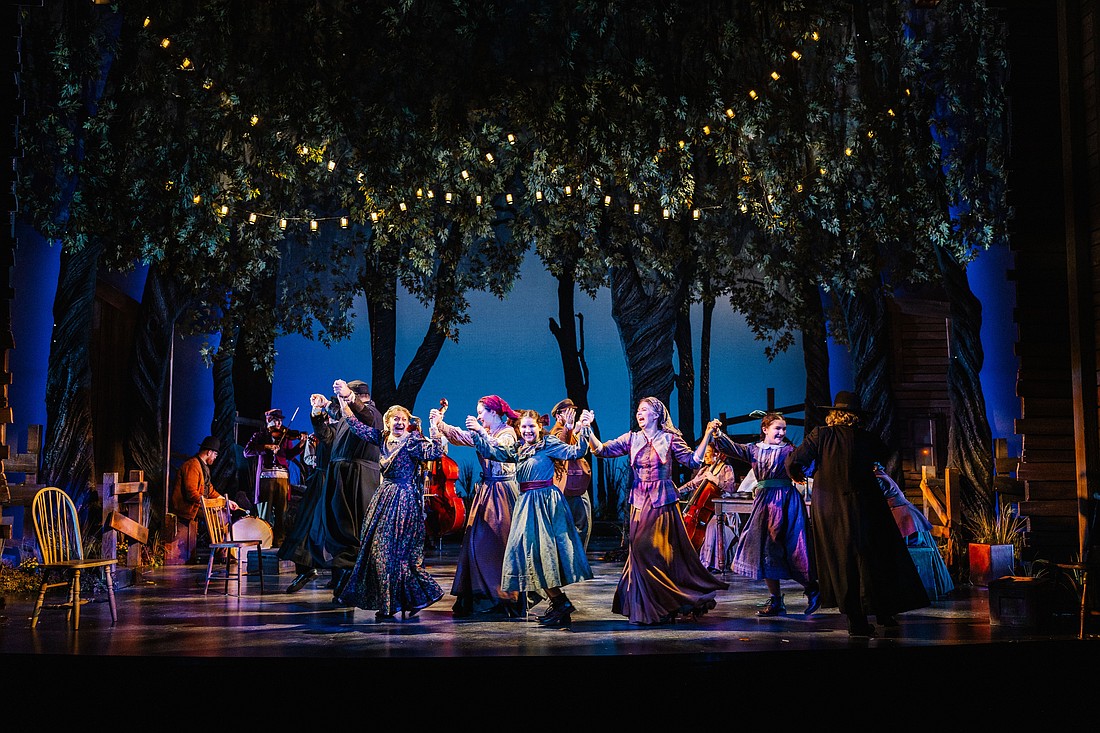
“The Fiddler on the Roof” has played at theaters around the globe since 1964. He’s finally come to the Asolo Repertory Theatre. In this inventive production, he’s not playing alone.
The music-makers aren’t hiding in the orchestra pit. The 26 actor-musicians carry their instruments in plain sight. They make their own kind of music — live, on-stage and in character as part of the action. It’s a very new spin on a Broadway behemoth.
Joseph Stein wrote the musical’s script; Jerry Bock composed the songs; Sheldon Harnick penned the lyrics. It’s based on Sholom Aleichem’s short stories about Jewish life in Anatevka, Russia, in 1905. Said shtetl is balanced as precariously as the titular rooftop fiddler.
On the ground level, the milkman Tevye (Jeremy Radin) tries to marry off his three oldest daughters. Sounds simple. But the village’s tapestry of tradition makes it complicated. Yank the wrong thread and the fabric rips.
Tevye pulls thread after thread. When the tapestry finally tears, it’s not his fault. The Czar has decided to kick the Jews out and make Russia Great Again. (Weep not. The villagers keep singing and escape to America.)
It’s a familiar story. But Asolo Rep tells it in an utterly unfamiliar way. A cast of actor/musicians creates a magical effect. The good citizens of Anatevka play accordions, clarinets, guitars, mandolins, violins — you name it.
That musical authenticity makes them seem like living, breathing characters, not caricatures. They’re relatable and real, not a nostalgic dream of villagers from 121 years ago. Their joy feels real — along with their heartbreak. That’s the director’s aim, of course.
Director Peter Rothstein creates an intimate space. The villagers feel up close and personal under his direction. The musical doesn’t feel like a big Broadway spectacle. Watching it feels like eavesdropping.
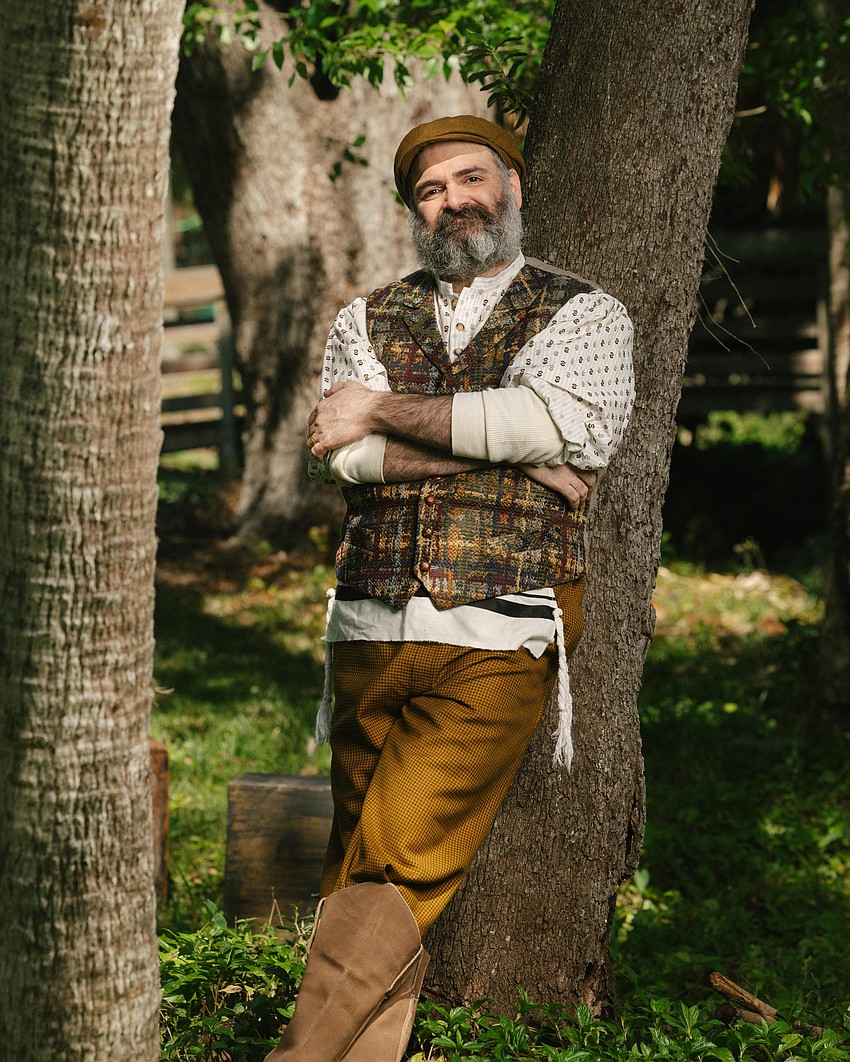
Radin’s Tevye is a likable, pious, hard-working patriarch. He’s gentle with his five daughters but sometimes loses his temper. His Tevye is a funny, down-to-earth character — and he instantly wins over the audience.
He also tries to get God on his side. Tevye maintains a constant dialogue with the Man Upstairs — along with the audience. And breaks the fourth wall, constantly. On the other hand … there is no fourth wall!
Tevye’s wife, Golde (Lauren Molina), is equally devoted to God, Jewish tradition and practical thinking as her husband. Teyve is a dreamer with heaven on his mind; she holds the household together with earthly horse-sense. (She’s the Alice to Tevye’s Ralph Kramden.) In a marital domino effect, their three older daughters fall in love – and fall away from tradition.
David Darrow’s Motel is a poor, young, self-effacing tailor who eventually stands up for himself. Tevye's eldest daughter, Tzeitel (Rachel Gubow), loves him. She cries her eyes out when Tevye uses a matchmaker to marry her off to Lazar Wolf (Jason Pintar), the town's rich, pompous butcher, who is a widower.
Tzeitel’s tears melt her father’s heart — and Tevye breaks the marriage deal with a tall tale of a dream featuring the ghost of Lazar's dead wife, who supposedly wants to hold onto him in the afterlife.
The radical ideas of Trent Dahlin’s Perchik don't sound so radical today (girls should be educated, for one), but they foreshadow the first Russian Revolution of 1905.
Daughter No. 2, Hodel (Noa Luz Barenblat), falls head-over-heels for Perchik — and the feeling is mutual. They don’t even ask for Tevye’s permission to marry — just his blessing. (He gives it anyway to save face.)
But though he's loosening the threads of tradition, Teyve has to draw the line somewhere. He does by forbidding his third daughter, Chava (Linda Bard), to marry Fyedka (Maxim Chlumecky) — a gentile and by definition, a threat to Anatevka. When Chava disobeys, Tevye casts her out of the family.
Tina Stafford’s Yenta reminds me of Imogene Coca. Her wisecracking matchmaker always gets a laugh. The Constable (Christian T. Douglas) is the not-so-gentle gentile lawman in charge of Anatevka. He wants to be seen as a nice guy. He warns Tevye that the Czar’s planning to expel the Jewish villagers. He doesn’t like it, but he’ll help make it happen. (He’s only following orders.)
It takes an army of talent to raise a village. The Asolo Rep has one.
Howard Tsvi Kaplan’s costumes evoke the worn, tatty clothing of a subsistence community. He dresses the town in simple, no-nonsense garb — except for the surreal, Mardi Gras-like robes and terrifying Day of the Dead-like masks in “Tevye’s Dream."
Matthew R. Meckes’ music direction hits it out of the park. This is “Fiddler” unplugged — and his arrangements are exactly right. Danny Pelzig’s choreography keeps the cast in perpetual motion. A dance duel in a tavern between the men of Anatevka and some menacing Cossacks is a standout.
When Tevye dances with joy, that’s just who he is — it’s naturally expressive body language. Show-stopping numbers like the “Bottle Dance” at Tzeitel and Motel’s wedding flow from Jerome Robbins’s original choreography.
Matthew R. Meckes’ music direction makes Bock and Harnick’s tunes sound like folk music, not show tunes.
Kate Sutton Johnson’s scenic design is outstanding. Her Anatevka is surrounded by an expressionist forest. Dead, forked limbs in wintertime; leaves descend from the rafters in spring. A turntable spins Tevye’s cabin to reveal the life of the family, both inside and out. Brilliant.
It’s a strong production — and it’s built on a strong foundation. The creators of "Fiddler on the Roof" found a throughline in Aleichem’s stories. They created a vehicle to crack jokes worthy of the Marx Brothers.
But Rothstein's version never succumbs to kitsch. It uses humor to deal with the pain of family and community ties being torn apart by anti-Semitism and political upheaval.
“The Fiddler on the Roof” is a musical about a lost world. It’s not a documentary; it's fiction that tells the truth. It captures the impact of the Czar’s decree forcing Jews to sell their homes and flee the country. Will family members and villagers be reunited and find a better life in America? We can only hope.
Anatevka is a fictional village. But it stands for many real ones. The communities that “Fiddler” celebrates are long gone. Asolo Rep's production makes sure you'll never forget them.