- July 22, 2026

-
-
Loading
Loading
Just more than one year into its two-year mandate to develop and recommend an update to the 2020 Downtown Sarasota Master Plan, the direction the 13-member City Commission panel remains unclear.
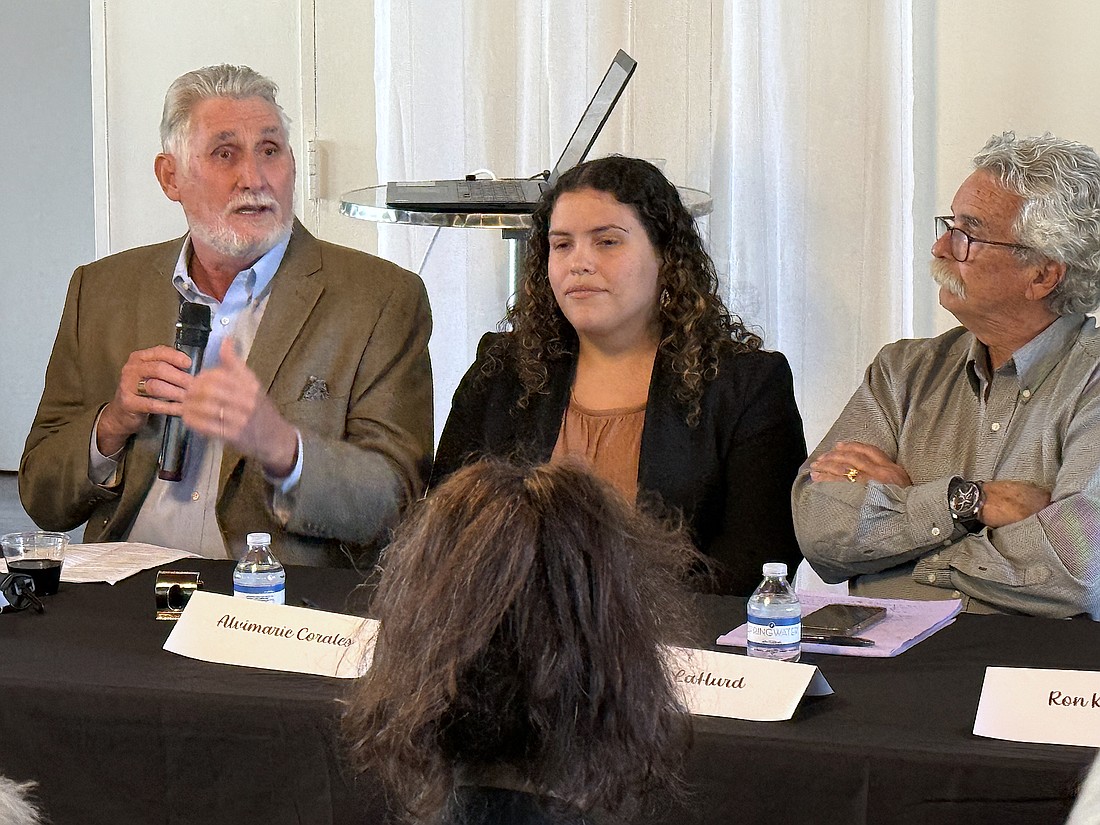
In the midst of the ad-hoc committee’s work, the Downtown Sarasota Condominium Association assembled a panel to discuss with its membership what they believe the outcome should be. The general consensus of four of the five panelists speaking to DSCA members on April 9 at that Sarasota Garden Club — excluding Capital Projects Manager Alvimarie Corales, who represented city staff — was thus:
That last point elicited a round of applause, ironically, from the condominium owners.
“First of all, I'd like to say, ‘Welcome to Sarasota,’” LaHurd said. “The good news is you're here. Bad news that you got here too late.”
LaHurd went on to trace the history of the city, describing its early political leadership as real estate speculators who had a deep interest in making Sarasota a success.
“Today, I'm hearing about how the process is community driven, the voice of the people. I just don't really see it that way,” he said. “I think Sarasota has typically been driven by the speculative dollar. In the old days, people like Owen Burns, John Ringling and Charles Ringling, they were investing their own money in these places. They had a vested interest in what they were investing in.”
LaHurd and Corales were joined by Jon Thaxton, director of policy and advocacy of the Gulf Coast Community Foundation, Planning Board member Dan DeLeo and Laurel Park neighborhood advocate Ron Kashden.
The discussion was by and large an indictment of the administrative review and approval of development in the downtown zone districts — perhaps the most controversial of Duany’s recommendations in the current master plan — that sidesteps the political and public process. It indeed resulted in the transformation of downtown from blight to vibrancy, but how much of the vision of Duany and the city at the time needs revision is the subject of the committee’s work.
“A master plan is a vision document that's created with this very delicate but critical balance between the community, the elected officials and your professional staff and consultants that you hire,” said Thaxton, a former Sarasota County commissioner. “I find all too often that this balance is disrupted, and it's usually disrupted because the public gets the short end of the stick and the paid consultants and the staff get the upper hand.”
Depending on perspective, the current master plan — the principles of which were codified in the city’s Comprehensive Plan and zoning code based on Duany’s new urbanism model — was a success or a failure.
“They were trying to solve a problem that people found vexing, which was suburban sprawl,” Kashden said. “Cities were spreading apart, so Duany and his peers came up with this idea of new urbanism. Let's create denser environments, things in an area that mix both commercial and residential. You keep on hearing the phrase ‘live, work, play’ in the same spot. That's what Duany and his peers were trying to get across.”
Twenty-five years of real-world application of the vision crafted at the turn of the century, it is now incumbent upon the Downtown Master Plan Update Committee to recommend, and the City Commission to consider, adjustments for modern-day application.
As the committee zeroes in on hiring a consultant to aid in completing its work, Corales was asked what she would tell the firm to ensure master plan update success.
“I would tell the consultant to begin with a robust public engagement strategy, because it's about getting that community buy-in," she said. "It's about getting the public from beginning to end through the process, and public engagement is a vital component to every plan and every project that we do in the city.”
She cited as an example the public engagement for the Main Street Complete Street visioning, to which the transportation planning staff dedicated a full year. Building trust in the process, Thaxton added, is paramount.
“Government deals in one commodity and one commodity only, and that's trust,” Thaxton said. “And so the only way that these master plans, these strategic plans, are going to work is if they embody the trust of the citizens themselves.”