- August 12, 2026

-
-
Loading
Loading
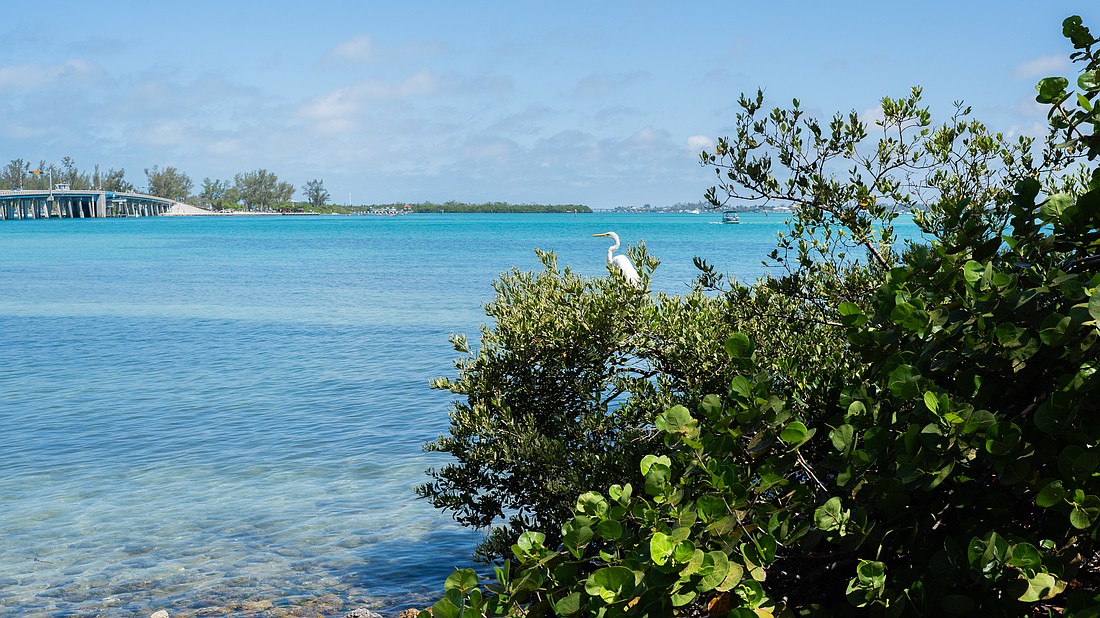
If a tree is cut on the shore and no one is there to see it, is it still damaged?
When discussing mangroves, this play on a philosophy 101 question has two answers. For the tree, yes, it has been damaged. For Florida Department of Environmental Protection, no way to tell.
With no police force dedicated to protecting mangroves, FDEP relies on reports by concerned citizens.
“It only relies on citizen reporting,” said Suncoast Waterkeeper Executive Director Abbey Tyrna. “That’s how most environmental laws work.”
Mangroves are protected by the Mangrove Trimming and Preservation Act, a 1996 law passed by the state of Florida to “protect and preserve mangrove resources valuable to our environment and economy from unregulated removal, defoliation, and destruction,” as the law states. When passed 30 years ago, it was estimated that there were over 555,000 acres of mangroves in Florida. A 2024 article published by Florida Department of Environmental Protection estimates there were 600,000 acres of mangroves in Florida 28 years later.
It's an impressive rebound after the state lost 84% of its historic mangrove population since the 1940s, according to an article by Florida Sea Grant.
But advocates for mangroves like Suncoast Waterkeeper Chairman Rusty Chinnis say a lack of enforcement of the mangrove preservation act has led to illegal trimming that has gone unnoticed and unpunished.
“I’ve been here a very long time, and it’s always been the case that when we do new rules and regulations, that’s fine, but there’s no enforcement,” Chinnis said. “The only difference between now and 30 years ago is it’s worse.”
Marc Ebling, co-owner of mangrove trimming company Suncoast Environmental Group, has been trimming mangroves since 1992, four years before the law regulating mangrove trimming was passed. In his decades of experience, Ebling said he has seen a recent increase of awareness of the regulations.
“It used to be like zero knowledge,” Ebling said. “But it seems like since the pandemic, more people have been living here full-time and they’ve been more accustomed to the rules.”
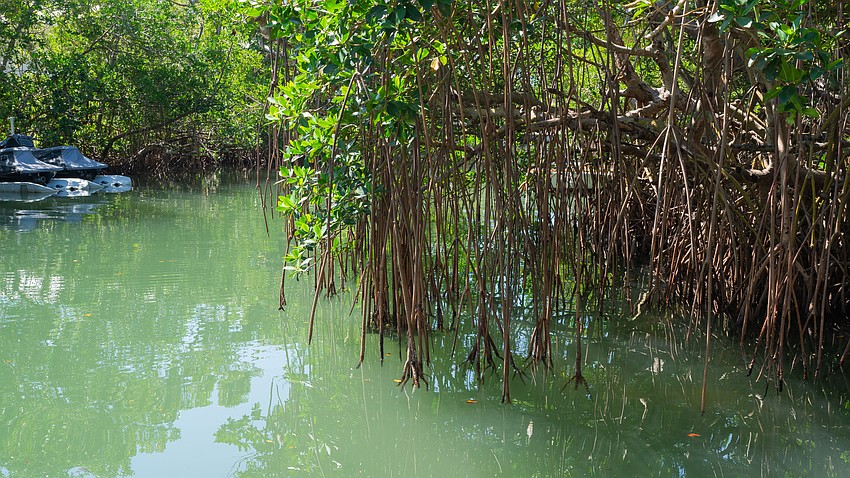
Some, however, know about restrictions on over-pruning but intentionally disregard them.
“I’ve had people just tell me flat out that they didn’t care,” Ebling said.
Others lose patience during the permitting process or decide to skip it entirely.
“When is it better to get a permit versus paying a fine to get the same thing done? There are homeowners that, if they’re already in house and they want to see, they want more of an instant view. And if the permitting process is kind of tricky, then it can take six months to two years to get it. That’s way too long to get a permit, and it encourages people to not get a permit.”
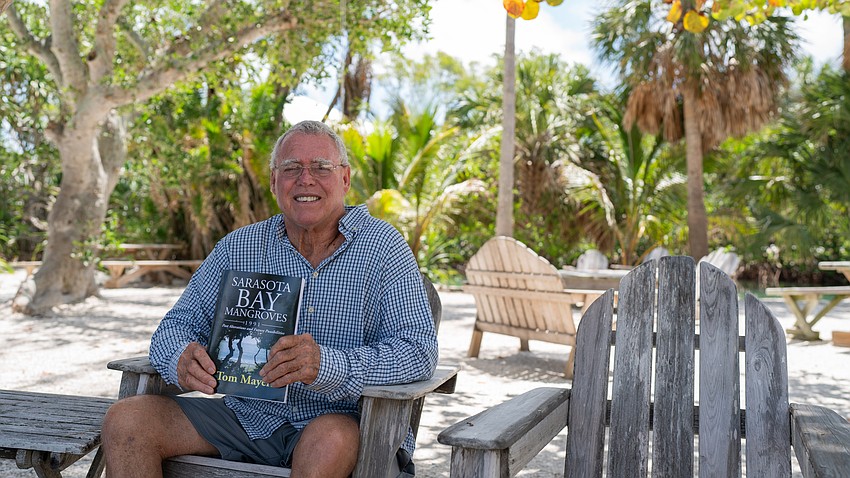
Ebling and longtime Longboat Key resident Tom Mayers are two of 23 people certified by the state of Florida as professional mangrove trimmers. Certified arborists may also trim mangroves legally.
Mayers, now retired from trimming, wrote his thesis on mangroves, which was later expanded and published as a book titled “Sarasota Bay Mangroves.” Mayers said the health and abundance of mangroves in Sarasota Bay can be looked at in three phases, starting with the end of World War II. That’s when major engineering projects like canals on Longboat Key, coastal development and rapid growth accelerated in the areas.
The second phase, as Mayers describes, is when scientific studies by W.E. Odum and E.J. Heald in the 1970s revealed that decaying mangrove leaves were a significant portion of juvenile fishes’ diets. Studies continued to prove the importance mangroves had on coastal ecosystems, raising awareness of the importance of the unique plants.
Then there was the passage of the mangrove preservation act in 1996. That regulated how much a mangrove could be trimmed, and how. It was a big change from how it was done by some before, Mayers recalls.
“You had people where their trimming technique was ... ‘yeah we just hold the chainsaw about waist level and cut them at that level’ because it was the easiest way to hold the chainsaw. There was no law then, so they did it,” Mayers said.
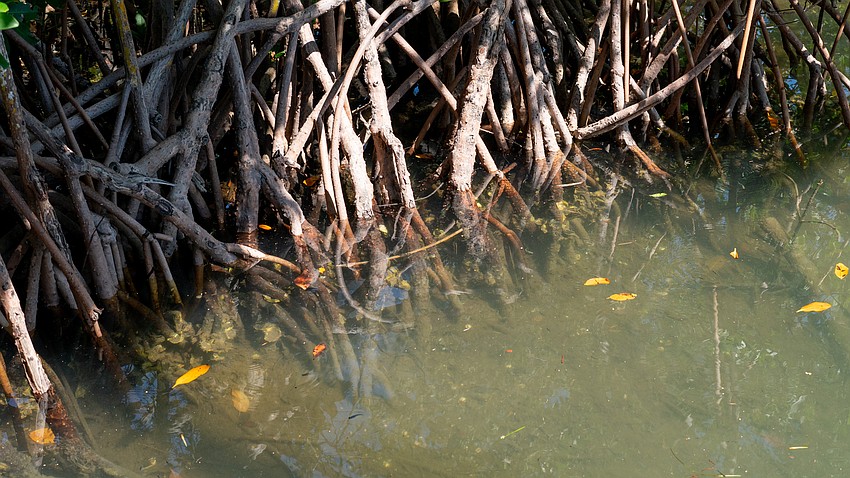
Now, mangrove trimming is a science, with trimmers like Ebling taking great care not to overtrim mangroves, both for the health of the trees but also to avoid violating the mangrove protection act. Red mangroves, the closest-to-shore variety with expansive prop roots, are fragile and the most sensitive to trimming.
“Most plants resprout where you cut them. Bushes and hedges they kind of resprout whenever you hedge them down,” Ebling said. “Red mangroves at a certain point stop doing that.”
The main violators of the mangrove preservation act, Ebling says, are tree trimmers, not the homeowners who pay them to trim.
“I see people that trim and it looks fine, but I know they’re not licensed to trim. I see people that do more than they should. I see people that trim areas that are considered no-trim areas, but they just don’t know that,” Ebling said. “One of the biggest offenders and reporters can always be the trimmer themselves as far as turning it in.”
And when a report is made, the potential offender is told a complaint has been made, and who made the report is public record.
“You can imagine what that does when that guy or girl starts telling all their neighbors ‘hey don’t use Mark, he’ll turn you in.’ That puts me in a very bad spot,” Ebling said. “I turn in all the ones that are just flat out blatantly bad. Anything close to call, I don’t get involved in that. I’m not the mangrove police.”
Chinnis always has his eyes peeled for illegal mangrove trimming. Recently, he was browsing home listings when he saw something that raised alarm bells. In the Zillow listing description of the Sarasota Bay-facing home on Broadway Street, the Realtor had written that the “seller is working to install a sea wall… Canal just dredged. Mangroves will be removed.”
“We got on their case and eventually that disappeared,” Chinnis said.
Chinnis said the listing is a firsthand example of why spreading awareness about the importance of mangroves is so important.
One segment of the population that are very aware of mangrove trimming regulations are tree trimming companies, Ebling said.
“I’m friends with probably six different tree companies, they won’t touch mangroves. They’re certified arborists, but they don’t want the liability, so they just won’t touch them,” Ebling said. “They usually just refer them to me.”
In the 20th century, a rush of bayside development saw the removal of acres of mangroves that were replaced with seawalls. The Sarasota Bay coastline, naturally abundant with mangroves, had largely been replaced with concrete seawalls, paving the way for a view, but at the cost of mangroves.
“You can see that in the city limits of Sarasota how most of the shoreline is not mangroves anymore, it’s seawall,” Tyrna said. “That’s one way development impacts mangroves.”
Suncoast Waterkeeper is getting ready to perform its third round of annual local inventorying of mangrove coverage. The volunteer program flies drones to take photos of mangrove canopies that are then fed into a software program that form a 3D image of the mangrove forests.
While not an overall view of the mangrove canopy regionally, the tracking serves as a method to see how natural events have impacted mangroves on undisturbed lands.
Tyrna said most of the monitoring of mangrove canopies are done in Manatee County rather than Sarasota County.
“We really focused on the north bay and in Manatee County where there are still natural shorelines,” Tyrna said.
Although the town of Longboat Key has no enforcement power when it comes to mangrove trimming, code enforcement still plays a role in protecting mangroves, said Planning, Zoning and Building Director Allen Parsons.
Parsons said if the town gets a reporter of a mangrove trimming, it will send staff to see if the work is authorized by FDEP.
“If it’s not authorized we would put a stop to that until such authorization is received, but mangrove trimming is actually something that by statute is handled by FDEP," he said.
Other local governments also play a role. Sarasota County is one of five counties in the state that is considered a mangrove trimming delegated local government by FDEP. That gives Sarasota County the ability to implement and enforce the mangrove preservation act.
There has been a range of enforcement year-to-year since the county and state entered into that agreement in 2017. The first year, just $250 in fines were collected. In 2024, a $55,000 fine was issued. In several years, including in 2025, no fines were collected.
“Since obtaining delegation, education and outreach on the importance of mangroves to the community and the associated regulations have been a focus,” reads a statement from the county’s planning and development services department. “When trimming or removal occurs without authorization, shoreline restoration is the primary focus in seeking to rectify those compliance cases. Restoration often eliminates the need for penalties.”
Last year, the county received seven complaints. Of those, five listed the outcome of the complaint as unfounded and two pending investigation. Code enforcement investigated 13 potential violations that resulted in five courtesy notices, six listed as “violation corrected” and two listed as ongoing.