- July 16, 2026

-
-
Loading
Loading
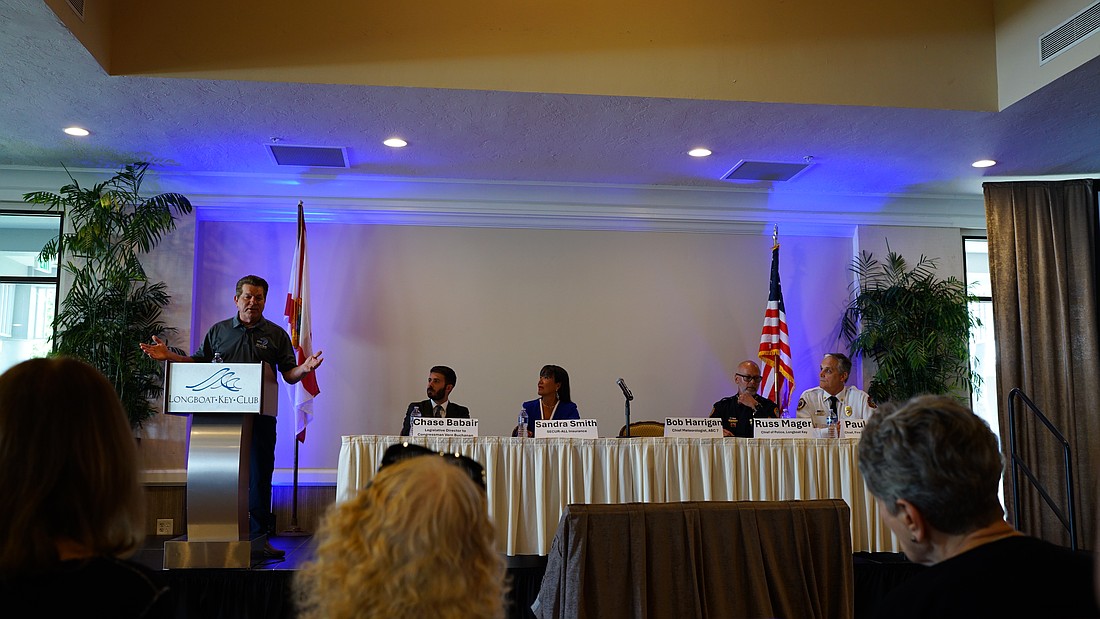
For those living on a barrier island, the beginning of hurricane season always garners interest.
That was evident by the attendance at the Disaster Preparedness Seminar on May 14, where nearly 200 people filled Longboat Key Club’s Harbourside Ballroom. With impacts from the 2024 hurricane season still fresh on everyone’s mind, residents of the barrier island paid close attention to advice from panelists.
The Longboat Key Chamber of Commerce organized the event. President Kim Verreault introduced the speakers and thanked sponsors and attendees, saying that an informed, connected and prepared populace ensures that Longboat Key remains a strong and resilient community.
Although ABC 7 Chief Meteorologist Bob Harrigan can’t tell whether the Gulf Coast will be hit by a hurricane, he did say seasonal forecasts point to a calmer season.
The “El Nino” weather pattern that NOAA expects to emerge this July means a warmer Pacific Ocean and a cooler Atlantic.
“During El Nino, the storms get ripped apart because of the strong upper-level winds generated by that warming of the eastern Pacific,” Harrigan explained. “The wind shear is much more, and you don’t see as much major hurricanes.”
Regardless of that seemingly promising prognosis, Harrigan said it’s important to be prepared every season.
“It doesn’t matter what the forecasts are. Just remember to prepare,” Harrigan said.
Harrigan also noted that the “cone of uncertainty” that is typically shared as a hurricane approaches does not mean you’re safe if you’re outside of the cone.
“A lot of the people in Fort Myers during (Hurricane) Ian were not in the cone for a long time,” Harrigan said. “Being in that cone doesn’t mean that’s the only people that have to worry.”
Congressman Vern Buchanan, though he could not attend, recorded a video message to share with attendees.
“My office is always there to help," he said in the video. "If you need any help in terms of FEMA or any other agencies, call my office and we’ll be glad to do what we can to help you quickly.”
In his stead was Buchanan’s Legislative Director Chase Babair, whose address included an explanation of the emergency declaration process and why it matters. Babair said the process begins in the aftermath of storms when emergency management teams survey an area to determine the extent of damage. That information goes to the state and then the federal government, which determines whether the federal emergency declaration is issued.
“That is why accurate reporting is so important,” Babair said. “The information gathered the first few days after a storm helps shape what resources the community receives later on.”
The crux of Police Chief Russ Mager and Fire Chief Paul Dezzi’s presentations were: “when we say evacuate, evacuate.”
Town Commissioner Gary Coffin shared a video that drove home that point to the crowd. It showed a river of salt water flowing over Gulf of Mexico Drive at the height of storm surge during Hurricane Helene.
Mager said that during extreme storm conditions, police leave the island, and rescue operations are simply not possible when the island is closed .
Harrigan advised that it’s good practice to keep your vehicle’s gas tank at least half full throughout hurricane season.
Babair, during his address to the crowd, said that insurance has become one of the biggest concerns for not only homeowners, but businesses across the state.
Invited to speak on the subject was Secur-All Insurance Agency Branch Manager Sandra Smith, who said that the mass exodus of companies offering property insurance in the state has begun to reverse.
“Thanks to (Governor) Ron DeSantis, he pushed to put tort reform in place to hold back the attorney fees that have been battling our industry for years,” Smith said.
Even still, Smith shared that Florida was the most expensive state for insurance in the country. That’s especially prevalent on a barrier island with high-valued homes.
“It’s not only expensive to build on Longboat Key, but it’s expensive to insure on Longboat Key,” she said.
Smith said the biggest misconceptions about insurance are that a homeowners’ policy covers flooding and that condominium association fees cover flooding or storm damage.
“If the waters rise up from the ground, and they enter your home or garage, it’s your flood policy that can make you whole,” she said.