1899 Fruitville apartment development advances

The Sarasota Development Review Committee has granted partial sign-off on an apartment project to remake a block between Fruitville Road and Fourth Street.


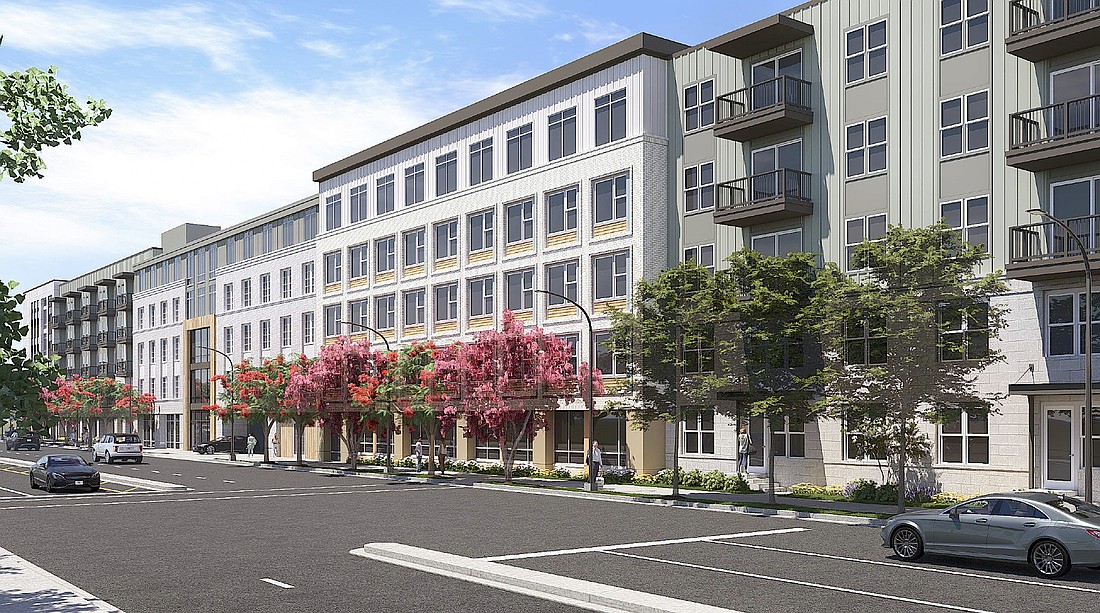
A rendering of the Fruitville Road elevation of the 1899 Fruitville project.
Image courtesy of Poole & Poole Architecture
  • Sarasota
  • News
  • Share

The reformation of an entire block of Fruitville Road in the east downtown Sarasota area has taken a step forward as a project currently called 1899 Fruitville, having received partial Development Review Committee sign-off at the June 17 meeting.

There is a caveat, though. Representatives of the Bristol Development Group of Franklin, Tennessee project were told by Certified Planner Rebecca Webster — in her last DRC meeting before leaving city employment — that should the results of a traffic study trigger additional review from any of the city’s development-oriented departments, the 324-unit apartment development must return to the full committee.

Bristol Development Group is proposing a five-story residential project on the 3.44-acre site that covers 22 parcels between Gillespie and North Osprey avenues, bounded to the north by Fourth Street. It will include 36 affordable/attainable-priced units per the city’s bonus density program.
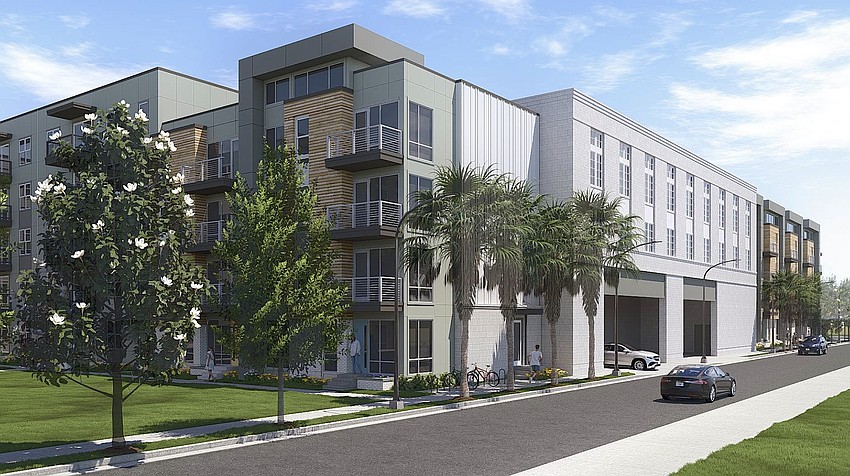
The garage entrance from Fourth Street in a redering of 1899 Fruitville.
Image courtesy of Poole & Poole Architecture

The site is currently home to one residence and a collection of small businesses and restaurants occupying a number of cottages of multiple bright colors.

The property is currently zoned Downtown Edge and no rezoning is requested. Because it is adjacent to the Downtown Neighborhood zone district — that neighborhood being Gillespie Park — the project proposes a code-compliant design of four stories along Fourth Street and five stories facing Fruitville Road.

Because the project falls within a downtown zone district, it requires only administrative approval. The developer is also seeking three administrative adjustments in first- and second-floor habitable space requirements.

Per code, administrative adjustments may be granted by Director of Development Services Lucia Panica for reductions of up to 25% of habitable space. The requests include:
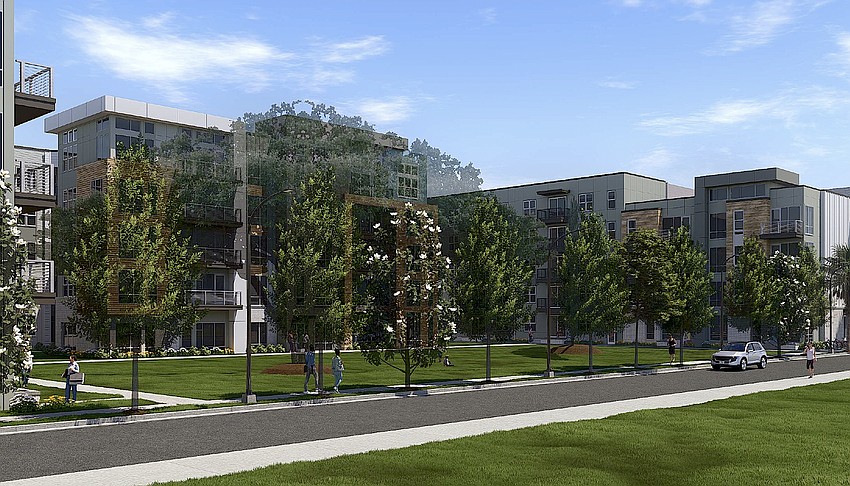
  • Fourth Street: A 19.3% reduction in inhabitable space from 341 feet, 9 inches of parallel façade to 277 feet, 6 inches. Access points and the courtyard along the street are not included in the calculation.
  • Fruitville Road: A 17.5% reduction in inhabitable space from 499 feet, 11 inches to 492 feet, 3 inches in the first floor and a 21.5% reduction on the second floor. For the first floor calculation, the Fruitville Road access point was excluded from the total building length.
  • A 6-foot inhabitable space forms a corridor around the garage entrance off Fruitville Road, the remainder of the frontage meeting the required 20 feet in depth. Also on Fourth Street, approximately 70 feet of frontage cannot accommodate habitable space due to the essential functional needs including loading, solid waste pick-up, and service access, according to the application, which also states alternative garage layouts were evaluated, but all options were constrained by the grand trees and their critical root zones.
A rendering of the courtyard of 1899 Fruitville along Fourth Street.
Image courtesy of Poole & Poole Architecture

An internal parking structure with entrances off both Fourth Street and Fruitville Road will contain 439 spaces. That’s 133 more spaces than the minimum requirement by code. In one of her final official acts with the city, Webster offered an advisory comment to consider reducing the number of spaces.

 

author

Andrew Warfield

Andrew Warfield is the Sarasota Observer city reporter. He is a four-decade veteran of print media. A Florida native, he has spent most of his career in the Carolinas as a writer and editor, nearly a decade as co-founder and editor of a community newspaper in Mecklenburg County, North Carolina.

Latest News

Sponsored Health Content

Sponsored Content