- August 4, 2026

-
-
Loading
Loading
In the U.S. some people want to grow up to be president. Unfortunately, some people grow up and try to kill the president. It’s a tradition that dates back to 1835. While President Andrew Jackson was attending a funeral, Richard Lawrence took two shots at the man nicknamed “King Andrew” for his royal pretentions.
Lawrence was an unemployed British house painter suffering from the delusion that he was a deposed king. That’s why he wanted to get rid of Jackson. He did not succeed. Then age 67, the former military hero fought off his attacker with his cane.
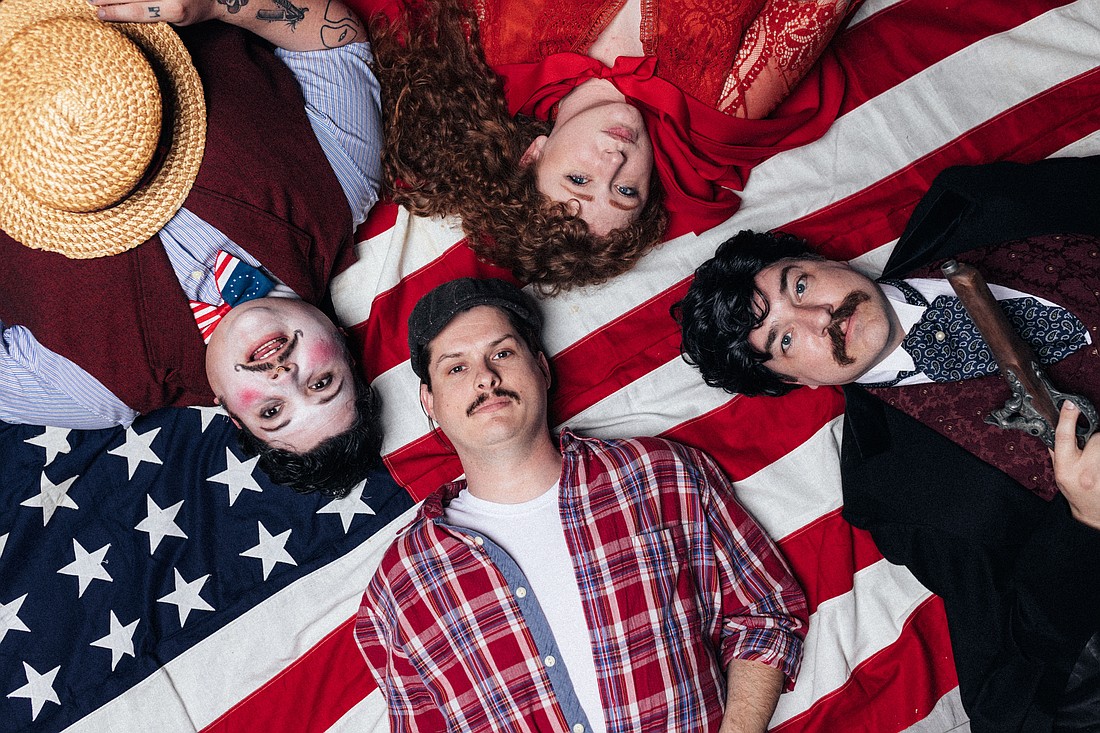
Lawrence doesn’t get a role in “Assassins,” the musical that Scott Keys is directing at The Sarasota Players from April 29 through May 10. But nine other presidential assassins and wannabes do. They are the “stars” of this vaudeville-style show with music and lyrics by Stephen Sondheim and book by John Weidman.
Why did the “Assassins” do it? More important, why should we care?
At first audiences didn’t care. When Sondheim and Weidman’s musical opened Off Broadway in 1991, it ran for just 73 performances. Critics said the musical failed to hit its mark because it was too dark and too confusing. The latter criticism was also leveled against Sondheim and George Furth’s “Merrily We Roll Along,” which closed on Broadway in 1981 after just 16 performances.
But “Assassins” and “Merrily” both got a second life. Like a fine wine, Sondheim’s musicals seem to get better as they age. Or maybe it’s the audiences who grew better.
When it was revived in 2004 on Broadway, “Assassins” played to packed houses and won the Tony Award for Best Revival of a Musical. (“Merrily” would have to wait another 20 years for its vindication, winning the same Tony in 2024.)
The rogues gallery in “Assassins” starts with John Wilkes Booth, the actor who assassinated President Abraham Lincoln, supposedly for dishonoring the South and tearing apart the Union. History stops in 1981 with John Hinckley Jr., an aspiring singer/songwriter who shot Ronald Reagan to get the attention of actress Jodie Foster.
The characters aren’t presented in chronological order, and liberties are taken with history. In “Assassins,” Booth kills himself, but he was actually fatally wounded by a soldier.
Nor did alienated factory worker Leon Czolgosz meet up with socialist Emma Goldman before shuffling off to Buffalo to kill President William McKinley at the 1901 Pan-American Exposition.
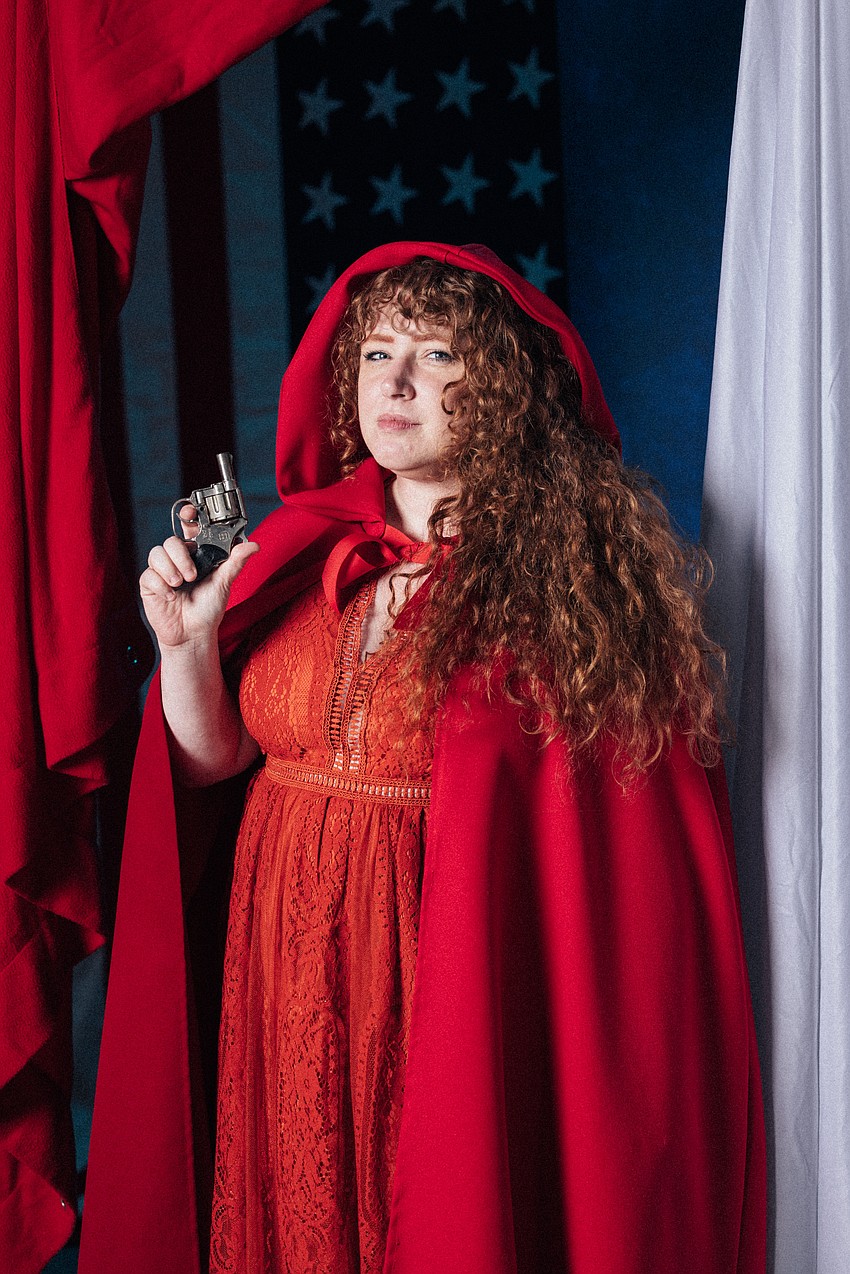
And California cult member Lynette “Squeaky” Fromme and accountant Sara Jane Moore never hung out together and traded notes about their reasons for taking aim at President Gerald Ford. Despite their on-stage coffeeklatsch, we never learn why two women of such diverse backgrounds both tried to kill the pride of Grand Rapids, Michigan.
In Sondheim and Weidman’s pastiche of history, the assassins bare their souls to one another in humorous and heart-breaking vignettes in what appears to be a purgatory for this rare category of sinners.
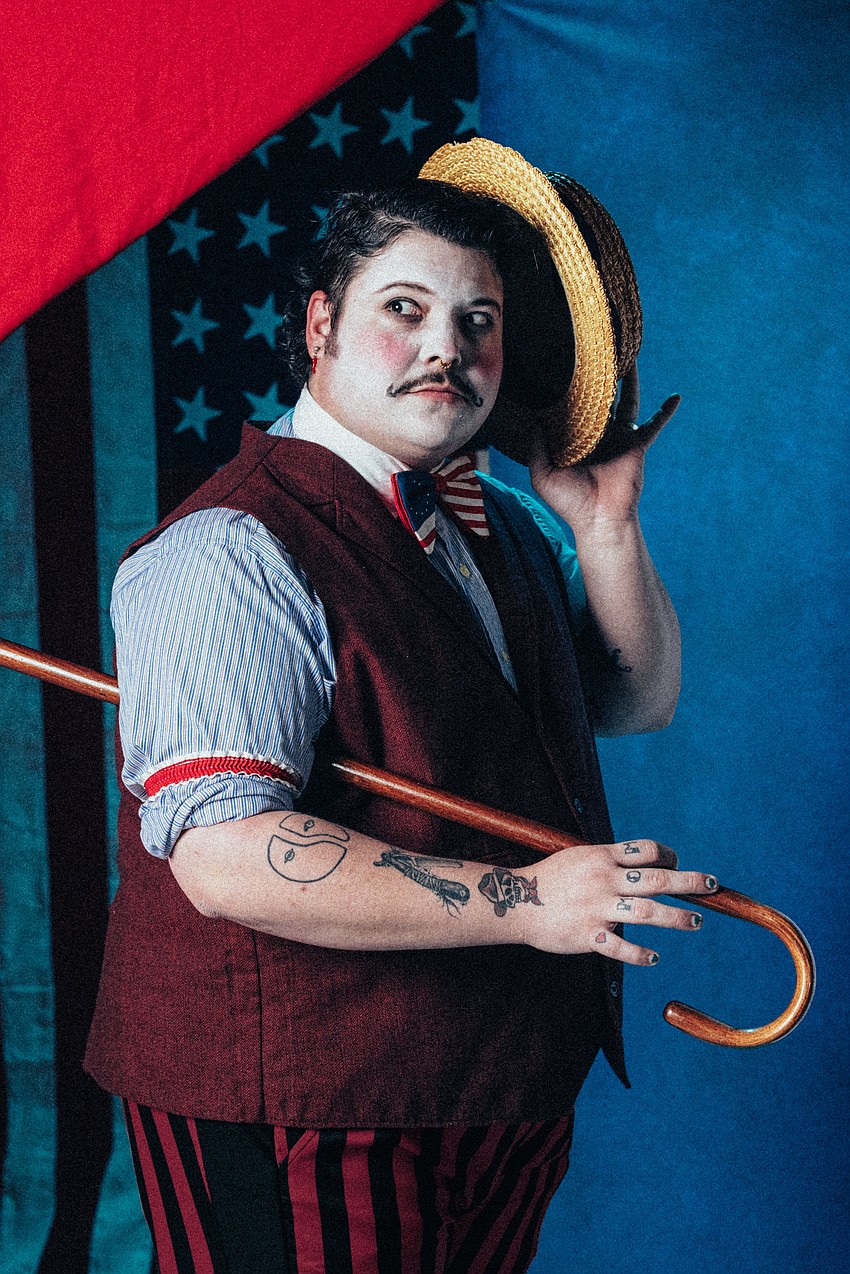
The musical establishes a throughline with the help of the Proprietor (Brian Finnerty), who sells the assassins guns, and the Balladeer (Jason Ellis), who tries to put the crazy, violent actions into context for the audience.
One of the show’s most powerful numbers comes at the beginning. “Everybody Got’s the Right to be Happy,” a duet between Czolgosz (pronounced COHL-GASH)) and the Proprietor, deftly encapsulates the siren song of the American Dream that sometimes leads strivers to the shoals.
In “Unworthy of Your Love,” Fromme and Hinckley share a duet about unrequited love. While Hinckley was obsessed with the actress who skyrocketed to fame as a teen prostitute in “Taxi Driver,” Fromme laments just being another one of cult leader Charles Manson’s female sidekicks, not his main squeeze.
With its dark themes and tawdry cast of characters, “Assassins” wouldn’t seem a natural fit for a community theater during America’s semiquincentennial year. But the Sarasota Players, now in its 96th season, has been provocative and fearless in the hands of a young team now led by Thayer Greenberg, managing artistic director and director of education.
In an interview in Mable’s Rose Garden at The Ringling on a recent beautiful April afternoon, Keys talked about his approach to directing the musical and what he wants audiences to take away from it.
Keys noted that the two words repeated most often in “Assassins” in both scene and song are “listen” and “connect.”
He continues: “In these shootings that we’ve been having, if the perpetrator survives, when psychologists go in and talk to them, they often ask, ‘Is there anything that would have stopped you?’ And the answer usually is, ‘If somebody had just listened to me, paid attention.’”
Booth is a rarity among the characters in “Assassins” in that he appears to have been driven by political motivations. Most of the shooters were overwhelmed by personal problems. If generalizations can be made, these characters came to believe that the odds of achieving the American Dream were stacked against them.
While Sondheim and Weidman are not without sympathy for the criminals, their musical is a carnivalesque fever dream of outlandish characters driven to desperation.
“It’s a sideshow, and they’re all kind of the freaks,” Keys says. “Now I know that sounds like such a hateful term, but that’s how they’re regarded, if they’re even regarded at all.”
The ethos of “Assassins” is perhaps best summed up in its song, “Another National Anthem.” As the characters lay out their respective reasons why they deserve a prize, the Balladeer breaks the bad news that one isn’t forthcoming:
Yes, you made a little moment
And you stirred a little mud
But it didn’t fix the stomach
And you’ve drunk your final Bud
And it didn’t help the workers
And it didn’t heal the country
And it didn’t make them listen
And they never said, “We’re sorry”
Those who saw Keys’ production of “Parade” at Manatee Players in 2024 may find some similar themes in “Assassins.” Based on a real-life story about a Jewish man accused of murdering a young female worker at a Georgia factory in 1913, “Parade” is another showcase of Americana that limns the national chiaroscuro.
“I like these shows that make a statement about our country, our world, our political views, but in a very human way,” Keys says. “Whether in a comic or tragic way, we’re trying to get at the humanity of these people, and what led up to the act. It’s not the act itself. It’s not a show about watching these presidents get assassinated.”
In addition to more than 30 cast members in “Parade,” balloons play a supporting role. No spoiler here, but Keys puts one in “Assassins.”
“Balloons show up in my shows because because they’re filled with breath and life,” he says. “I always find them to be a very powerful symbol.”
Key’s production of “Assassins” features a different ending from the Off Broadway original and the Broadway revival.Although he doesn’t change songs or dialogue, Keys’ finale is more hopeful than other versions of “Assassins.”
If they were looking for immortality by trying to kill the president, most of the assassins fell short. The only two that can be considered household names are Booth and Lee Harvey Oswald, perhaps because the presidents they killed were much beloved.
Nearly everyone alive on Nov. 22, 1963 can remember where they were when Oswald shot John F. Kennedy.
Hinckley didn’t win Jodie Foster’s love, but in an unlikely real-life coda, he has remade himself as a singer/songwriter since being released from prison in 2022.
The image makeover seems to be working, especially among those too young to remember the 1980s. Keys says that when actor Kevin Moroney mentioned to a friend that he was playing Hinckley in “Assassins,” the person responded, “Oh yeah, the musician.”
Even if its streets aren’t paved with gold, it would appear that America is still the Land of Second Chances.