- July 29, 2026

-
-
Loading
Loading
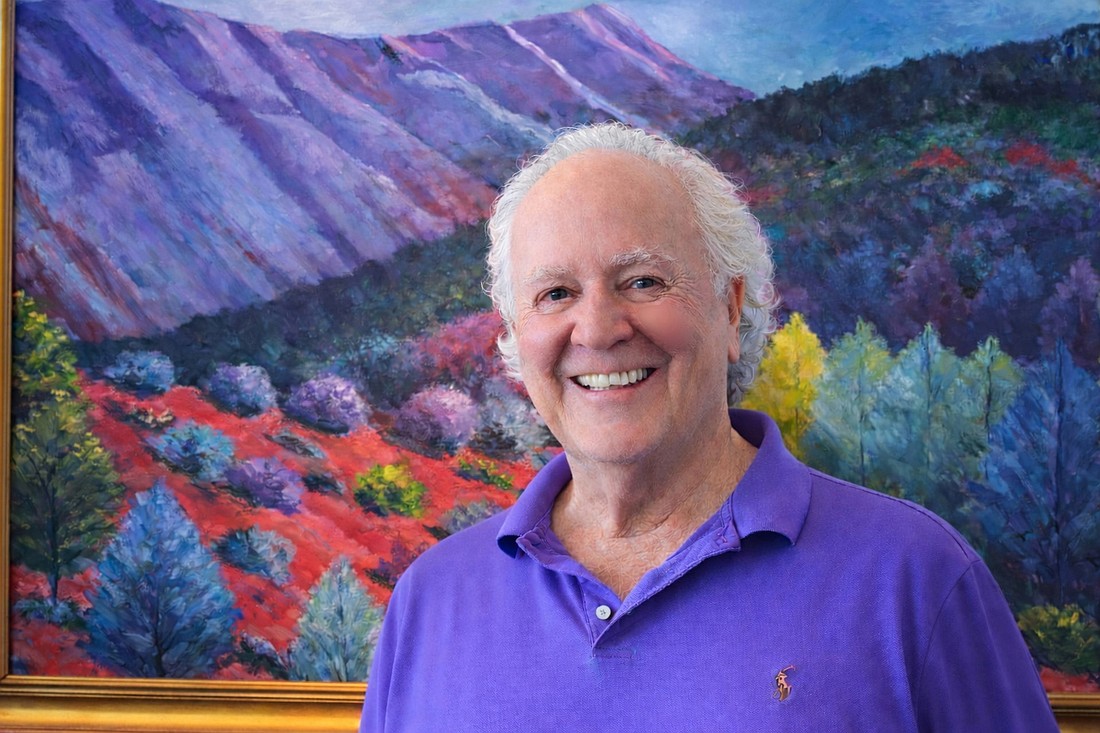
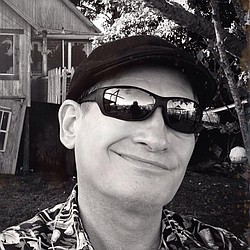
William Kelley is a Sarasota-based painter and global thinker. His imagery explores questions of memory, identity and what the Romans called genius loci — the spirit of a place. He thinks big, and he paints big.
A visit to Kelley’s downtown studio begins with wine and conversation. He’s not big on art theory, but he’s a natural-born storyteller. His tales wander through travel, epiphanies and long-ago sunsets.
His large-scale paintings tell their own stories. They fill his studio walls like vast, open windows. They’re not realistic, but they’re oddly immersive. How does he do it?
“I’m basically a color person,” Kelley says. “Everything begins with color. That’s been my whole story.”
It’s actually many stories. Over five decades, Kelley’s artistic odyssey has taken him across continents, subjects and scale. His art has seen many changes. But he always speaks in the language of color.
Kelley traces his mastery of color to Siesta Key. He moved there in 1983; his wife, author Susan Kelley, joined him after they married in 1989. Their beach house had a panoramic view of the Gulf of Mexico. Nature’s Technicolor glory deeply influenced Kelley’s art — sunsets especially.
Once the sun touches the Gulf horizon, it takes about two-and-a-half minutes to disappear. A short span of time. But Kelley saw glimpses of infinite change.
“Gulf light refuses to stay still,” he says. “The colors go crazy as the sun sets. They change every second.”
To capture the sunset’s mercurial color shifts, Kelley did up to six studies a night. He’d tape watercolor paper to the seawall by his house and sprint like a relay racer, painting from sheet to sheet as the sun set.
He’d then merge those studies in a single oil-on-canvas painting. A time-lapse image, not a freeze-frame. The eye reads its overlapping colors as motion. That was Kelley’s goal.
“I wasn’t just painting one moment of the sunset,” he says. “I painted all the moments together. It’s how I paint time.”
In 1991, Kelley opened a gallery in downtown Sarasota’s Jack Dowd building, a lively hub of artists, entrepreneurs and outsiders. He met a lot of people there. They show up in Kelley’s work.
“Arts Day, Sarasota” (1991) is a bustling street packed with musicians, friends and historical figures. A playful composition. Kelley compares it to The Beatles’ “Sgt. Pepper” album cover.
But some faces are blurs of color — like they’d moved when the camera clicked. It makes them feel oddly alive. And in a way, they are. The year 1991 is 25 years in the past. In this painting, it’s always the present.
Kelley was still painting time. But he was now capturing cultural history. Not desolate cliffs and sunsets, but slices of human experience. His figurative art had transformed. His landscapes would too.
In the late 1990s, Kelley and his wife began spending part of the year in Florence. His studio overlooked the Ponte Vecchio and the Tuscan hills. The view was drop-dead gorgeous — and it got him out of his studio.
He roamed the countryside, painting landscape after landscape. Imperceptibly, those landscapes grew. After a visit to Paris’ Musée de l’Orangerie, they took a giant leap.
That museum boasts eight enormous Claude Monet paintings — a day in the life of a lily pond. They’re on display in a huge circular gallery. Kelley stepped into that circle. And had an epiphany.
Monet’s paintings aren’t picture windows to look through. They’re portals that imaginative viewers could enter. “That’s how I wanted to paint,” he says. “I knew it instantly.”
Once Kelley returned to Florence, he followed in Monet’s footsteps. He launched a series of large-scale landscapes. These were immersive, but it wasn’t just a question of size.
The focus sharpened. Colors didn’t bleed. Trees and hillsides took on a faceted clarity. These new vistas went beyond realistic — they were hyper-realistic. Critics and collectors noticed. Kelley continued on this new direction. But Monet wasn’t his only artistic influence.
Kelley points to a panoramic canvas — a mountain bursting with psychedelic color. Imaginary? No. He says it’s “Mont Saint-Victoire” (2008), a very real mountain in southern France. It seems oddly familiar. What’s the story?
“That’s Cézanne’s mountain,” he says. “I painted it once. He painted it 200 times or more. I don’t know how he did it.”
Kelley studied this mountain on site and painted it in his Florence studio. And then painted many more. He was growing as an artist. His landscapes also grew — along with their hypnotic power.
How did Kelley do it? What was his secret?
Observation. Unflinching vision. Really looking at what you’re painting with laser-like attention. Monet did it with water lilies; Cézanne did it with his mountain; Kelley did it with everything he painted in this new series. Each brush stroke got his full attention. That captured the viewer’s attention.
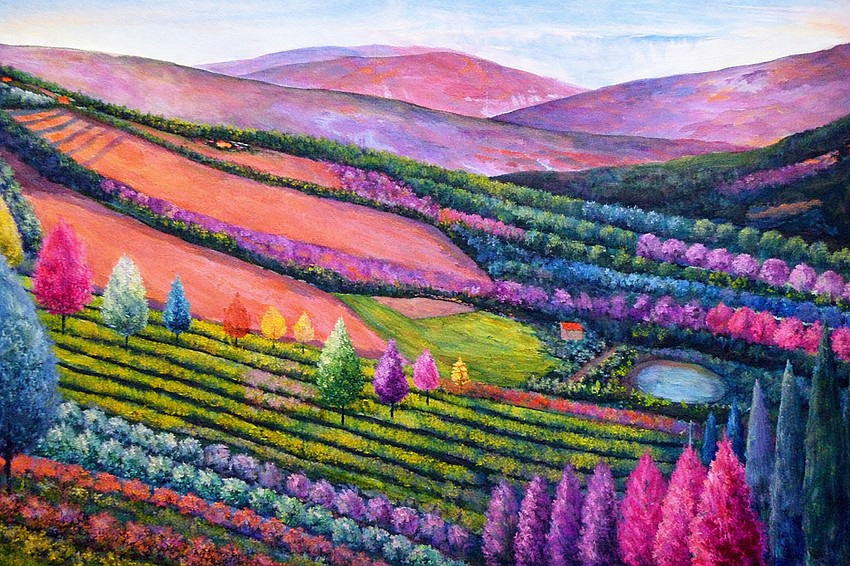
“Tuscan Soul” (2009) took it one step further. It’s a vista of the Panzano Valley — but not a place you can visit. It only exists in Kelley’s mind.
“I combined several landscapes,” he explains. “Same valley, different viewpoints, one painting.”
Where Kelley’s sunsets layered time, this work layers space. Not a shattered Cubist effect. It’s more like the Panzano Valley’s greatest hits.
Rolling hills, their contours marked with grooves like giant melted records. The grooves are a vineyard of pyrotechnic grapes. Trees with leaves of electric blue and lemon yellow rise up between the rows. Violet, misty mountains in the distance.
It’s a beautiful scene. A distillation of many vistas. It’s everything Kelley loves about this place. It’s the valley of his dreams. And he obviously dreams in color.
The title came from a Florentine art supplier. Who studied the painting and quietly said, “This is my soul.”
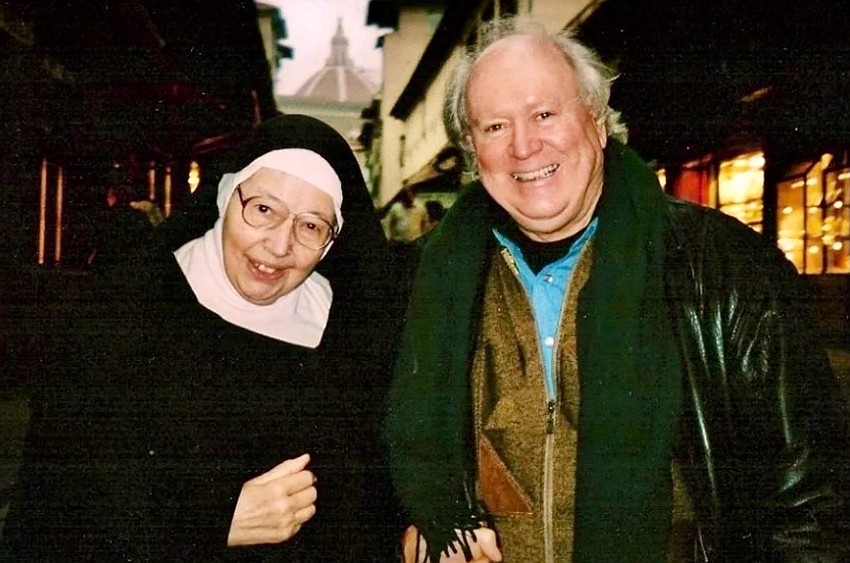
This linear narrative of Kelley’s artistic path is an editorial fiction. His actual talk didn’t take a straight line. This natural-born storyteller spoke of many things. Of his benediction from Sister Wendy, the art-critic nun with a global audience on the BBC. Of his close encounter with AC/DC frontman, Brian Johnson. Of his near-death experience in a car accident coming back from Tampa airport.
Long story short: Kelley’s still here. And he’s still painting.
His latest painting sits on an easel. A new sunset. It’s still a work in progress.
Kelley smiles. That isn’t new. He’s always smiling.
What makes him smile? Why is he so happy?
“Because the studio’s my happy place,” he says. “When I paint, I’m in Zen land.”
That “land” spans Florida beaches, Tuscan hills and far-flung landscapes. His immersive paintings distill, time, space, memory, and every color of the rainbow.
Kelley’s paintings always begin with color.
They never go to the same place.