
- July 19, 2026

-
-
Loading
Loading

“Alexander Calder: The Nature of Movement” finds a new spin on Calder’s kinetic creations at Marie Selby Botanical Gardens. We take his restless “mobiles” for granted today, but they challenged a basic sculptural assumption of his time.
Sculpture isn’t supposed to move. If it does, it’s probably falling over.
Calder disproved that assumption when he created his first mobile in 1931. His sculpture moved — without falling over! A simple idea — and simply radical.
Calder wasn’t the first sculptor to incorporate motion. But he was the first to make motion an artistic principle, not a gimmick.
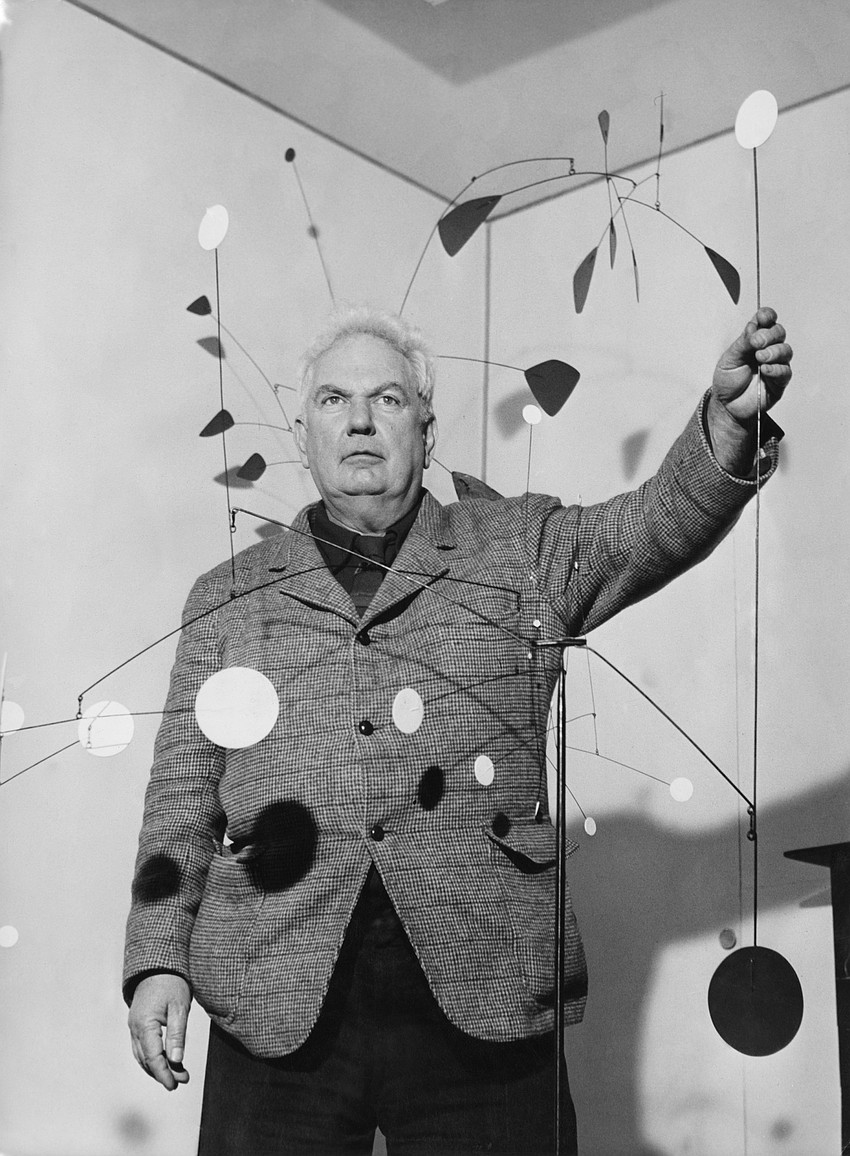
David Berry, Selby Gardens’ chief curator, notes that Calder was both a trained engineer and an artist. He grasped how materials worked — and his mobiles were rooted in practical, engineering knowledge. The members of Selby Gardens’ horticultural team share that understanding.
“They know what they’re doing,” Berry says. “They really did their homework.”
Their horticultural vignettes in the 10th installment of the annual Jean & Alfred Goldstein Exhibition Series aren’t recreations of specific Calder pieces. They’re original creations inspired by his kinetic sculpture and following his principles. Where Calder worked with sheet metal and wire, Selby Gardens’ creators employ the living medium of air plants.
Where Calder shouted in primary colors, they whisper in earth tones. Minor differences. Calder’s sculpture had its own visual language. Selby Gardens’ team speaks it fluently. And they’ve got a lot to say.
Expressive logic drives the vignettes they’ve created in Calder’s vocabulary. This show’s not an academic exercise. You might learn something, but it’s an experience, not a lecture.
The experience begins in the Display Conservatory. Before entering, you pass below “Plants Above All,” a mobile of hanging air plants, swaying gently on red discs. More small-scale vignettes await inside.
A mobile of black stones and rugged bonsai hovers against a blood-red backdrop. It reminds me of Roger Dean’s floating islands on several “Yes” album covers. Or James Cameron’s rip-offs in the “Avatar” series.
Another untitled mobile balances black-and-white shapes resembling guitar picks. Palms, bromeliads and a calathea sprout in front of them in shades of riotous red, deep purple and dark green.
More installations flank the serpentine path through the botanical gardens. The horticultural team created these as well. But on a much larger scale.
The “Calder Cascade” splashes down on the lily pond garden. Three metal sculptures: yellow, red and blue. Each is a waterfall. The water splashes down on tiered shapes resembling water lilies or the dancing forms of Calder’s mobiles.
“Red Mangrove” echoes a mangrove’s arching, crimson roots. It’s structured like one of Calder’s massive, motionless sculptures. Not a mobile, but a “stabile.” (Jean Arp, Calder’s friend and fellow artist, jokingly coined the term and it stuck.)
“Rooted in Nature” is a trio of gargantuan sculptures. These lovingly mimic the prop roots of the Selby Gardens iconic Moreton Bay fig tree.
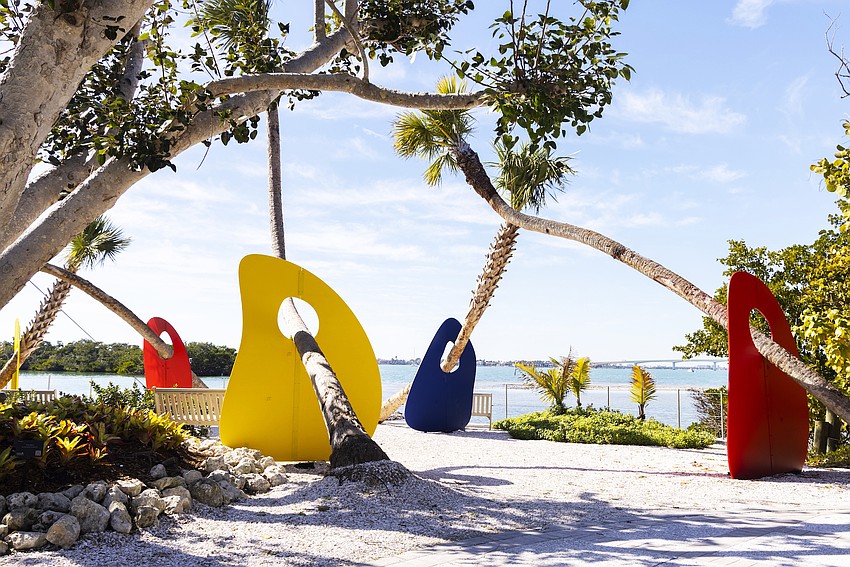
“Sabal Stabiles” is a cluster of Calder-like forms facing Sarasota Bay. Instead of dangling from a mobile, they’re planted in ground. These brightly colored blobs resemble giant artist’s palettes. Each has a giant hole — with a sable palm threading its way through it. Art and nature become one.
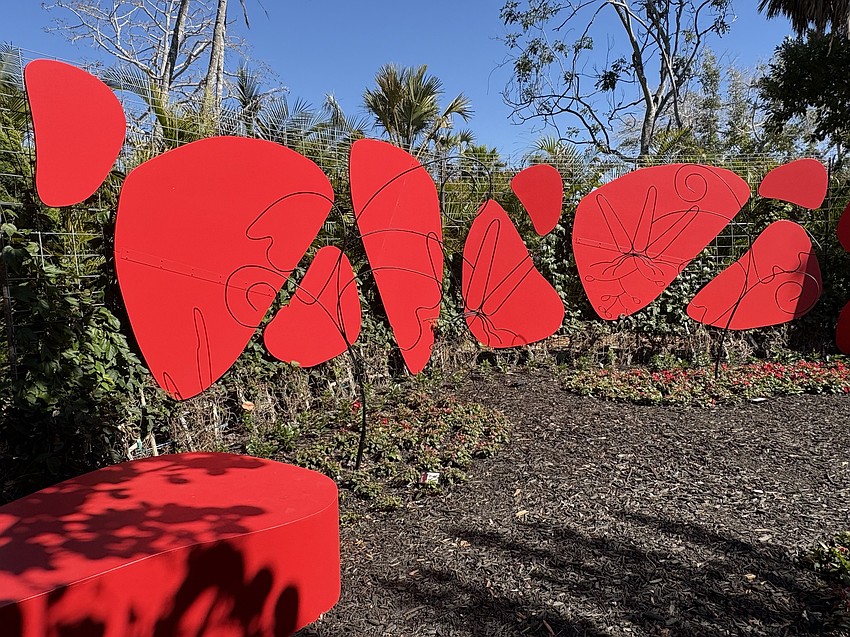
“Passiflora” blossoms in huge red shapes like Passiflora petals. (The real thing grows on a trellis a few steps away.) Metal flowers sprout in front of them. Like Calder’s wire sculptures, they’re just outlines and don’t block the view.
Big or small, inside or out, these vignettes are impressive. According to Berry, that’s thanks to the horticultural team’s countless calculations.
These included weather patterns, topography, the optimum plants for each vignette, the quirks and needs of these plants, how they change over the seasons, and how visitors will respond.
It’s a lot of hard work. If it sparks a sense of wonder, it’s worth it.
The Museum of Botany & the Arts circles back to Calder’s two-dimensional source code. The work you’ll see is his — not a homage. Reproductions of the artist’s early images include drawings, lithographs, illustrations and in-the-moment figure sketches of the horses, humans, lions and elephants at the Ringling Bros. and Barnum & Bailey Circus at Madison Square Garden (1925).
Calder’s circus studies vibrate with implied motion. Limbs kick. Horses rear. Acrobats tense like coiled springs. This art may be flat, but it’s charged with kinetic energy. It’s also Calder’s love letter to the circus. In fact, the artist loved the circus so much, he created his own miniature circus — the Cirque du Calder. With that, his art officially entered the third dimension.
André Kertész’ photos (1929) capture Calder hard at work (or hard at play) on his tiny circus. He’s having fun with puppets and wagons — and he’s also making them move. It's a baby step. But the artist’s vector of motion leads directly to his later mobiles.
Thanks to a loan from The Ringling, the museum boasts an actual Calder mobile. “Black Cascade — 12 Verticals” (1953) is delicately hypnotic. It’s a chain of black metal shapes that seem to fall like drifting leaves. But that’s an illusion. Because the mobile is perfectly balanced on spidery legs, they never hit the ground.
It’s a stunning exhibition. The talents of Selby Gardens design and horticultural teams did outstanding work. Berry worked with Nathan Burnaman, Ian Cole, Nadine Kremblas, Angel Lara and Mike McLaughlin on Selby Gardens’ horticulture team. He also collaborated with Abby Wright Day, Craig Kroeger and Megan Laureno on the museum exhibition team.
But is Calder’s art right for Selby Gardens?
Previous exhibitions in this series typically revolved around artistic depictions of nature. Calder’s art is far from typical. At first glance, his mobiles seem utterly unnatural.
Even their birth process was industrial. To make them, the artist cut out crazy shapes from sheet metal, painted them in race-car colors, then hung them from wires. But look closer. You’ll see they’re subtle imitations of life.
Like leaves, clouds and butterfly wings, the abstract shapes of Calder’s mobiles have no right angles. (They’re “biomorphic,” if you’ll pardon my artspeak.)
More importantly, Calder’s kinetic sculpture shares the key distinction between the living and the dead. His mobiles move — just like every living thing on the planet.
Calder’s art is exactly right for Selby Gardens.
You’ll be moved when you see it.