- July 28, 2026

-
-
Loading
Loading
There is something about power. Something about it that just seems to get to people.
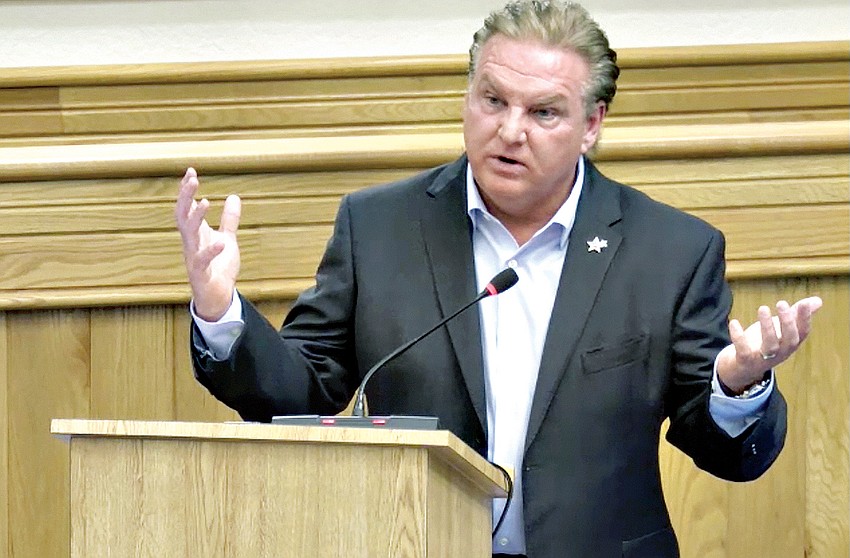
Or maybe, it’s just Mike Moran, the Sarasota County tax collector.
It’s the way he goes about things.
To that point, an angered Sarasota County School Board filed suit last Friday in the 12th Judicial Circuit Court, seeking a temporary and permanent injunction and declaratory judgment against Moran (as Sarasota County tax collector).
The board says Moran unilaterally and illegally has been charging the school district a first-ever commission on the money it collects on the school district’s extra voter-approved one-mill tax.
The board says that commission through March has diverted $2,055,798.65 to Moran’s office, depriving the district — students, teachers, etc. — of funds that were designated for educational uses when voters approved the one-mill tax in 2022.
The lawsuit is the predictable culmination of our new tax collector bullying ahead in a first-year rush to throw out and trash the 40 years of operational success by his predecessor, Barbara Ford-Coates; and to make a grab for millions of someone else’s tax dollars to, as he says, build “a modern institution” to better serve taxpayers.
Perhaps it’s more like, well, to build his modern empire.
For the past 16 months, Moran has operated with little public attention, charging ahead from the day he took office in January 2025 to transform the tax collector’s operations.
It’s classic “new sheriff”-Al Haig syndrome: “I’m in charge,” and things are going to change. Indeed.
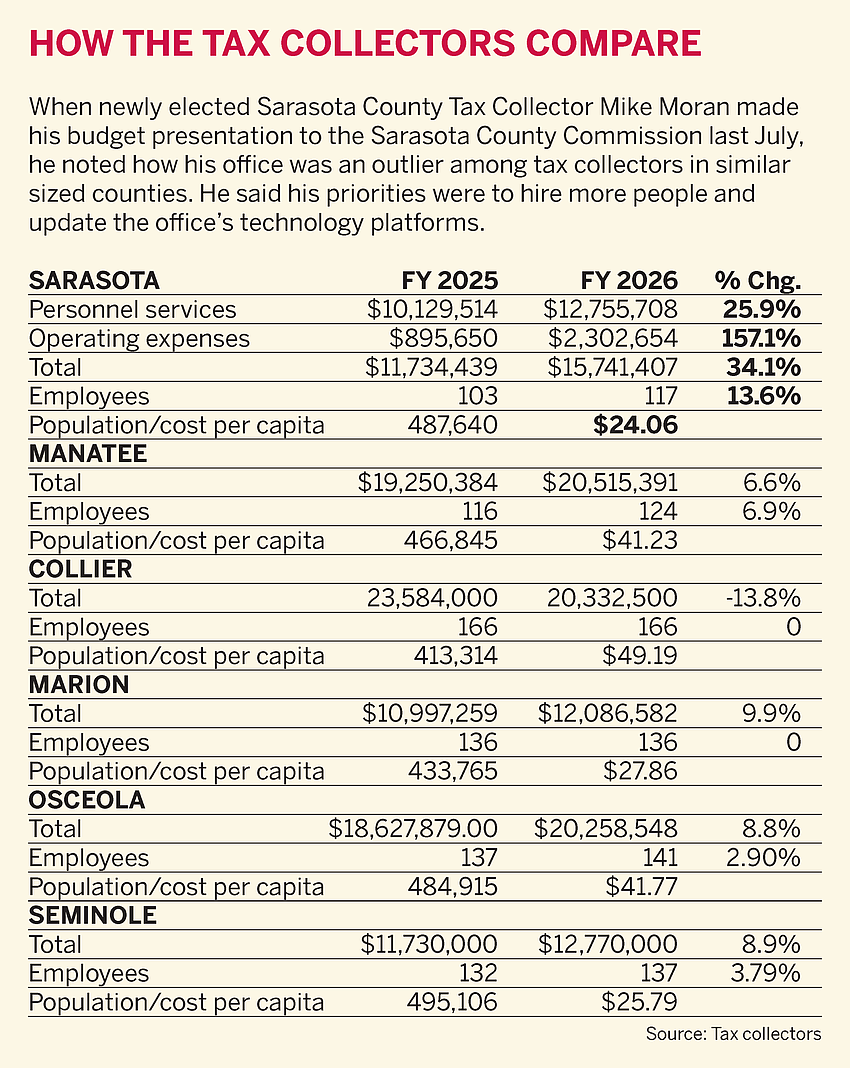
In his first budget year, compared to his predecessor’s last year, the tax collector’s expenses will be up by what most people would say is an astonishing 34%, or by $4,006,968. Payroll increased 26%, up 14 people to 117 and up $2.6 million; and operating expenses jumped 157%, increasing $1,407,004 (see box).
How could he do that? From where did the money come?
The only way a tax collector can get that additional cash is to charge more than his predecessor did for the service of collecting taxes for counties, municipalities, school districts and multiple other special taxing districts.
As state law stipulates, tax collectors can charge a commission for their services according to a prescribed formula.
And surely, for those who have watched Moran during his two terms as a county commissioner, it’s no surprise that when he launched his efforts for more money to do what he envisions, he saw where the money was and armed himself with arguments to justify the grab. Here are two of them:
Over the past 16 months, he has forged ahead, determined to get his way, a well-known Moran “M-O.”

And if you watched this saga unfold as if it were a TV series, the school board lawsuit has come about, not just because it’s about money, but because of the way Moran has gone about getting it. The issue has mushroomed into a legal battle that’s now costing taxpayers legal fees and diverting the time and money of the school district and tax collector resources.
When you know the details, it’s clear: All of this easily could have been prevented.
The issue surfaced publicly April 12, when Sarasota County School Superintendent Terry Connor presented a remarkable State of Education for Florida and Sarasota County at a Sarasota Chamber of Commerce luncheon.
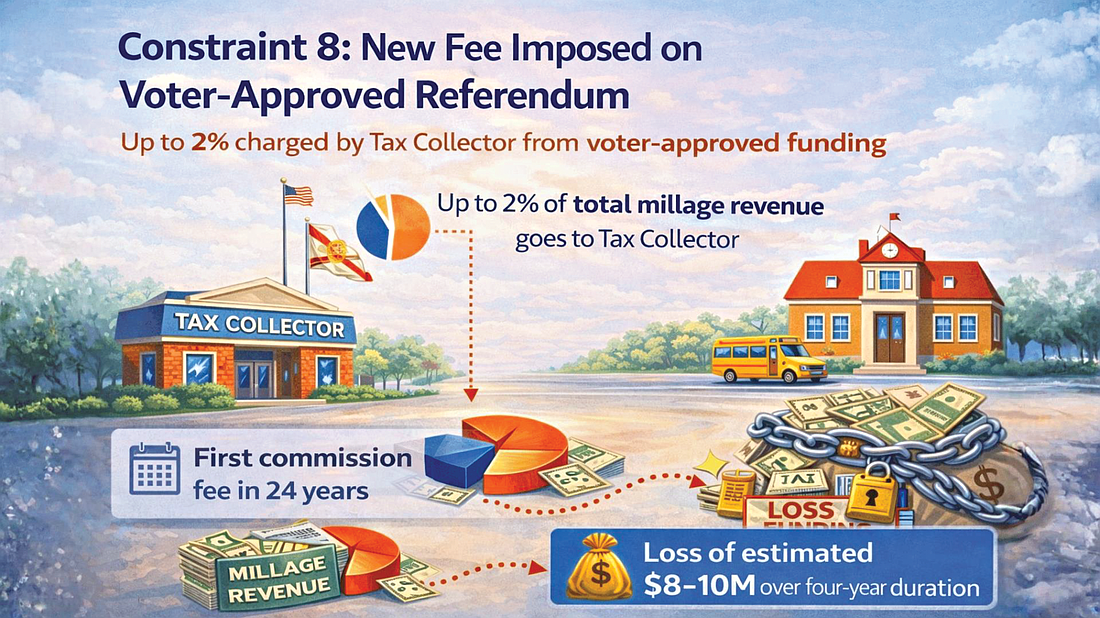
Connor enthralled his audience with 59 slides of data. But there was one slide that triggered a visceral reaction. The one displayed above.
Connor explained that Moran’s office was changing how the tax collector is paid — a method that had been in place for 23 years, ever since 2002, when Sarasota County taxpayers first approved the extra one-mill school tax.
During a Q&A after his remarks, you could see the news of Moran’s new school district commission incensed audience members. They couldn’t believe the tax collector was taking money away from Sarasota County’s children for the tax collector’s benefit.
Few in the audience had no idea what had been occurring since Moran took office in January 2025.
It’s almost always the case when a new boss takes over. The new CEO wants to show his or her competence. As the cliché goes: Take it to the next level.
That means change.
If the organization is in a tailspin, the CEO sees that change is needed immediately. If it’s operating successfully, the CEO has time to observe, learn and make gradual improvements.
When Moran came into the tax collector’s office, managers saw he was eager to make changes. He immediately hired Guidehouse, an international consulting firm, to do a forensics accounting analysis.
In the campaign before his election, Moran charged Ford-Coates with “overcharging our taxpayers.” He specifically questioned Ford-Coates’ overtime payments of $461,752 over a two- to three-year period, mostly during the COVID years.
Guidehouse reported two employees in particular — Joe Garafalo, the collector’s CFO, and Sherri Smith, deputy tax collector, worked 1,672 and 1,764 extra hours, respectively, in fiscal 2021 and 2022. That resulted in additional pay of $191,890 to Garafalo and $166,129 to Smith, according to Guidehouse.
In September 2024, during the campaign, Ford-Coates responded to Moran’s charges in the Sarasota Observer: “During the period following the pandemic … we had employees leave to care for family members, pursue other opportunities, move to other regions, etc. This resulted in turnover at nearly four times our historic rate.
“Throughout 2023, one employee worked 75-80 hours per week because of these staffing shortages,” Coates wrote. “This was the equivalent of two jobs, and I paid the employee for the actual time worked.”
Ford-Coates rejected Moran’s indirect allegations of wrongdoing and mismanagement. “My office’s financial operations are audited each year by an independent external auditing firm, and I have always received a ‘clean’ audit with no issues or comments.”
For fiscal 2023-24, the independent auditor, Carr Riggs & Ingram wrote: “Rules of the Auditor General requires us to communicate noncompliance with provisions of contracts or grant agreements, or fraud, waste, or abuse, that have occurred, or are likely to have occurred, that have an effect on the financial statements that is less than material but warrants the attention of those charged with governance. In connection with our audit, we did not note any such findings.
“In our opinion, the Tax Collector complied, in all material respects, with Section 218.415, Florida Statutes, regarding the investment of public funds …”
While noting it does not express “an opinion on the effectiveness of the Tax Collector’s internal control,” the auditor said, “… we did not identify any deficiencies in internal control that we consider to be material weaknesses.”
Seven months later, though, Moran’s Guidehouse consultants completed their forensic audit. In the executive summary of its 26-page report, it said:
“The practice of paying extra compensation in the manner observed to exempt employees appears to violate the Fair Labor Standards Act.” It also cited “Inconsistencies between payroll records and CFO’s explanation for extra compensation.”
This was just what Moran wanted — proof of poor management and ammunition for what was to come.
Here is another business and management truism: When you stay in a job more than 25 years, no matter how passionate you are, you get comfortable, develop hard-to-break routines, likely become complacent, not eager to change. If it ain’t broke, don’t fix it.
Even so, under Ford-Coates’ long-time tenure, the tax collector’s office clearly was not broken.
For Pete’s sake, she was elected 10 times — 10 four-year terms. Voters approved her resoundingly each time. They wouldn’t have done that if she were incompetent. Even more remarkable: Ford-Coates was a registered Democrat in a Red Sea.
What’s more, thousands and thousands of Sarasotans who made trips to the tax collector’s office repeatedly encountered the unexpected: a pleasant experience at the DMV!
In the course of reporting this, everyone interviewed was universal: They exclaimed how efficiently and pleasantly the tax collector staff treated them under Ford-Coates.
Typical comments: “When you went to the DMV in New Jersey, it was the most horrible experience ever. I couldn’t believe it when I came here.”
“Barbara was obsessed with customer satisfaction,” a former tax collector staff member said. She required staff to give her a report every week on customer reviews and feedback cards.
That is what the public saw. What the public did not see was that Ford-Coates also operated one of the most financially efficient tax collector offices in the state.
Florida has 67 county tax collectors. They collect their county’s ad valorem tax payments, tourist development taxes and business taxes. They issue driver licenses, vehicle tags, boat tags, mobile home decals, disabled parking permits and title applications. They sell hunting and fishing licenses.
The tax collectors fund their operations mostly by charging commissions for collecting ad valorem taxes. They also charge fees for the other services.
The commissions are calculated according to a Legislature-approved formula. Tax collectors commonly say the formula amounts to up to 2% on all collections.
In fiscal 2023-2024, Ford-Coates’ final full budget year, her office collected $1,470,442,850 in property taxes and fees for local governments. Its commissions were $21,549,909 million, or 1.4% of collections.
Once tax collectors extract their commissions to fund their operations, they send the leftover amounts, or the “excess,” back to the taxing authorities in corresponding proportions.
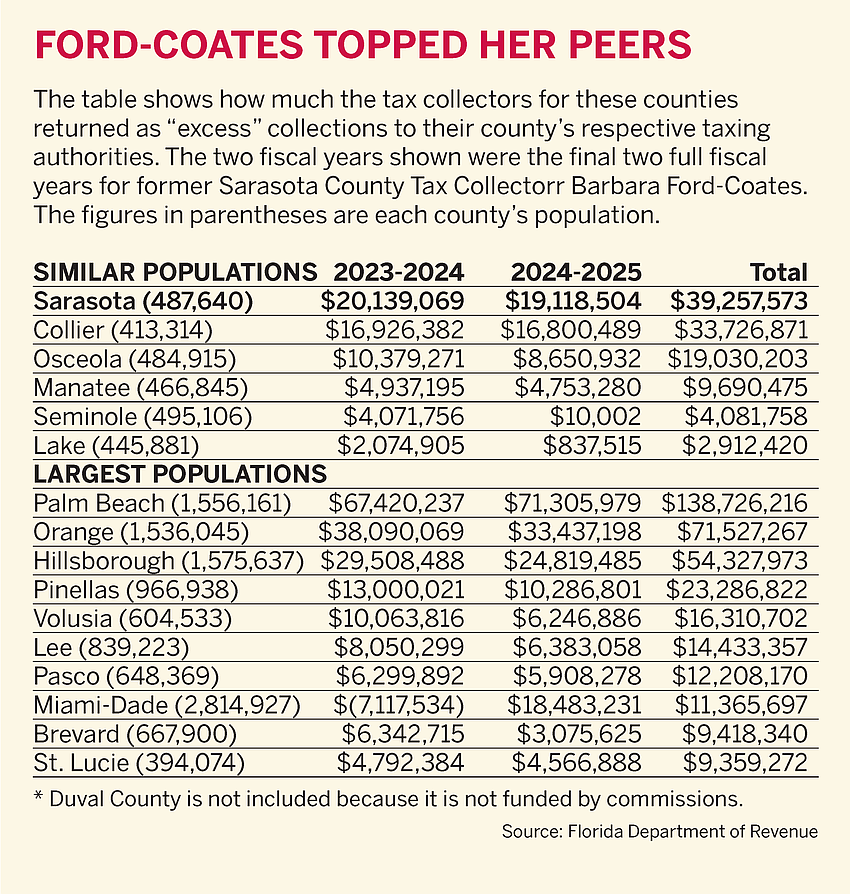
During Ford-Coates’ era, the Sarasota County tax collector routinely was among the state’s leaders for sending back the most money and operating the lowest-cost office (see box, page 8).
In her final two fiscal years in office, Ford-Coates returned $39,257,573 to her county’s taxing authorities — far more than five other counties of similar size. And when you compare cost of operations on a per-capita basis among similarly sized counties, Ford-Coates’ office was easily the least expensive.
What? Then how could this be an operational disaster that greeted the new tax collector?
Moran, nevertheless, painted a pernicious picture to the Sarasota County commissioners.
At a July 1, 2025, commission meeting for the 2025-2026 budget, Moran began his presentation by providing operational statistics — creating a scene that his office is inundated daily with mounds of work and transactions.
By Moran’s numbers: It’s collecting almost $2 billion a year; processing more than a million transactions a year for the state; 1,200 transactions a day; 1,600 phone calls a day; 1,200 online transactions a day; 700 pieces of mail a day.
“I don’t know if that even really tells the story, because if any of you have been in our offices on a Monday or a Friday, these can have incredible spikes,” he told commissioners.
Then came the slides. First up: Priorities for FY 26 … “Modernize Technology!!!” it said in red letters.
“The second bullet point is the number one, two and three priority of that office is modernizing the technology,” Moran said. “We are a deep, concerning outlier in this area. For perspective, out of 67 tax collectors in the state of Florida, we are the only one that is on the software platform we’re on.”
Moran then gave commissioners a foreshadowing that in the future he may not be returning as much money to the county. “So I’m just being very cognizant that we need to have a hand-in-glove relationship when I’m using the funds to properly run that office. It could affect your excess.”
Then came more data to show how awful conditions were in the tax collector’s office — “the reality of what I’m dealing with,” he said.
He showed two charts (see one of them below) comparing his office’s staff count and expenses compared to nine other counties “that fit in the profile matching Sarasota.” (Note: Volusia, Brevard and Pasco counties each have more than 600,000 population compared to Sarasota’s 487,000.)
“We are literally 53 full-time employees away from the average, he said. “So this affects everything. It affects turnover and burnout staff. It affects wait times. It is something I have to pay attention to and making sure we’re properly budgeting for it and planning long-term.”
On expenses, Moran told commissioners: “We are literally almost $2.9 million annually behind on operating expenses … it’s just simply an outlier.
“I’m committed to making sure I have the proper staffing and technology like any other business.”
Without context, of course, you’d say he makes a good business case. But you also could see his presentation as a setup — to get the commissioners sympathetic to his desire for more money.
On Feb. 26, 2026, in another budget meeting, Moran did it again — trashed Ford-Coates, albeit more explicit this time.
“The prior leadership was in that office for 49 years. We inherited an organization with artifacts, not office equipment … This wasn’t a forward-thinking organization. It was a museum with office hours.
“Our priority is modernization and infrastructure investment.”
Later on, Moran posted another slide for commissioners: “the one-time expenditures that I’ve had to deal with …
“I wasn’t there but a very, very short time, and the IT group came to me that our main server that runs the entire operation was well beyond its useful life and in failure. It was a $325,000 conversation.
“Of course, any reasonable person, I said, would do whatever it takes get it fixed immediately.”
What Moran did not report was that the tax collector’s office, the clerk-comptroller and property appraiser were all on the same platform and had been working with the vendor for at least three years for updates and improvements — before and after COVID. But each time the vendor provided new features, Ford-Coates’ office said the changes were unsatisfactory. “It was a valiant effort on both sides — the vendor and us,” a former staffer told us.
OK, yes, everyone knew the system was dated. But it wasn’t an “artifact.” While Ford-Coates was unsuccessful completely updating technology, the office still was working well enough to remain one of the most cost-efficient.
As Moran painted a picture of operational neglect and excessively deferred maintenance in that February meeting with county commissioners, he also made a brief reference to the issue that has now mushroomed into a lawsuit.
“Since we last met, there are two issues that we talked about through correspondence between our offices. One is the excess issue. The past tax collector administration was not distributing the annual excess as outlined in Florida statute as far back as our records can show…
“(And) the school board issue. … The Sarasota County government was paying the school board’s state-mandated commissions for approximately 23 years under the past administration. This is corrected in the last tax distribution. For reference, the FY ’25 was almost $2.2 million.”
These were two more dings at Ford-Coates.
But none of the commissioners questioned Moran on either point, showing no interest in the matters. They didn’t need to. By that time, they had already voted to approve Moran’s charging the school district a first-ever commission.
Indeed, Moran’s grab for school district money actually began well before the February 2026 budget meeting. It had been underway since the first half of 2025.
But his efforts took on full momentum on July 28, 2025. Moran sent Superintendent Connor and Sarasota County Administrator Jonathan Lewis a one-and-a-half-page letter.
Subject: “Clarification on responsibility for payment of millage collection fees related to school board voter-approved levy.”
Wrote Moran: “I am requesting your assistance in determining which entity is properly responsible for the commission on the voter-approved school millage going forward …
“I would greatly appreciate it if you could connect and come to a conclusive understanding regarding this matter, and then formally advise my office on how to proceed.
“My goal is simply to ensure that we are handling this appropriately, transparently and in alignment with both the law and the expectations of all stakeholders.”
Classic Moran — always cordial and polite, even though you sense an ulterior motive.
Sarasota School Board attorney Dan DeLeo saw through it. He was perturbed. He responded to Moran’s letter on Sept. 5. Excerpts from his 1,100-word letter:
“This office sees no rationale for the sudden and complete shift of course brought on independently, and without justification, by the newly elected Tax Collector. …
“The gross divestment of funds by the Tax Collector’s office would have real and detrimental effects on the ability of the School Board to continue to adequately provide for its students as well as employ resident staff and educators …
“Be advised the School Board takes this claim very seriously and intends to zealously defend against the unrightful taking of taxpayer dollars intended for the School Board.”
Moran responded with another email. He requested to meet face to face with Connor.
According to Connor, Moran “said if this is already moving down a legal pathway, then we can just let the lawyers take this. But if I was amenable, he said let’s have a conversation. I said, absolutely. I said the last thing we want to do is go down a legal path. So I invited him to the office.”
Moran went to Connor’s office in August 2025.
“It was very convoluted,” Connor said. “I couldn’t get a good grasp of what his stance around the issue was.”
The conversation concluded with Connor recommending Moran meet individually with the school board members. Which he did, all but Tom Edwards.
Politely and cordially, Moran informed the school board members he was just following state statutes.
The school board took no formal action.
But Moran did. He sent letters to the county commissioners, making the case that the county for 23 years incorrectly had been paying the school district’s commission on the extra one-mill tax.
It worked. At an Aug. 19 budget workshop, commissioners took only 2 minutes and 40 seconds to end that 23-year practice. There was no detailed discussion about any of the ramifications to the school district or whether charging the school district was legal. They voted 5-0.
Commissioner Teresa Mast: “I don’t know if this is the right time to bring it up, but I wanted to discuss real quickly the letters that we received from our Tax Collector Mike Moran. One in particular is the $589,556 from the school board fee … I’m not interested in continuing to pick up the tab. This needs to be passed on to the school board. They can find the money. It’s time to turn that over after 23 years.”
Commissioner Ron Cutsinger: “We appreciate the collaboration we have with the school board … This is a mistake that needs to be corrected.”
Commissioner Joe Neunder: “We appreciate the relationship with the school board, but business is business.”
With that, Moran had an important imprimatur to proceed full speed. On Sept. 4, 2025, Connor received the following letter from the county:
“We’d like to inform you that the Board of County Commissioners discussed this situation at its Aug. 19 budget workshop and voted to discontinue paying this commission on the school board’s behalf beginning in fiscal year 2026.”
Said Connor: “We were like, ‘Oh my God, they just voted this.’”
Since November 2025, Moran has been taking a commission on the district’s extra one-mill tax.
According to Connor, the first hit came in December. It was a shocker: Moran claimed $4 million. It was a mistake, but after “back and forth,” Connor said, it was corrected.
The total taken as of April 17, 2026, has been $2,055,798.05.
That date is significant. School Board attorney DeLeo sent Moran a letter on that date formally demanding Moran “immediately cease collecting, withholding or retaining any commission on voter-approved school millage funds, and to return all commissions improperly diverted to date, together with any interest accrued.”
DeLeo concluded the letter:
“Please be advised, however, that if this matter is not resolved within five (5) days of your receipt of this letter, the School Board may be compelled to move forward with seeking Judicial relief …
“The harm caused by the continued diversion of these trust funds is real, immediate, emergent and ongoing. As a direct result of your unauthorized taking of millage funds, the School Board has already been forced to limit employee health care benefits, roll back educational programs and implement staff reductions. Every day that passes without resolution compounds this harm to the students, teachers, and taxpayers of Sarasota County.
“We trust that this matter can be resolved cooperatively and in the best interests of the Sarasota County community.”
DeLeo invited Moran to contact him to “discuss terms of a negotiated resolution” in person or via telephone.
Moran’s response? A letter that same afternoon, via email.
He wrote that he was awaiting an opinion from the Florida attorney general, which “will likely resolve the core of this issue, potentially avoiding costly litigation and saving Sarasota County taxpayers significant resources.”
There was no phone call, no face-to-face meeting.
In an interview with Connor and DeLeo April 24, the question was posed: “Did Mike Moran ever say anything like this: ‘This is what I’m thinking regarding the collection of commissions. I know this is a lot of money that would affect you. Is there a way we can figure out how to work this out?’”
Connor, recalling Moran’s visit last August: “No. I asked for that. In the spirit of working collaboratively, I asked ‘Is there a glide path to something? Can we negotiate something?’ I told him our budgets were already set and approved. This $2 million will create a major significant deficiency in our budget.”
His response?
Connor: “His response was that it wasn’t his authority. It would be the county commission’s authority. He said he can’t unilaterally decide to create anything outside of what he said the statute says.”
On Friday, April 24, the school board had enough. It filed suit against Moran.
After being served Tuesday, Moran responded: “We respectfully suggested that the School Board wait until the Florida attorney general issued its opinion on the matter, which would save the taxpayers money, but apparently, they would rather spend money on attorneys than the children.”