- July 22, 2026

-
-
Loading
Loading
At home, laundry is a simple chore. At a fire station, laundry is an evolving safety protocol.
For the East Manatee Fire Rescue, the death of Edward Wadlinger III in 2017 gave the then-new Chief Lee Whitehurst added incentive to make changes to how lingering carcinogens on gear were handled after a fire.
Wadlinger retired because of a cancer diagnosis and died two years later. He was 42.
“It affected us,” Whitehurst said. “I colluded with our union, so it wasn’t me alone. But I thought, why don’t we make Ed’s passing not for not. We came up with a program using his nickname Wad to remind these guys when they’re on the scene that cancer awareness starts with the individual.”
WAD now stands for Wash your face and hands, Avoid breathing smoke and Decontamination.
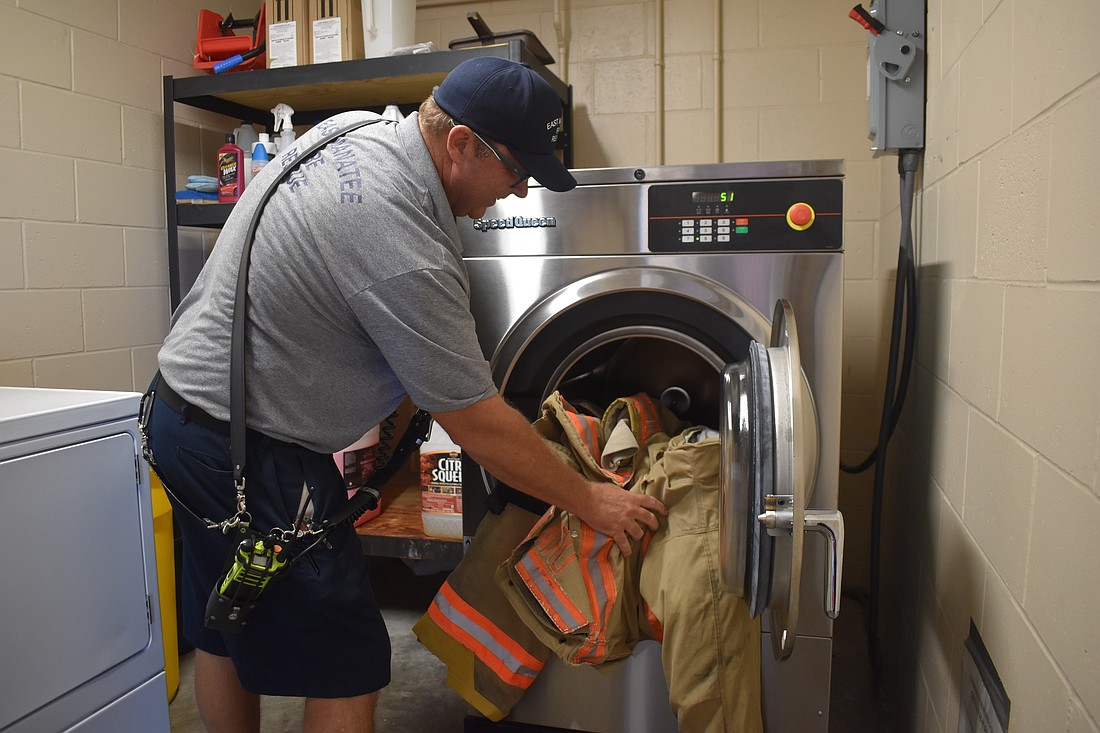
For the decontamination, each firefighter has two sets of bunker gear and every station has a Speed Queen Extractor, an industrial-sized washer that weighs about 500 pounds.
EMFR received $12,248.25 from the Firefighter Cancer Decontamination Grant to buy a Speed Queen for its new Station 9 that is anticipated to break ground in May on Bourneside Boulevard.
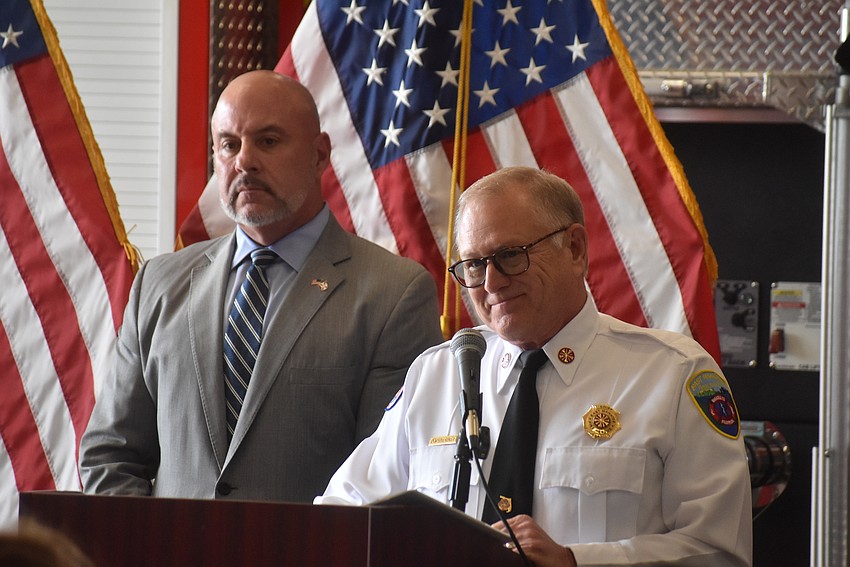
Florida Chief Financial Officer Blaise Ingoglia presented the check during a news conference April 9 at Station 1 on Lakewood Ranch Boulevard.
Whitehurst described the machine as “a fancy washing machine on steroids.”
“It’s built to clean the products of combustion and carcinogens in our firefighting gear,” Whitehurst said. “Currently, one-third of our firefighters will contract some form of cancer. Those are the statistics as of right now, and our goal is, of course, to reduce that.”
The Speed Queen Extractor is about the size of a washing machine at a laundromat. It can handle an extra large load of laundry, but only one set of bunker gear at a time because each set has four layers that have to come apart before being washed — the outer shell, inner layer, thermal barrier and moisture barrier.
Lieutenant Jack Gamble estimated the gear weighs about 40 pounds when soaking wet.
“The suits would tear up our other washing machines,” he said. “And (the Speed Queen Extractor) does a better job of cleaning the gear.”
CitroSqueeze is used instead of regular laundry detergent. It’s specially formulated to remove hydrocarbons and soils that come from fires and chemical spills.
Doubling up on the bunker gear was a much more expensive decontamination effort. Just one suit costs about $4,000. Given a staff of about 130 firefighters within the district, the gear cost over $1 million.
“That’s something we had to execute over time,” Deputy Chief Paul Wren said. “Even as large as we are and as well as our budget is funded, we couldn’t cover all of that expense in a year.”
Gamble explained that without the second set of gear, firefighters would opt not to wash their sooty gear after a fire because wet gear is worse in the moment.
“When you go into a fire, it turns into steam and you’re steaming yourself,” he said.
Now, the firefighters wash their gear immediately because a backup is ready to go if they get another call.
But sometimes, even the Speed Queen isn’t enough to fully decontaminate the gear.
In 2017, a fire broke out at Callaghan Tires at 1301 44th Ave. E.
“We had guys cleaning their gear three, four times, and they were still getting soot out of it,” Gamble said. “Everything that’s in those tires created a black, nasty, carcinogen-laden smoke, so that was the push to figure out how to (further) decontaminate this gear.”
Uniform T-shirts and pants that have been exposed to that kind of contamination are thrown out. But there were about 50 firefighters on that scene, which is approximately $200,000 worth of gear.
That gear was sent out for a liquid CO2 cleaning, which removes even more toxins than the extractor. Since then, each set of gear gets a CO2 wash at least once a year.
Ingoglia noted that fighting fires today is much different than fighting fire 30 or 40 years ago. For the most part, structures were built of wood and concrete. Now, chemicals, petrochemicals and plastics are burning inside the structures, too, creating a multitude of carcinogens.
“That’s why we’re seeing firefighters with a higher rate of certain types of cancer,” Ingoglia said. “We need to recognize that.”