- August 5, 2026

-
-
Loading
Loading
It was the best of times, it was the worst of times, it was the age of wisdom, it was the age of foolishness, it was the epoch of belief, it was the epoch of incredulity, it was the season of Light, it was the season of Darkness, it was the spring of hope, it was the winter of despair, we had everything before us, we had nothing before us, we were all going direct to Heaven, we were all going direct the other way — in short, the period was so far like the present period, that some of its noisiest authorities insisted on its being received, for good or for evil, in the superlative degree of comparison only.” –Charles Dickens, "Tale of Two Cities," 1859
To borrow from Arnold Schwarzenegger in “Terminator 3”: “I’m back.”
Cue audience: Collective “Ugh.” Maybe a “good” or two. Or a lot of: “Who cares.”
After 30 years of spewing free-market, laissez-faire (“Leave us alone”) diatribes in this space, it seemed like a good time back in late July to take off for three months to try to figure out whether to spare you of further spewing, keep going, disappear altogether or take on a new adventure in a different direction. The place to contemplate all this was at the foot of Cheyenne Mountain in Colorado Springs.
It didn’t work.
It looks like you’ll be stuck with me for a while longer, albeit not as often, say, once a month.
That is, unless our elected officials go bonkers enough that they cause the kind of gasket blowing that someone needs to say something. (Count on it.)
But during the three-month sabbatical, it was a time to unplug from here and Florida; stare at the mountain for inspiration; observe the surrounding happenings of Colorado Springs; and, occasionally, tune in to what was happening in the U.S. and Washington and around the world.
The big things, of course, were the assassination of Charlie Kirk; obliteration of Iran’s nuclear facilities; and the so-called peace deal between Israel and Hamas. But here in the U.S. and Washington, it’s pretty much the same ol’ scheisse.
In fact, it’s remarkable how so much of what is happening everywhere — in governments around the world, in the U.S., in Colorado, Florida, Sarasota, Manatee and Longboat Key — if overlayed like a translucent page on the 1920s, ’30s and ’40s, the match would seem like a duplicate. Heck, you could go back to the 1770s that Dickens wrote about London and Paris, even as far back as 170 A.D. during the time of Marcus Aurelius Antoninus in Rome and see how little human behavior changes.
This conclusion emerged after reading the pages of hardback books that have been on a long reading list, a stack that has been waiting for years. A sampling:
The first three are still in progress. The latter three were consumed cover to cover.
In the forward to “Meditations,” the translator, George Long, writes about the period of around 174-164 A.D.: “The fact is certain that in the time of M. Antoninus (Marcus Aurelius), the heathen populations were in open hostility to the Christians, and that under Antoninus’ rule, men were put to death because they were Christians.”
Surely you’ve heard of the massacres of Christians occurring for more than a decade in Nigeria. The Hudson Institute reported that Islamist extremists have slaughtered 52,000 Christians over the decade; thousands of women and children raped, kidnapped and slaughtered; more than 20,000 churches attacked and destroyed since 2009 by various Islamist extremist groups.
In our own country, Kirk, today’s Jesus-like and St. Paul-like evangelist, was gunned down for his beliefs and speaking them.
In “Tale of Two Cities,” Dickens wrote: “In England, there was scarcely an amount of order and protection to justify much national boasting. Daring burglaries by armed men, highway robberies took place in the capital itself every night; families were publicly cautioned not to go out of town without removing their furniture to upholsterers’ warehouses for security …”
Yep. Think of D.C., Chicago, New York, Baltimore, Memphis, as well as London and Paris.
When the Trump Deranged Syndrome mobs came out on “No Kings” Day, the irony was laughable. They flung the standard epithets of “Hitler,” “Nazi” and “fascist” in reference to Trump. But had they read Shirer’s book on the rise and fall of Hitler, they would know how moronic they are. Trump let’s them speak. Hitler gassed them — 6 million Jews, Catholics and others.
Maybe this might resonate: In his trilogy on World War II, author Rick Atkinson reported what was found at Auschwitz: “seven tons of women’s hair shorn from victims, 348,820 men’s suits and 836,515 dresses, neatly baled” and pyramids of dentures and spectacles whose owners had been reduced to ash and smoke. More than 1 million were exterminated there.”
Is that what “King Trump” is doing?
Which pivots us to Mencken and Nock. They were particular attractions during the sabbatical because they were famous journalists, writers, editors and cultural and political observers of their times — from 1920 to the mid-1950s. You might say they were akin to being the Charles Krauthamer and Victor Davis Hanson of their day, albeit not nearly as polite.

Mencken and Nock were ruthlessly, brutally blunt. They abhorred the inevitable evils of government and Statism and were unabashed defenders of individual liberty and laissez-faire capitalism. They were cynical, unforgiving critics of the stupidity of the gullible mobs and had gruff disdain for politicians. Mencken:
Hard to argue he was wrong — especially at the gubernatorial and federal levels.
Nock is far less known than Mencken, but no less brilliant of a writer and seer of the world as it was in his day. He jolted politicians and the intelligentsia during Franklin Roosevelt’s vast expansion of the federal government when Nock wrote what became a famous essay, “Our Enemy, the State.” Read it. He nailed it.
Like Mencken, Nock saw little good in the State. He believed wholeheartedly that the U.S. was unavoidably destined for collectivism.
“It had not yet got a glimpse of the elementary truth which was so clear to the mind of Mr. Jefferson, that in proportion as you give the State power to do things for you, you give it power to do things to you; and that the State invariably makes as little as it can of the one power, and as much as it can of the other.”
Nock also saw the fatal flaws of public education:
“Our system was founded in all good faith that universal elementary education would make a citizenry more intelligent; whereas most obviously it has done nothing of the kind …
“Aside from this negative result, I saw that our system had achieved a positive result. If it had done nothing to raise the general level of intelligence, it had succeeded in making our citizenry much more easily gullible. By being inured to taking as true whatever he read in his schoolbooks and whatever his teachers told him, he is bred to a habit of unthinking acquiescence, rather than to an exercise of such intelligence as he may have.”
Altogether, when you read what Mencken and Nock wrote about politicians and our democratic republic in the 1940s, you likely could conclude: Nothing has changed in a century.
The illiterate mobs of today are no different than they were then. The politicians of today are no different than they were then. They want to intervene and control every aspect of our lives, thinking they are improving society. Ha.
Nock was ever the skeptic on that point. “I have regularly had occasion to notice that grandiose schemes for improving society-at-large always end in failure, and I have not wondered at it because it is simply not in the nature of things that society can be improved in that way.”
To be sure, Mencken and Nock can leave you dejected. Indeed, apologies for this sounding like such a downer. But it’s true: Human behavior hasn’t and doesn’t change.
Nonetheless, at the end of his “Memoirs,” Nock gave his reader hope and encouragement on how to make things better:
“Il faut cultiver notre jardin.” … “We must tend our garden.” (See the accompanying box below.)
As we live through the best of times, the worst of times, it’s a great reminder to us all.
Add Gulf of Mexico Drive-gate to Longboat Key’s official lore.
You can count on town historians to cite the debate over whether to rename Gulf of Mexico Drive as Gulf of America Drive.
Too funny: When it comes to the town’s annual ad valorem tax rates and budgets, you can count on one or two fingers the number of residents who show up for the budget meeting. But, whoa, talk about changing the name of the town’s main drag, that’s poking the hornet’s nest.
Once everyone thought through the inordinate hassles that a name change would bring on residents and businesses, the decision for town commissioners emerged.

We’ll side with the patriots — that our preference would be Gulf of America Drive. But commissioners absolutely did the right thing.
What the heck, most residents don’t call it Gulf of Mexico Drive anyway. It’s “GMD.”
Meantime … Another example of unnecessary government intervention: Raised medians on GMD.
For about a century, GMD has worked just fine without raised medians and with middle turn lanes. But soon we’ll have more costs for taxpayers — the maintenance of the medians’ plants and sprinklers. What’s the benefit?
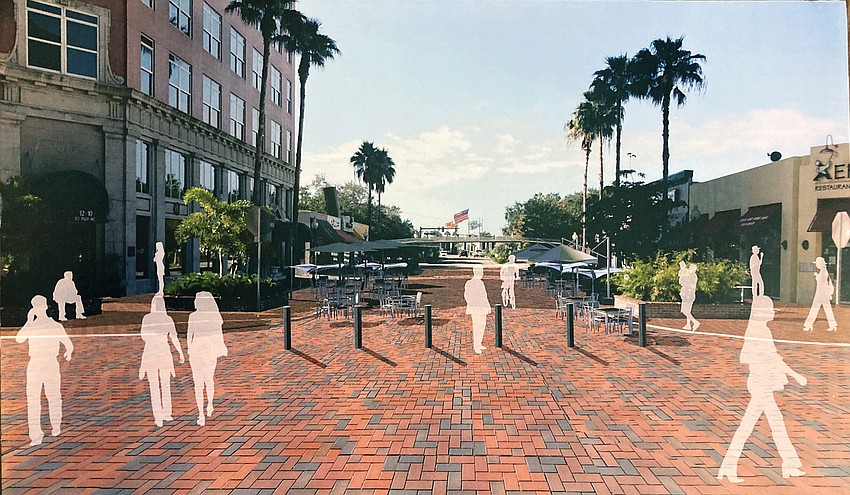
In the vein of how nothing changes (see above), that’s the debate over what to do with Main Street parking downtown.
The late Gil Waters, one of Sarasota’s leading lights, was the force who brought the Ringling Bridge to fruition after years of battling the city’s small-town thinkers.
One of the projects he was unable to complete was his vision of turning Main Street from Orange Avenue down to Gulfstream into a pedestrian-only, European-like plaza from, say, 10 a.m. to 9 p.m. Waters went so far as to create the accompanying rendering.
City commissioners this month approved going ahead with two more years of design and engineering for the Main Street Complete Street project, a mix of parking ideas. But here’s our bet: This debate will never end.