- July 25, 2026

-
-
Loading
Loading
While the reports of property taxes’ demise in Florida were greatly exaggerated this month in headlines and instant-news stories, the deeper details of what the state Legislature approved in special session June 2 are far more nuanced than a click-grabbing headline.
First off, it’s not a done deal.
To be enacted, the proposed tax-system overhaul put forth two weeks ago requires 60% approval in the November election. Initially, that bar doesn’t appear insurmountable, based on polling data.
A query by Stetson University shows 77% of respondents would “definitely” or “probably” vote yes. A similar poll by the James Madison Institute found 77% in favor, and 54% said they pay more in property taxes now than they did five years ago.
Here’s a deeper dive into what you’re going to see on the ballot this fall.
Florida’s ad valorem system of assessing and collecting property taxes has several mechanisms to reduce tax burden.
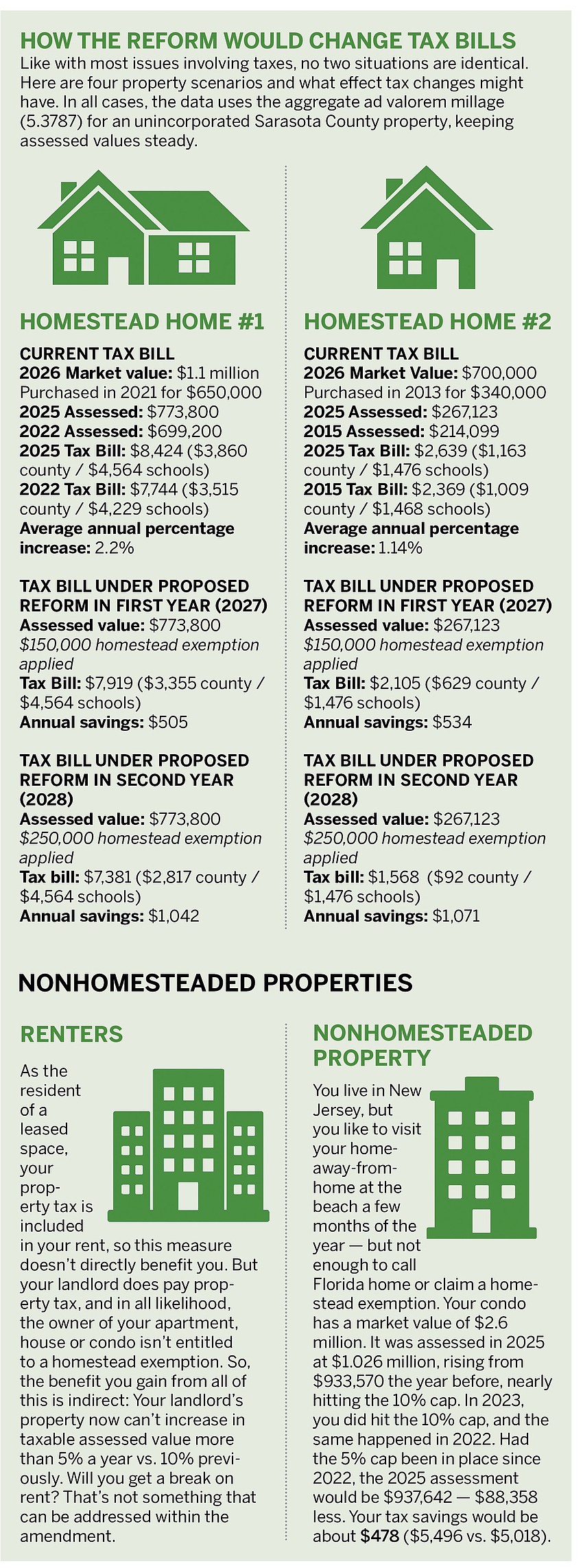
Within the first year of ownership, Florida residents may apply for a homestead exemption on their primary residences by March 1 of each year if they lived in the home on Jan. 1 of the same year. Once in force, the first $25,000 of this exemption applies to all taxing authorities. The second $25,000 excludes School Board taxes. And since Jan. 1, 2025, the annual exemptions are indexed for inflation, amounting to $51,411 for the 2026 tax year.
Florida’s Save of Homes provisions are designed to insulate taxpayers from sharp rises in assessed values, allowing for no more than a 3% year-to-year increase for homesteaded properties. But, if that owner sells, the baseline taxable value resets to current levels for the new owner and then is subject to the 3% ceiling once again.
Nonhomesteaded properties, such as second homes owned by residents of other states, can gain a maximum 10% annually in assessed value and routinely do during times of increasing property values.
In Manatee County, about 47% of residential and real property is homesteaded. In Sarasota County, it’s about 45%.
The constitutional amendment would build toward a so-called super homestead exemption, totaling $250,000 for bona fide residents of the state before Dec. 31, 2026 — though still not applying to school districts. There, only the original $25,000 exemption still applies.
Local governments would be restricted to funding only specific segments of spending with money derived from property taxes. They are:
Once a part of the plan, a state trust fund to help small, rural counties offset the losses of property tax revenue was removed before the final vote by the Legislature.
Florida municipalities are restricted by law in raising tax rates above 10 mills ($10 per assessed $1,000 of assessed value), not to mention public sentiment on election day. Manatee County currently totals 7.856 mills in aggregate. Sarasota County levies an aggregate millage of 5.3787.
A study undertaken by the Tax Foundation found that complete property tax elimination would require an average combined state-local sales tax rate of 15.34% to break even, more than double what residents pay in Manatee and Sarasota counties. And that would require unlikely state approval and voter approval locally.
Though more work remains and nothing yet has been proposed, part of the amendment makes it possible for counties, municipalities and school districts to provide additional forms of tax relief, up to full elimination of taxes by voter approval.
In some cases, part-time residents of Florida could shift residency to the Sunshine State to qualify for the exemption. In those cases, a Declaration of Domicile would have to be filed with the county clerk, proving rescinded residency elsewhere.
State Sen. Bryan Avila: “Our nation was forged by pioneer patriots who left everything behind and risked their lives for the dream of living in freedom on their own piece of property. We agree with Gov. DeSantis that having to continually pay the government for the right to live on your own property flies in the face of that dream.’’
Sadaf Knight, CEO of the Florida Policy Institute: “Unfortunately, thisproperty tax reform measure does not represent cost savings, but rather a cost shift — one that will force local lawmakers to cut local services that families rely upon or increase other taxes and fees to make up for the missing revenue. In either case, everyday Floridians ultimately pay the price for the massive loss in property tax revenue.