- June 25, 2026

-
-
Loading
Loading
Sarasota resident Michael Moss has been a racer since he was young.
At age 13, he started saving to buy a Chevy, in anticipation of having a driver’s license. Later, he began building Chevy engines, many of them with Duntov cams — the famous high-performance camshafts designed by his hero, Zora Arkus-Duntov — in his family garage and speed shop. While attending college, he drag raced his Chevrolet Camaro.
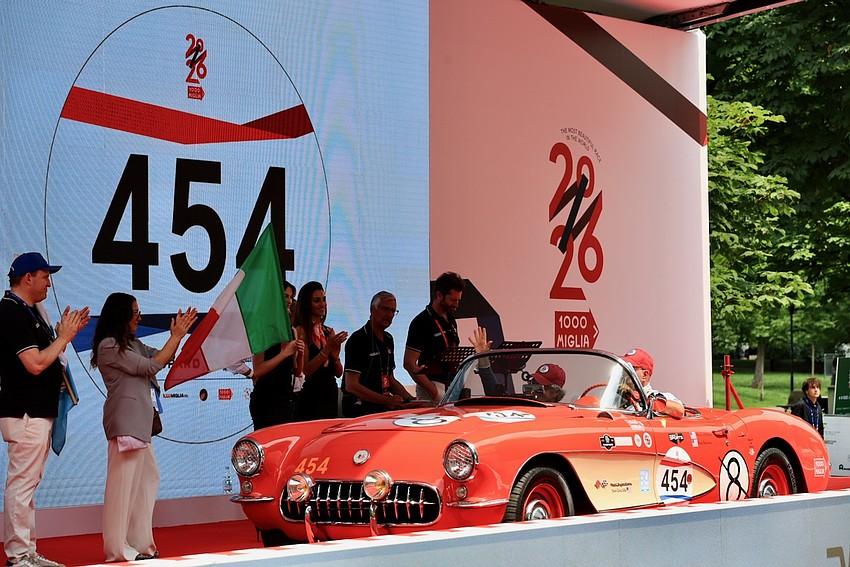
But Moss had never had an experience like the 1000 Miglia rally. He calls the rally in Italy reenacting the legendary endurance race held from 1927 to 1957 “just the craziest motorsports thing I've ever done.”
In a figure-eight form from Brescia to Rome and back, the course covered 1,250 miles from June 9 to June 13. For Moss, it was also an experience that involved some unexpected moments of danger, as well as a last-minute replacement navigator in his friend John Cutrone.
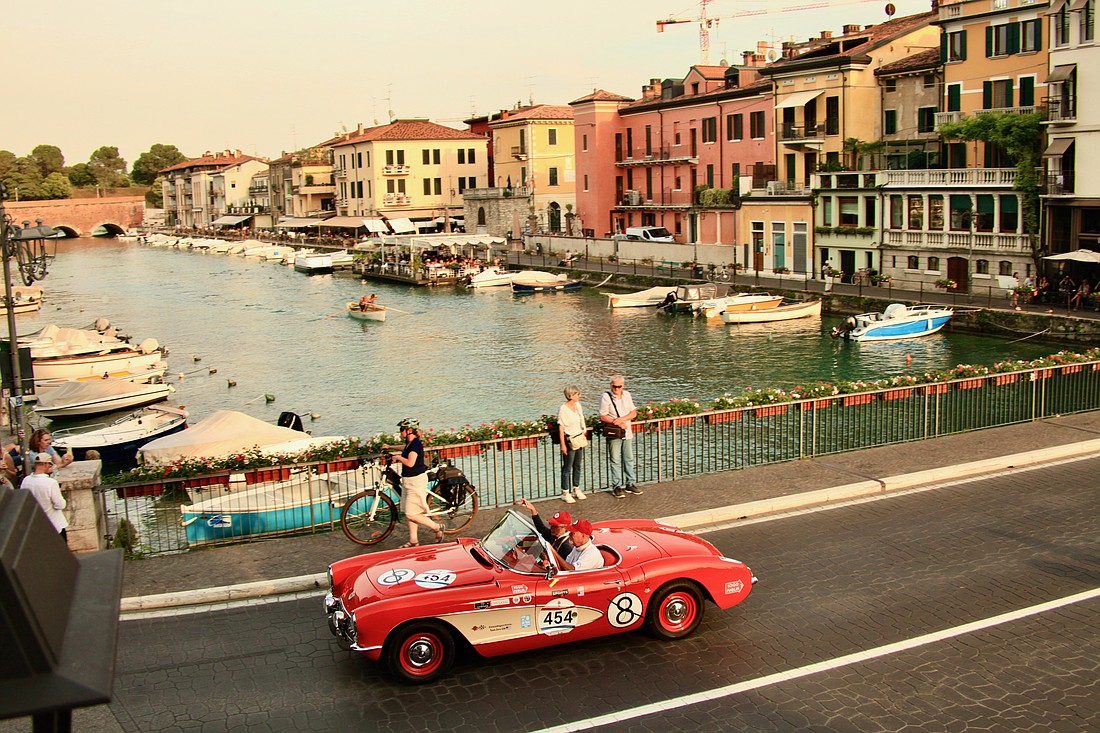
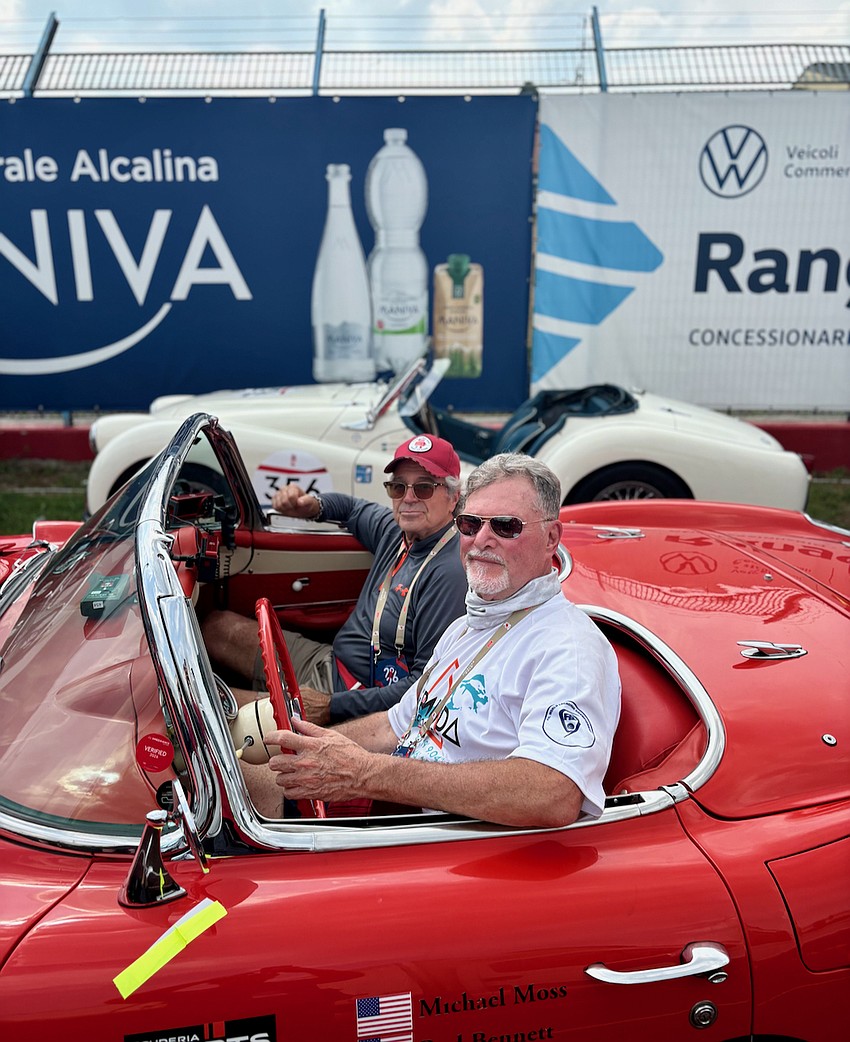
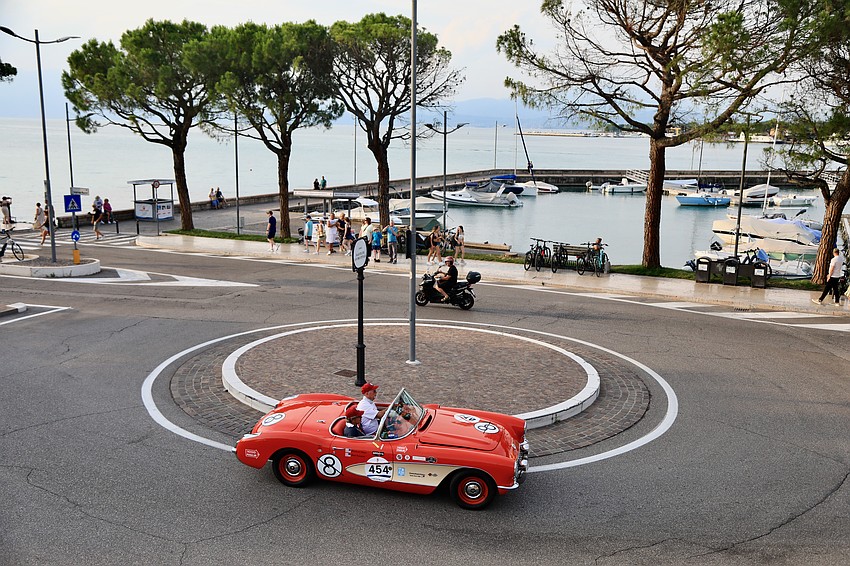
The duo drove the Spirit of Zora, a 1957 fuel-injected Corvette. Being among the later vehicles to depart according to the event format, they finished in 371st place out of 436 cars entered, 50 of which did not start or did not finish.
Moss says just finishing the race, which took place in the grueling heat, while operating amid three hours of sleep per night and 15 hours of driving per day, was an accomplishment.
The original race, the Mille Miglia, which racing driver and entrepreneur Enzo Ferrari called the “world’s most beautiful road race” and the “world’s unique traveling museum,” ultimately came to a tragic ending.
In 1957, it was shut down after a crash that killed Scuderia Ferrari driver Alfonso de Portago, his co-driver Edmund Nelson, and nine spectators resulted in public outrage.
The event was resurrected in 1977 as a rally, which takes place on public roads alongside regular traffic, using prescribed averages to determine place and assessing penalties for breaking traffic laws.
The event is intended for cars built before Dec. 31, 1957 that belong to a car model that took part in at least one edition of the Mille Miglia.
Although that didn't apply to Moss's Corvette, he was able to enter due to the guest list, which included the vehicle because of its character and historical significance.
His plan is that the race won’t be the last.
Along with Martyn Schorr, a fellow member of Sarasota Café Racers who is the founding editor of Vette Magazine, Moss co-founded Team Zora, an initiative whose goal is to honor the legacy of Zora Arkus-Duntov by competing in 1000 Miglia events.
Arkus-Duntov is remember for his performance engineering and racing achievements at Chevrolet and with the Corvette.
Moss's vehicle, the Spirit of Zora, was one of 35 cars representing the country at this year's event and was the first to ever represent Sarasota outside of 2014, when Brian Johnson of AC/DC, served as a celebrity driver for Jaguar. The vehicle, painted Venetian Red, is powered by what Schorr says is the highest performance engine available in 1957.
Schorr says the outfitting of the car made finding mechanical parts more difficult and expensive. Fortunately, a network of car enthusiasts from Sarasota stepped up to help Moss along the way, both mechanically and with emotional support.
“The best village on the planet are the car guys in Sarasota…” Moss said. “It was really terrific having all these friends who considered it their venture, their team to go and help do things. Unbelievable. Absolutely great. This great team of friends—it wouldn't happen without everybody.”
The first big incident happened as the rally began, when the original navigator got sick and wasn't able to participate.
“You’ve got to jump in, buddy,” Moss recalled telling Cutrone, a fellow member of Sarasota Cafe Racers, a group for which Schorr is a founding member. Cutrone was initially hesitant due to his lack of navigation experience.
Moss says he handed Cutrone a series of books while complimenting his intelligence, books he would spend the next days buried in as they traversed towns, cities and mountain roads.
As they traveled through Italy, Moss says he was struck by how well-loved American cars were outside of the country. They were constantly greeted by the spectators lining the streets, who would often ask them for autographs.
“Unless you're doing it, it's nothing like you can understand, and also the fanatical interest by the Italian people,” he said of the event overall. “I mean, you'd have little old ladies out there jumping up and down, screaming, waving the flags. Wouldn't happen in Sarasota.”
Navigation was a learning curve for Cutrone. Using a GPS isn’t allowed, and participants have to track their route using the road book and a device that measures kilometers. In some cases, finding the right road is easy, and in some cases someone can miss it, Cutrone said.
If drivers become lost, the 15-and-a-half hour days could easily turn into 16- or 17-hour days, he said.
Cutrone says he enjoyed the sightseeing along the way. Although he'd visited the country before, he had the chance to see new locations, one highlight for him being the Basilica of Saint Francis of Assisi in the town of Assisi.
As he had been to Italy before, some of the terrain, fortunately, was familiar.
“Driving through towns like Vicenza and Lucca and places like that were great, and what was good for me is I had been to some of these places before, and then driving through, I kind of knew where I was going,” he said.
Although they got lost in Rome for three hours, Moss says that by the fifth day, they were working as a team.
“I was driving well, and he was navigating fabulously," he said.
But driving and navigational skills could not prevent some of the mechanical breakdowns to which classic cars are prone. One of the most notable incidents happened in Riminy, on what Moss describes as a road of six to eight lanes, when the entire steering wheel became disconnected.
But the scariest part of the trip, say Moss and Cutrone, was winding down from the Alps, when the car's headlights became severely damaged, as well as the brakes. As they wound around mountain roads and alongside cliffs, Moss mainly braked using the engine, taking each movement slowly and inching downwards at 8km an hour.
“I have to tell you that when we finished with that, we thought about packing, said we can't do this again,” Moss said. “But you know what? We were out the next morning and we were determined to finish. You can't go to Italy and put on a performance of getting off the mountain, and then not the next morning. The brakes are cool, they're working... Let's go out and do it again.”
When the reached the end of the course, Moss says all of the sense of being tired lifted. They were greeted by friends and thousands of people, laughing and hugging, and beer, champagne and wine.
Looking back at the experience, Cutrone calls it “life-changing.”
“I would tell you that my experience is exciting, exciting, exhilarating, a little bit dangerous, exhausting at the end,” Cutrone said. “At the very end of the race, I didn't expect this feeling of being completely overwhelmed. Then we finished, we finished safely, we didn't damage the car, we got a good time. It was great."
Moss says that in the end, it didn't come down to just their journey, but also the experience of their friends in the car community in Sarasota.
“It takes a village, like all these guys, plus many, many more," Moss said. "The whole group got together, and some of the guys who don't know anything just came along for physical support, and laughs... I think it really brought a whole group of older guys together to have fun and enjoy it, and they all live vicariously through what John and I do.”