- July 29, 2026

-
-
Loading
Loading
The wheels of government move notoriously slowly, but natural disasters happen quickly.
That disconnect is the reason Longboat Key Town Manager Howard Tipton continues to emphasize the need for the town to fill its fund balances, which is difficult to do while it awaits $29.7 million from FEMA for Hurricanes Helene and Milton.
“You’ve got to have the reserves or else you’re just going to the bank and borrowing money,” Tipton said. “You’ve got to have the ability to respond.”
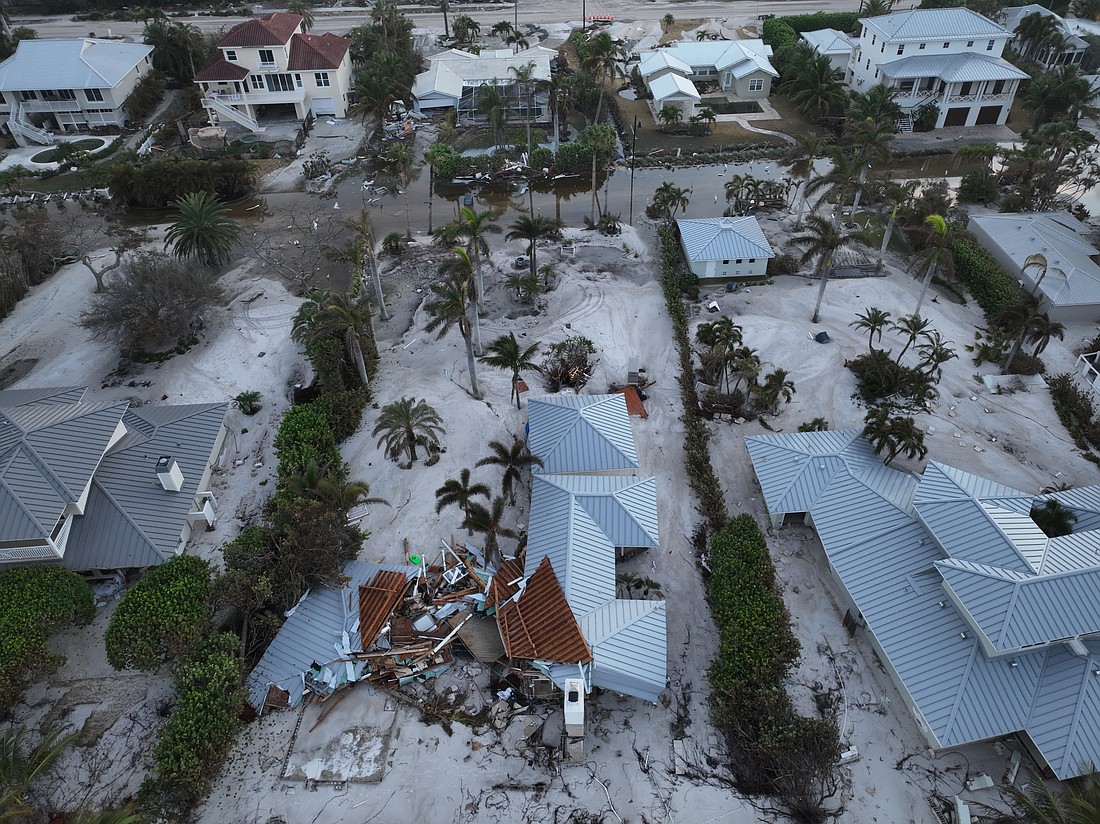
When the barrier island took the brunt of Hurricane Helene’s storm surge and Hurricane Milton’s winds, the town of Longboat Key did not have time to wait for bureaucracy. Cleanup efforts began immediately.
It was a big push in the literal sense. Bulldozers shoved sand off the roads and into piles on the curbs and sidewalks in the days after Helene.
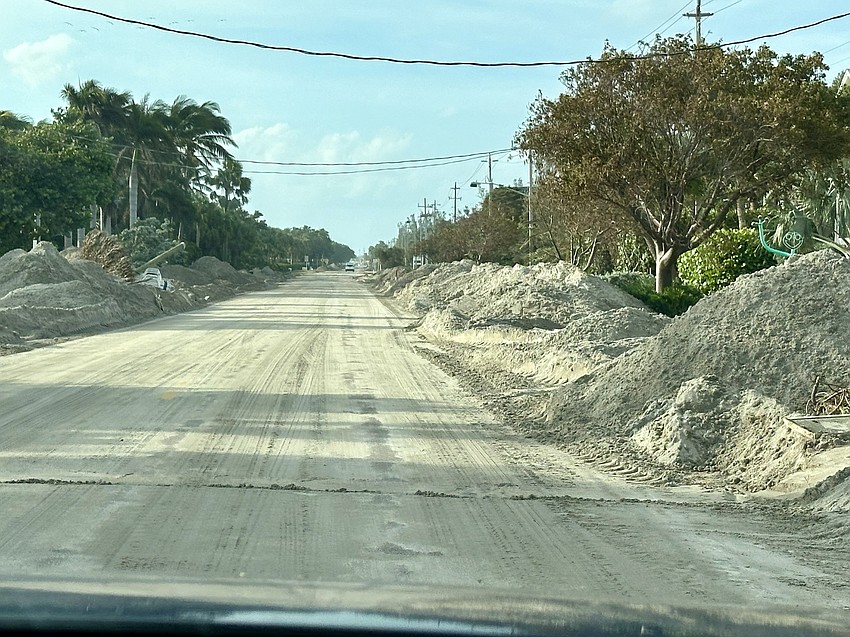
Public Works employees repaired lift stations and cleared drainpipes. Damage assessments were meticulously documented island-wide.
Cleanup was a big push financially, too. The town spent $5.6 million on debris removal, according to its claim with FEMA.
“We did three or four budget amendments to pay for all the work that was done,” Finance Director Susan Smith said.
But, while town employees could make a dent in the cleanup, outside help was also needed. Tipton said the town has the equipment to push the debris off the roadway, but not to load it into trucks to be hauled off-island.
Disaster cleanup reimbursements roughly follow the same formula. The federal government fronts 75% of the costs, the state 12.5% and the county or local government pays the rest out of pocket. FEMA is required by the Stafford Act to reimburse eligible localities at least 75% of storm-related cleanup costs, but FEMA’s share can increase to 90% or 100% for certain costs immediately following a storm.
FEMA does not pay for storm repairs, though, since they’re in the reimbursement business. The town initially pays landscapers and contractors to remove debris. Town staff is paid overtime, which is also eligible for reimbursement.
The town has received FEMA reimbursement for eight out of 26 eligible projects for a total of $316,319.12, mostly for overtime costs to town employees. The town, however, is still waiting on $29.7 million.
Of the $29.7 million the town hopes to receive from FEMA, a large chunk isn’t for damage to infrastructure or overtime costs, but for its main attraction: The shoreline. Longboat's 10-plus miles of beach lost more than 600,000 cubic yards of sand, according to estimates from the town’s public works department and environmental consultants.
The town’s claim with FEMA is for 400,000 cubic yards of sand at a cost of $12.2 million. It’s not the first thing one may think of when they think of storm damage, but the destruction of dunes and degradation of sand on the beach leaves the community vulnerable to future storms.
FEMA sees replenishing the shoreline as a worthy defensive investment — but only if the beach is maintained.
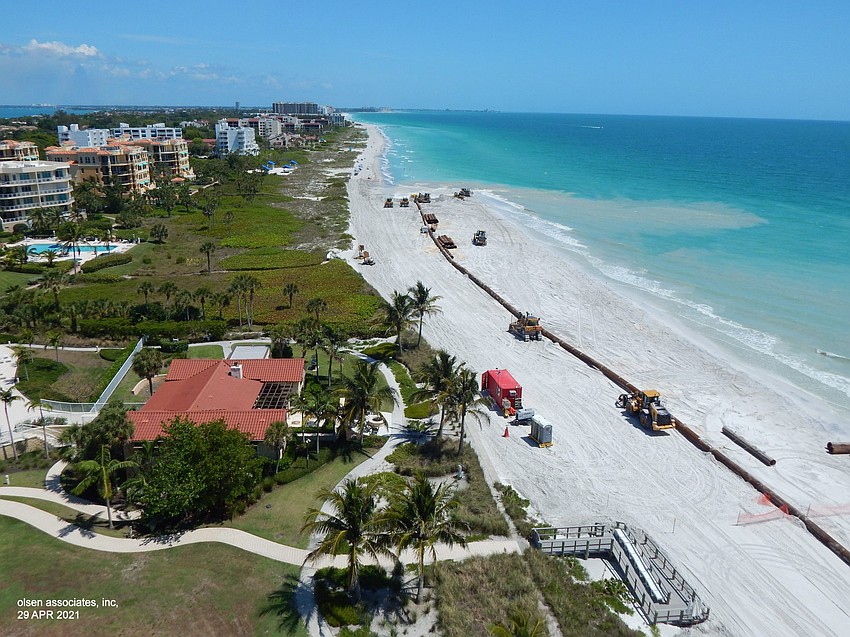
Longboat Key’s seven-year recurring beach renourishment schedule makes it eligible to receive FEMA money for a future project to restore hurricane-caused erosion. The next round, an 800,000 cubic yard project, is scheduled to begin in 2028. Public Works Director Charlie Mopps wrote in an email the town had a productive meeting with FEMA in mid-July.
“The Beach FEMA folks should be approving our beach ask and sending it to the next level of approval by now,” Mopps wrote.
Tipton said dealing with FEMA has its challenges and frustrations. You have to follow their process, and be incredibly meticulous about documentation, he said.
“One of the challenges that we have is that your FEMA representatives will change 10 times between the time the storm hits and the time you actually get reimbursement," Tipton said. "So you have to retell this story of everything that you did to a completely different person who for some reason has no notes on any previous conversations, so it’s just like starting over again.”
Tipton also expressed concern over FEMA shutdowns and uncertainty around whether future weather impacts will be declared emergencies, a necessary step to unlock federal funding.
Frustrations about delays aren’t localized to Longboat Key. In Washington, D.C., this month, the House Committee on Transportation & Infrastructure held a hearing to discuss potential FEMA reform. Acting FEMA Administrator David Richardson shared with lawmakers a vision of FEMA where “disaster response and recovery are locally led and State-managed, with Federal support available when needed.” He said doing so will decrease processes that create delays and backlogs in FEMA and lead to quicker FEMA claim turnaround.
Again, the wheels of government turn slowly. Adam Cross, a lobbyist for Longboat Key with Potomac Partners, updated Town Commissioner BJ Bishop on the latest from Capitol Hill.
He doesn't expect FEMA reform this session.
“But it is good news that there is bipartisan agreement that the difficulties the town has been experiencing originate at the federal level and therefore need to be resolved soon," Cross wrote.
The town’s reserves are looking better than they did in late 2024 when the emergency fund balance dropped to $477,000.
The town’s goal is to have 120 to 180 days of operating expenses in its total fund balances. Right now, the town has about $11 million spread across three fund balance categories. That’s 163 days of operating expenses.
“The daily rate is the entire operating budget divided by 365 days,” Smith said. “It’s about $67,000 a day to operate.”
After the 2024 hurricane season, the $750,000 that sat in the “Future Capital” bucket was emptied, which it remains.
The “extreme events/natural disasters” fund is back up to $2.4 million. If the property tax millage increase from 1.960 to 1.999 is approved by the Town Commission, that would pave the way for a $529,252 boost to the emergency fund. That would bring the fund to $2.9 million, or 43 days of operating expenses.
Reserves are used for emergencies, but also can be drawn down to pay for big projects. At the moment, that’s not an option.
“The streets in Sleepy Lagoon and the Village and Buttonwood, we don’t have the cashflow to manage those projects,” Tipton said.
If acting FEMA Administrator Richardson’s vision for the future of FEMA, where the organization is a port of last call, comes to be, fund balances could be even more important moving forward.
However, rebuilding those reserves will be a tall task if voters approve of Amendment 3 in November.
“Going back in history, there was a time when the federal government really didn’t cover a lot of this stuff,” Tipton said. “We could go back to those days, but we’re not geared for it today. And that’s why the property tax discussion is such a concern for local governments across the state because we all count on reserves to front end these recovery efforts. If our primary revenue source is taken away from us, I don’t know how we keep those reserves in place.”