
- July 22, 2026

-
-
Loading
Loading
Is photography an art form? It’s a question that has consumed practitioners and patrons ever since the medium was introduced in France in the early 19th century. The controversy heated up when George Eastman introduced the Kodak No. 1 box camera in 1888 with the slogan, “You press the button, we do the rest.”
If anyone could take a decent photo and receive prints after mailing their film to Eastman Kodak, then anyone could call themselves a photographer. That wasn’t true of other art forms like painting or sculpture, which required talent and training.
To distinguish themselves from mere artisans and amateurs, a group of photographers led by Alfred Steiglitz formed the Photo-Secession movement in 1902. Members of the movement, which included Edward Steichen, Clarence H. White and Gertrude Kasebier, stressed the subjective vision of the photographer over documentation.
They used a variety of printing methods to achieve a painterly effect in their photos, a trend that was called “Pictorialism.” Through the quarterly magazine Camera Work, Steiglitz reproduced Photo-Secessionists’ work through photogravures, a process by which photos were transferred to a metal plate for printing.
Through their galleries at 291 Fifth Ave. in New York City, Photo-Secessionists helped introduce European abstract artists such as Pablo Picasso, Francis Picabia and Constantin Brancusi to American audiences. Later, the gallery would embrace avant-garde American painters such as Georgia O’Keeffe, who married Steiglitz in 1924.
At 291, as the gallery came to be known, photography shared space with sculpture and painting. No photo albums for these artists.
The early days of photography were a heady time. They have captured the imagination of Christopher Jones, the Stanton B. and Nancy W. Kaplan Curator of Photography and Media Arts at The Ringling.
Jones has curated an exhibition of early photography called “The Evocative Lens: Pictorialism and the Rise of Fine Art Photography” using images from the museum’s permanent collection.
During a recent tour, Jones explained that when he first arrived at The Ringling in 2012, he was drawn to the early art photographs in the museum’s permanent collection.
“It was something I kept kind of going back to over the years,” Jones says. “Then I finally realized recently that through the gifts that we’ve gotten over the past decade or so that we have some really great examples of Pictorialism and that we could tell an interesting story about this pivotal time and the history of art and photography.”
The works in “Evocative Lens” capture what Jones terms “an origin moment when everything was kind of wide open.” The show attempts to capture the “arguments people made, the choices they made, how they presented photography as art.”
Jones notes that Steiglitz had the financial wherewithal to spearhead the Photo-Secession movement because he “was essentially a trust-funder.” He ultimately parted ways with his colleague White, who began teaching photography at what was then known as Columbia Teachers College and accepting advertising assignments that used his photos. White committed the cardinal sin of pursuing commerce.
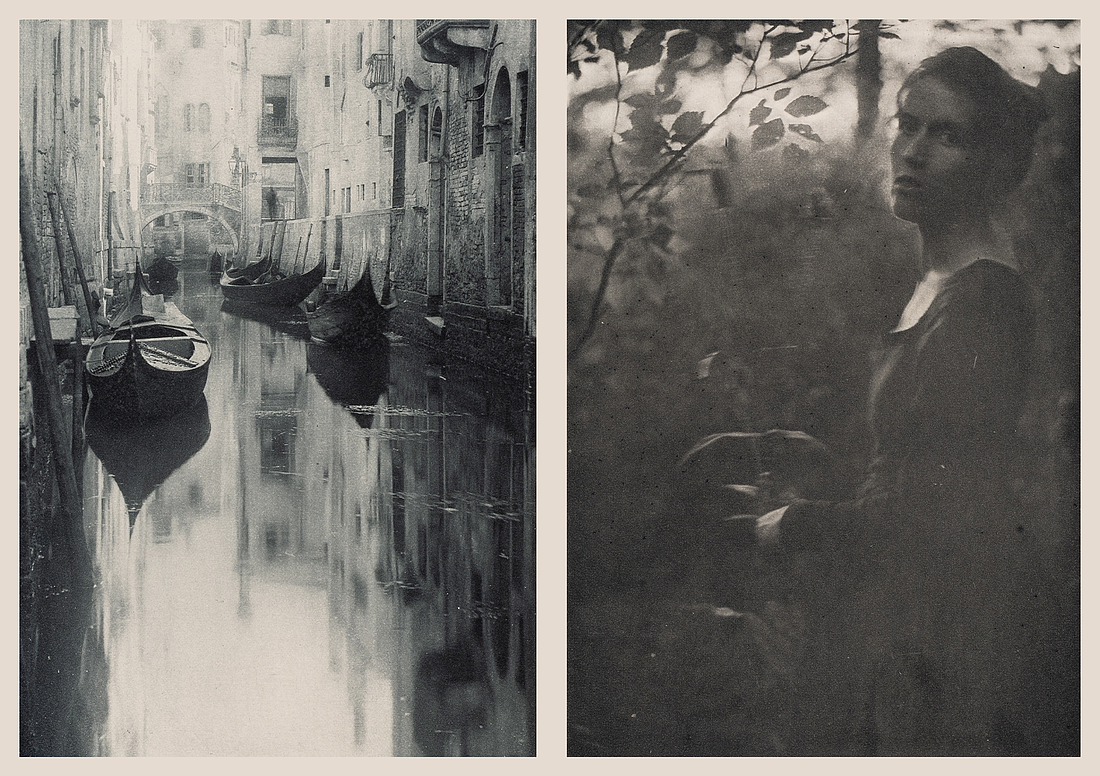
One of the most enchanting photos in “Evocative Lens” is White’s photo of his sister-in-law looking wistfully into the camera at dusk. Titled “Edge of Woods-Evening,” the photogravure print was a gift of Warren J. and Margot Coville to The Ringling in 2013.
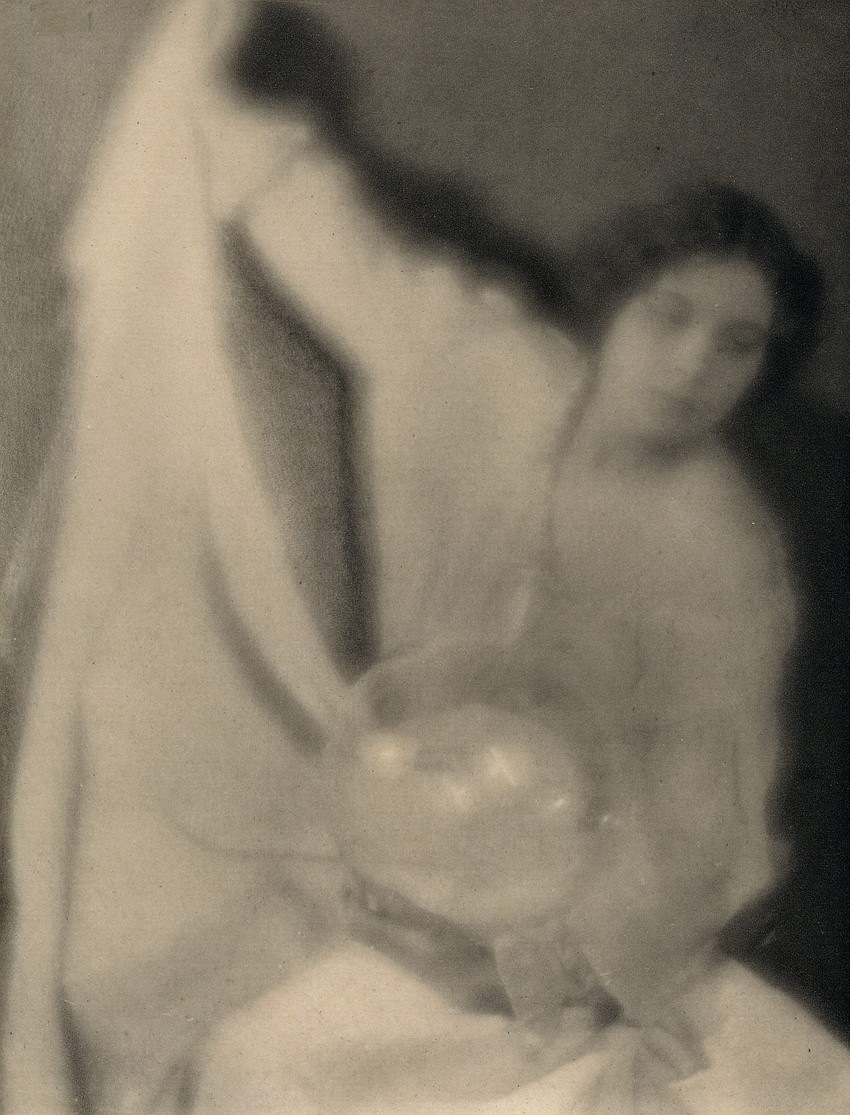
Before Steiglitz and White went their separate ways over creative differences, they experimented together with different types of lighting and printing to achieve gauzy and ghostly effects. One bold example of this collaboration is aptly called “Experiment 28.”
A gift from the Richard & Ellen Sandor Family Collection, it shows a woman in a white with a glass sphere in her lap who is sweeping her dress up into the air with her right hand. A gypsy reacting to a ghostly vision in a crystal ball? Perhaps. In any event, the blurred effect in “Experiment 28” is ethereal and other-worldly.
Perhaps because there were no requirements to become a photographer other than learning how to operate the camera, women were at the forefront of Pictorialism. In addition to the work of Kasebier (1852-1934), “Evocative Lens” includes photos by pioneering female photographers Anne Brigman (1869-1950) and Eva Watson-Schutze (1867-1935).
The Ringling exhibit underscores how women were able to capture vulnerability in their subjects in a way that typically wouldn’t have been possible with a man behind the camera. Given the formal social relations at the time, women and children wouldn’t be inclined to relax or be playful with an imposing male photographer whose gender automatically conferred authority. The male gaze was powerful long before it was named.
We can’t show you Watson’s-Schutze’s 1904 platinum print, “Nude Woman on a Rock, 1904,” in these pages, but you can see the 2020 gift of Warren J. and Margot Coville in the Ulla R. and Arthur F. Searing Wing at The Ringling. It's hard to imagine it being taken by a man because of the naturalism of the photo.
Members of the Photo-Secession movement were influenced by the work and philosophy of James McNeill Whistler, who died a year after Steiglitz formed his group. Best known for the painting of his mother formally known as “Arrangement in Grey and Black No. 1: Portrait of the Painter’s Mother,” Whistler’s etchings and his philosophy of “art for art’s sake” left a big impression on the proponents of photography as an art form.
“A common theme throughout Pictorialist work is this emphasis on atmosphere, mood and shadow. A lot of them were inspired by the Aesthetic movement at the end of the 19th century, including the etching revival,” Jones says.
“The early art photographers were trying to emulate the graphic arts, painting and watercolors as much as they could,” he says.
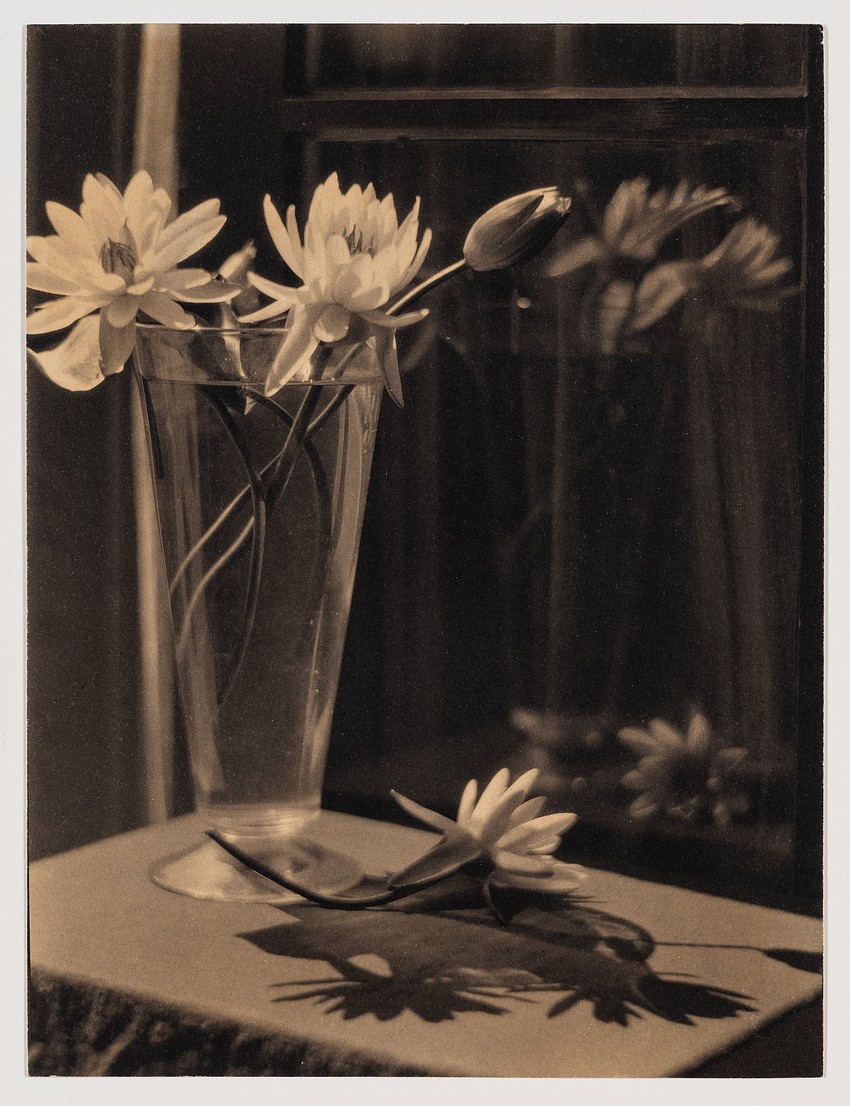
In a world where technology has made uniformity widespread, it’s a revelation to see the different shades of sepia and grey in the black-and-white photographs on display at The Ringling. To an eye accustomed to sharp images captured by digital photography, the prints appear fuzzy or even out of focus. But these dream-like effects were intentional.
The evolution of the Pictorialists’ work is particularly evident in the work of Steiglitz, who lived to be 82. Among his landmark photos in The Ringling exhibition is “The Steerage,” which he took in 1907 of the ship Kaiser Wilhelm II, on which he sailed to Europe.
Although the scene capturing the class differences between passengers on the upper deck and those on the lower deck as they disembark has been hailed as an image of the quintessential immigrant journey to America, the ship was actually going the other way when Steiglitz took his now-famous picture.
But here’s the thing about Pictorialism. When the photograph is art, it is as subjective to the viewer as it is to the creator. In other words, reality doesn't matter.