
- July 20, 2026

-
-
Loading
Loading

When two friends from work retire, they sometimes get together for coffee or a show. The more energetic might play pickleball or do volunteer work together. But Linda McKee, former head librarian at The Ringling, and Deborah W. Walk, retired Tibbals Curator of the Circus, write books.
Their latest book, “Ringling, Böhler, Thyssen and the ‘Greta Garbo Vermeer,’” investigates the provenance of a painting once attributed to Johannes Vermeer. It’s more likely to have been painted by Han van Meegeren, a forger who lived more than two centuries after the great Dutch master.
McKee and Walk haven’t determined who painted “The Girl with the Blue Hat,” as it’s more formally known, but that’s not their goal. They want to tell a good yarn. They’ve succeeded beyond their wildest dreams, but not without some help from a twist of fate.
In the introduction to their book, McKee and Walk state that it is not their “intention to attribute the work to any artist but to consider its place within a group of other earlier known similar forgeries, many purchased by important collectors.”
They describe their book as “a case study of the life of a singular painting ... and its place in the twentieth-century revival of Vermeer.”
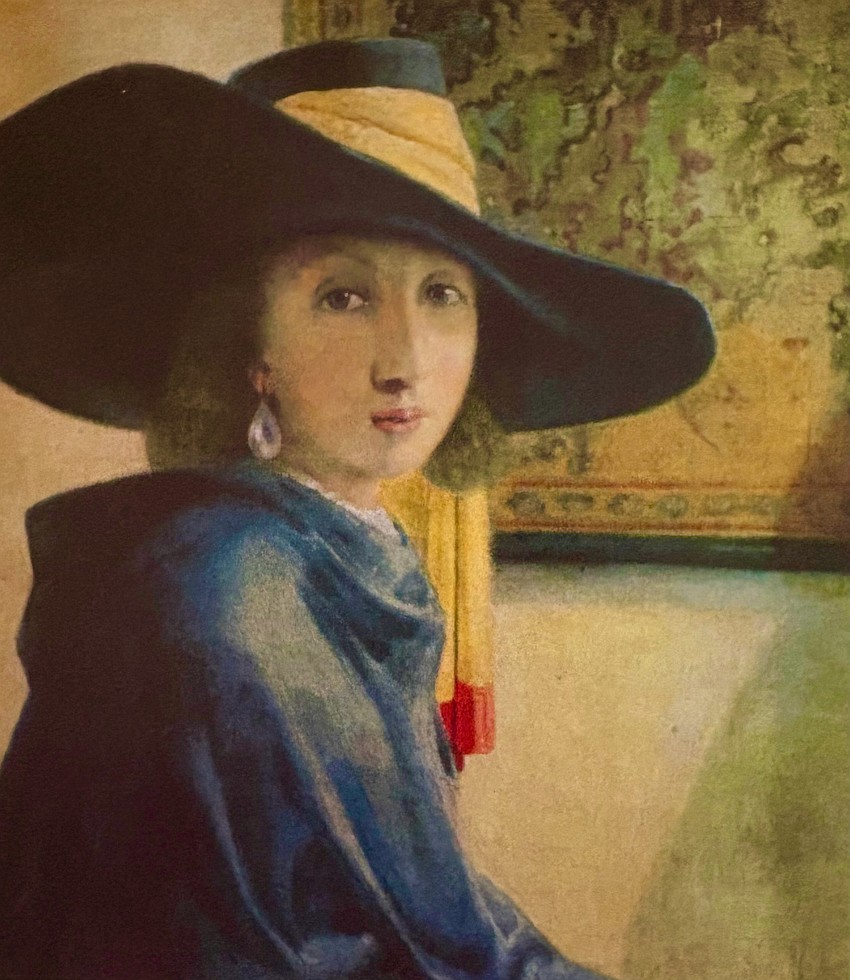
In the course of their research, McKee and Walk have unearthed the continued existence of a painting once owned by circus magnate John Ringling and an art dealer. Over the years, the painting came to be known as the “Greta Garbo Vermeer” because its subject bears a striking resemblance to the legendary Swedish-American actress.
As anyone who has read “Alice’s Adventures in Wonderland” knows, the proverbial rabbit hole is often irresistible, especially to scholars and amateur detectives with an insatiable curiosity. The art world is filled with these types. The internet, with its YouTube videos, feeds their enthusiasm.
Just the way the tulips of 17th-century Amsterdam fueled a mania, the artist Vermeer, who lived from 1632-75, in recent years has spawned a frenzy of must-see exhibitions, books and films, including “The Girl with the Pearl Earring.” Frida Kahlo may be this year’s It Girl (again!), but Vermeer never goes out of fashion.
McKee and Walk began their journey down the Vermeer rabbit hole back in 1995. That’s when The Ringling received a box of German documents detailing the commercial activities of art dealer Julius Wilhelm Böhler.
Ringling used Böhler and other foreign dealers to help him acquire the European masterpieces that he ultimately bequeathed to the people of Florida.
The trove, which had been discovered in the Böhler family home, was forwarded to The Ringling by the art dealer’s nephew, Florian Eitle-Böhler.
The receipts, letters and other records were in German, a language that McKee knows. After translating them, she learned that John Ringling, the founder of the art museum that bears his name, once co-owned with the Cassirer Gallery of Amsterdam a missing portrait called “The Girl with the Blue Hat.”
The documents delivered to The Ringling showed that an entity referred to as “Sarasota” in receipts jointly sold a painting by "Vermeer" to German industrialist Baron Heinrich Thyssen-Bornemisza for about $132,000 in 1930.
Böhler’s index card indicated that the painting, which was not part of the collection that John Ringling bequeathed to his eponymous museum established in 1927, was owned half by “Sarasota” and half by Cassirer.
This was big news in the art world, where interest in well-done forgeries of Vermeer generate almost as much excitement as the originals.
The revelation that John Ringling once owned the “Greta Garbo Vermeer” and the record of its 1930 sale was enough to prompt McKee and Walk to write a scholarly book that was years in the making. But the best (or worst, depending on how you look at it), was yet to come.
Shortly after the co-authors finished their book and put it up for sale on Amazon, they were contacted in 2025 by Claudia Clark, an art historian based in Switzerland. Further communication revealed that one of Clark’s clients had “The Girl with the Blue Hat” in their possession.
For nearly a century, no one knew whether the painting still existed.
It was known that the Thyssens moved their art out of Germany to Switzerland during World War II, but then the trail of the “Greta Garbo Vermeer” goes cold. “After 1950, any mention of the painting stopped. It seemed to disappear,” says Walker.
Stop the press! But it was too late for that. The book was already on the market. In light of the news, McKee and Walk took took their book off Amazon’s website and rewrote it. That’s what you do when you’ve dedicated your career to scholarship about circus magnate-turned-art-collector John Ringling.
As with most breakthroughs, the unearthing of “The Greta Garbo Vermeer” raises many questions. First and foremost: Who has the painting? “Dr. Clark wouldn’t reveal who owns the painting,” says McKee. “She let us know that it’s in existence.”
Over coffee, McKee and Walk imagined the possibility of bringing the “Greta Garbo Vermeer” to The Ringling for an exhibition. But while the retirees could help open doors, it’s up to the museum’s current team to fulfill that dream, they note.
In the meantime, McKee and Walk are working on their next book. We weren’t surprised to learn that the authors are keeping the topic under wraps. Those rabbit holes can get pretty crowded sometimes.