- July 9, 2026

-
-
Loading
Loading
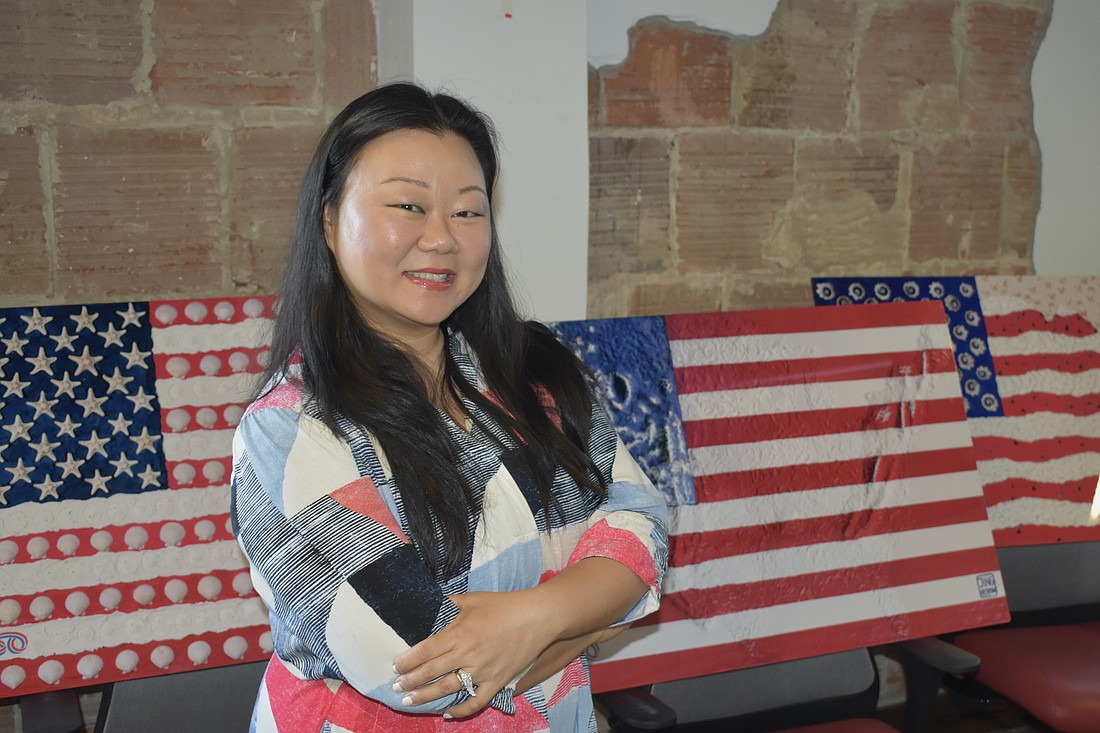
Growing up in Beijing during the 1980s, there were certain words Jing Herman says she heard often.
“In China they love to talk about the U.S. more than any other topic," she said. "You have over a billion people just repeating beautiful country, beautiful country, beautiful country."
Herman, who turned 44 on July 3, didn't have a lot of time to spend exploring nature growing up in Texas, or later while living in New York. Later on though, she started exploring nature with her kids during the COVID-19 pandemic. The shells she collected became one of the inspirations for her painting "Starfish Spangled Banner."
Now, with 10 flag paintings behind her over the course of a year, the Sarasota artist is on a journey with a goal of creating 50, each highlighting a different aspect of the country.
"My work is meant to be not political whatsoever, but to really just reveal the beauty of the land, reveal the common ground that we stand on, and a lot of people have said that looking at my American flag paintings, it gives them 'a surprising sense of hope,' and a lot of people have said that it makes them feel more optimistic about America," Herman says.
So far, others have taken notice; after she applied to America250, the bipartisan initiative celebrating the country's 250th anniversary which was signed into law by President Barack Obama in 2016, she became an official artist on the America250 store, which currently carries three prints of her work and one original.
Herman took a long journey towards becoming an artist. When she was young, she was skilled in Chinese watercolor painting and loved looking at art supplies, although her family could hardly afford them.
“In the 90s, the term starving artist, I think that was still common, and that's just a general concept that you just can't make a living being an artist," she said. "I think that was what was culturally well-known at the time. I think perhaps it’s not the case anymore.”
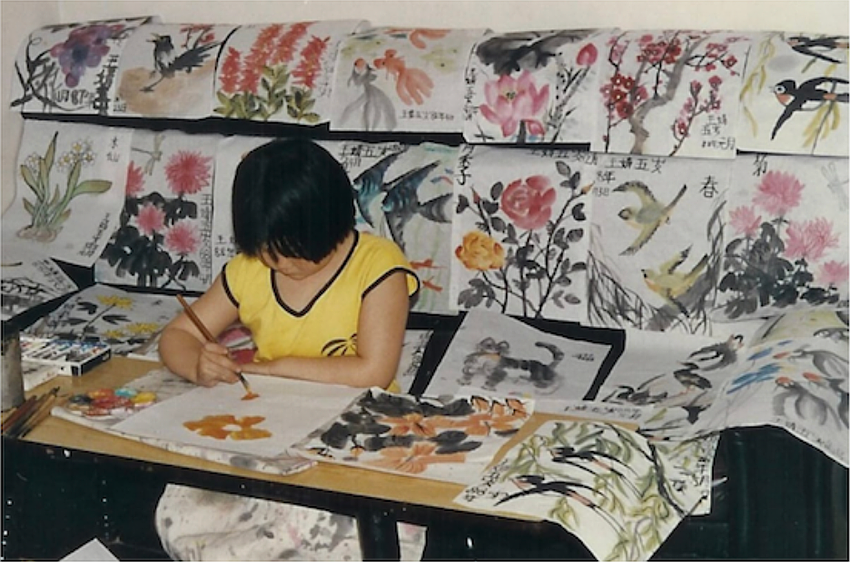
Her family came to the United States when she was 10 after her father, a mathematician, received a full scholarship to the University of Texas at Austin to pursue a master’s degree. He later attended a Ph.D. program in Dallas.
Her father was busy in the program while her mother was busy working at a Chinese restaurant throughout the day.
At the time, Herman had to look up every word in her homework, and teachers called her parents in for a conference, thinking she was unable to speak. However, math was easy for her, multiple grades below the level she had been learning at in the highly competitive environment of China.
Herman majored in marketing because of her love of art and design, but after an internship at Bloomberg News that involved a group that was entirely women, she decided the field wasn't challenging enough.
In Chinese, there is a concept called chī kǔ, which translates to “eat bitterness,” or to endure hardship without complaint, something she says she inherited from her parents, who lived through China's Cultural Revolution.
“I’ve always felt like I should do the hardest thing, and when I was 22 the hardest thing was investment banking,” she said. “I loved the boot camp environment. Actually, all my jobs, I think, was in a male-dominated environment. When I was little, my mom always said, if a boy can do it, you can do it better. You can be smarter than the boys.”
Herman attended the NYU Stern School of Business before she was hired by Bear Stearns, becoming a top-bucket analyst. She worked 80 to 100 hours a week, sometimes sleeping at the office under her desk with a pillow. Most of her social life revolved around her coworkers.
She later worked as a vice president at JPMorgan Chase and later became the U.S. CEO of Gett, a leading ground transportation management platform used by over a quarter of Fortune 500 companies, launching and leading the company's operations in New York City.
During the pandemic, Herman co-founded 28Muses, leading calligraphy workshops for major corporations such as Amazon and Google. It was around that time, with her attempt to inspire creativity in others through the company, that she began a journey back to the art world.
After her oldest daughter said she wanted to be an artist when she grew up, Herman says she returned to the anxiety she felt about the field when she was young, and she set out to prove there was a path for her daughter.
Herman says that over the course of our lives, the American flag has been a largely static symbol, but that wasn't the case in the 19th century, when it changed many times as new states were admitted to the union.
She says it's important for people to be able to see themselves in the flag, to feel a connection to the symbol, but also to each other.
“I think when people see the overlap of their city or state, or their love, their environment reflected in an American flag, they see themselves in the flag,” she said.
Herman wanted to source all of her materials from the United States. Some of the items she used included organic cotton from Texas and wool yarn from sheep in the U.S. She has spent a lot of time at gem shows, a place where she says finding U.S. materials can be difficult, as most of the items are imported.
She embeds items into the surface using a non-toxic paste she developed, and emphasizes the use of non-toxic materials.
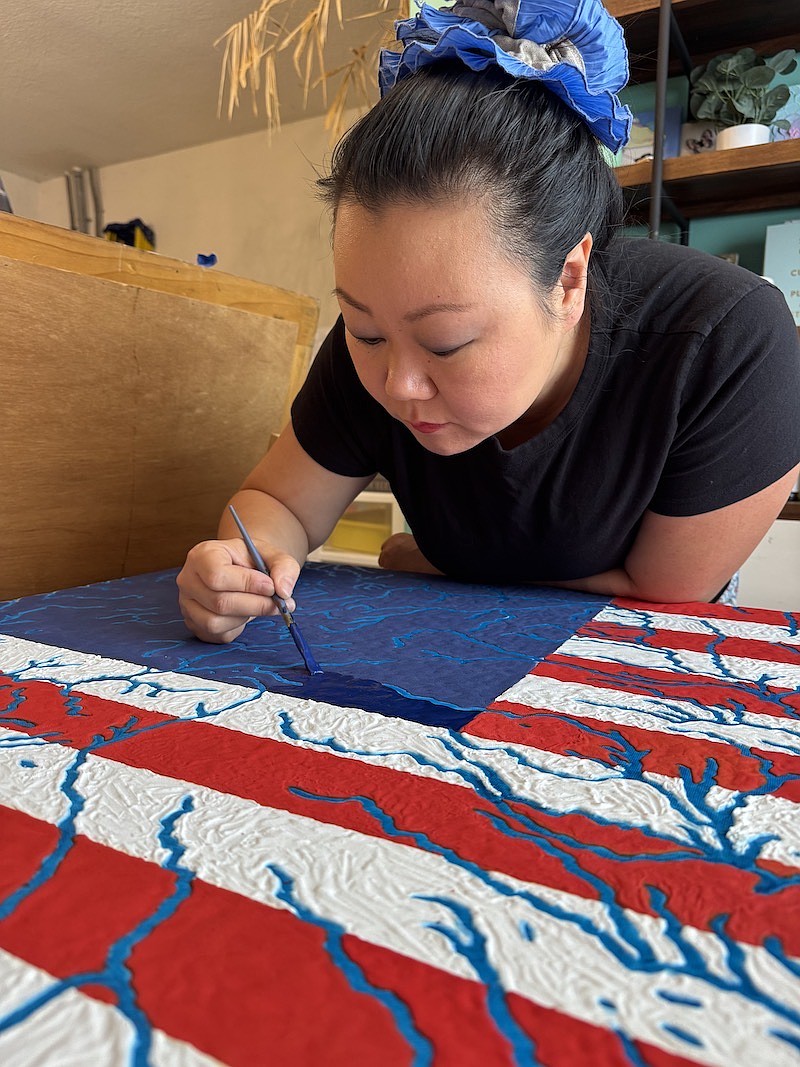
Herman's second painting, “Life, Liberty & the Pursuit of Happiness,” which spells the words of its title in pennies, was gifted to the White House Historical Association around the same time the penny was retired. It will soon be available through the White House Historical Association website.
That painting was followed by what she calls the "sister paintings."
Herman says when she meets someone from Chicago or the Great Lakes, they are drawn to her work "American Rivers," while someone who grew up in the mountains is drawn to "American Mountains."
“I think that a lot of our identity is actually based on the land itself,” she said. “We don't think of it that way, but all of our memories, like swimming in the water, going to the beach, or your summer camp, or having a cabin in the woods, so much of your shared memories is specific to the lands.”
Her latest painting, “Purple Mountain Majesty," focuses on Americans coming together, incorporating purple barnacles as the animals are filter feeders, removing toxins from the water.
“My hope is for America, is that we start to remove the toxin from social media," she said. "I think real humans talking, meeting each other; we are able to converse, we are able to have a conversation, and that's where it begins. So my hope is that systematically we can remove the toxins, so that people can just come together.”
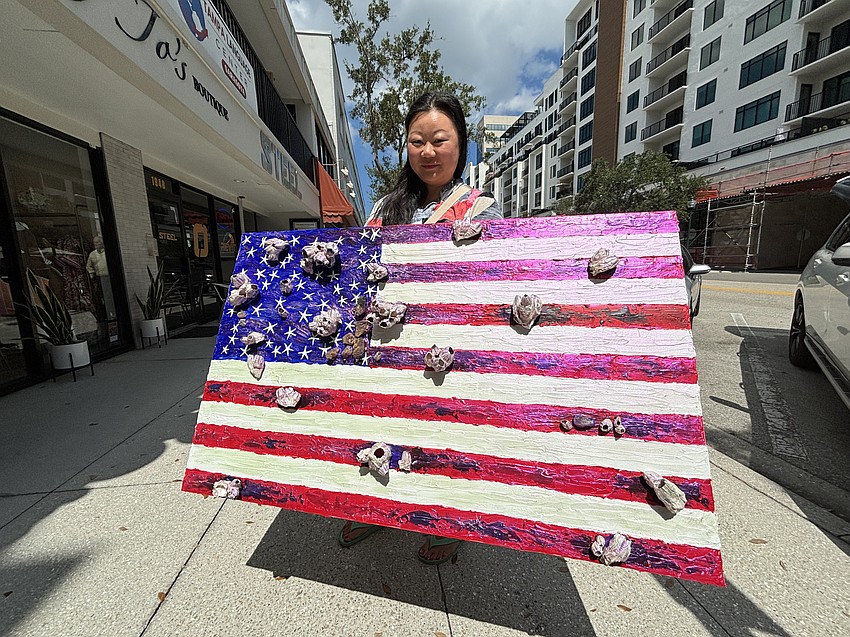
Herman says while the country may appear divided, she believes people have more in common than anything else. She says people naturally take for granted what is familiar to them, but she thinks that coming from outside the country has allowed her to have a different perspective on America.
“Being born an American citizen is the biggest privilege that you can have in the world, but I think if you're born American citizen, you might not realize that,” she said.
Herman says she is now living her American dream. She continues to work on her flags, which she can complete at a rate of about one per month, amid homeschooling her kids. Herman says it's good for artists to be "obsessed" with something.
Like Jasper Johns, who created 40 flags in the 20th century, she hopes to produce a large volume of work.
“Most people say quality matters more than quantity," she said. "Quality, of course, matters, but once you have quality, I think quantity, doing it in volume, doing a lot of the work, whatever work that you're doing, I think actually makes it more impactful as well.”