- March 18, 2026

-
-
Loading
Loading
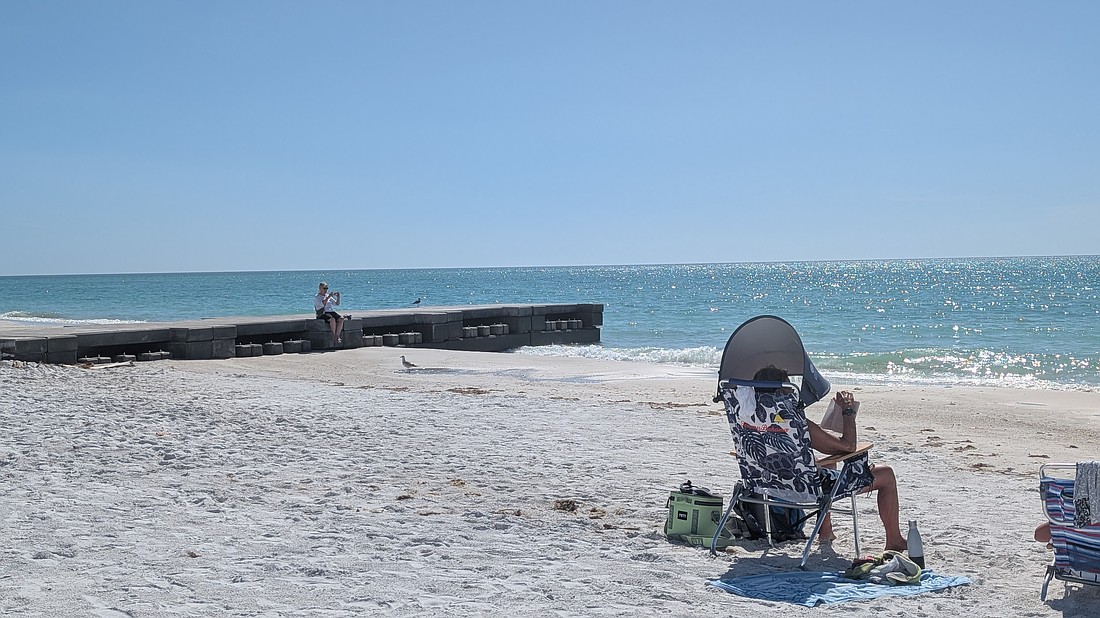
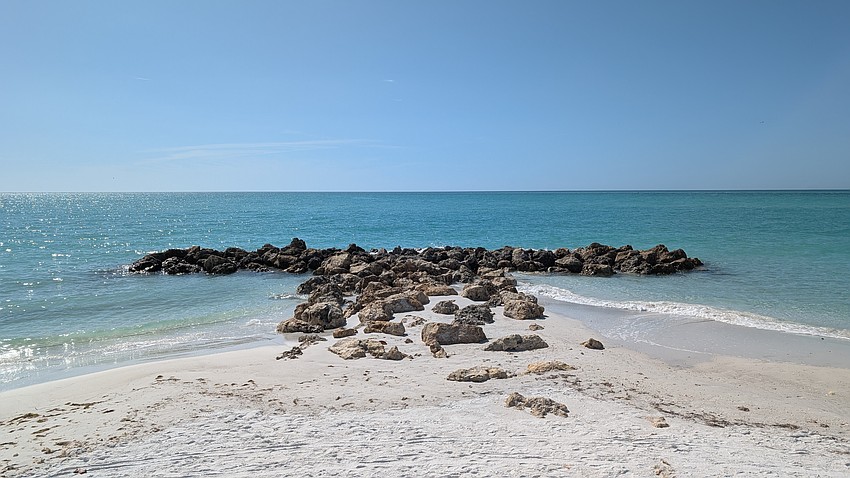
Jagged, giant rocks are stacked atop one another on the north end of Longboat Key. The gathering of boulders juts about 15 feet into the Gulf before extending parallel to the shoreline to create the shape of a capital letter T.
That’s a beach groin, one of the few tools the town of Longboat Key has that can protect the shoreline from constant erosion.
Groins come in different varieties and are made of different materials.
There are concrete groins, rock groins, timber groins. They can be permeable, semi-permeable or solid. But no matter the variety, the end goal is the same: reducing longshore erosion.
Reducing the amount of sand that washes out to sea is important because erosion can damage property and reduce recreational beach space. The town recognizes that importance and spends big to combat erosion. Maintaining Longboat Key’s beaches are the biggest expense of the town. In 2028, $32.9 million is planned to be spent on a massive beach renourishment. In that project, 800,000 cubic yards of sand will be placed on the beach.
On some parts of the beach, more sand needs to be placed than in other areas. When Mopps and the town’s Coastal Engineering Consultant Al Browder see problem areas like that, groins are considered as ways to combat that heavier than normal erosion.
In 2021, three T-shaped permeable rock groins were added to the north of two existing concrete permeable adjustable groins (installed in 2015), and two more groins were constructed to the south. That completed the north-end beach groin field.
“If you include the PAGs (installed in 2015), the entire groin field is now seven groins,” Mopps said.
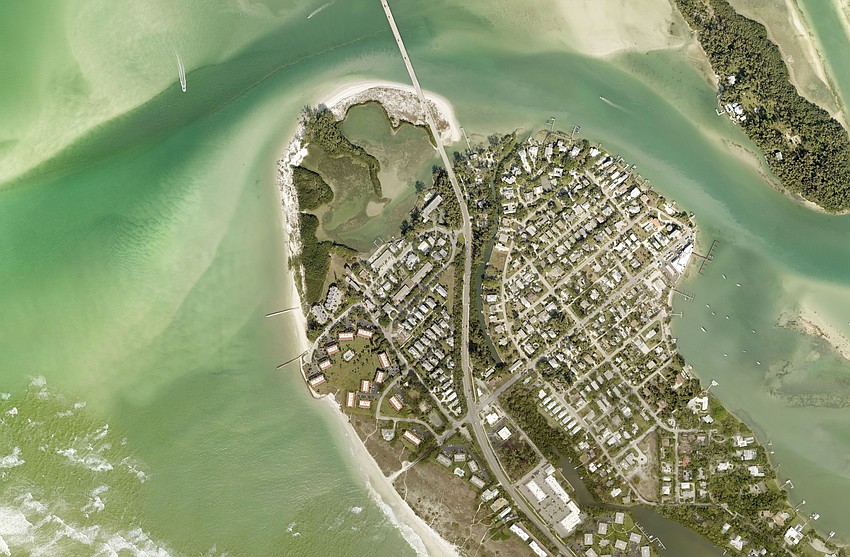
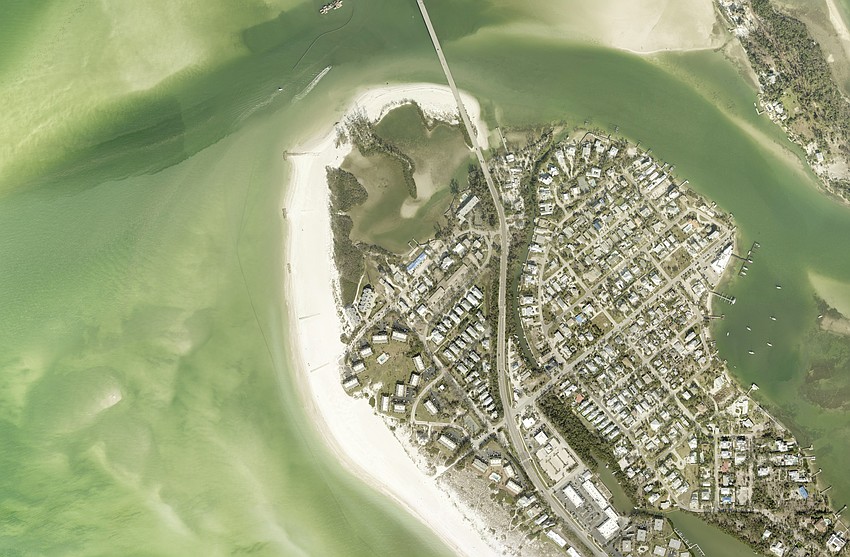
How that seven-groin system has impacted erosion is something that’s been monitored by the town and its consultants since.
“After we put in those groins, we’ve been doing physical monitoring,” Mopps said. “Even after major hurricanes, all the way until now it still looks amazing.”
The groins were deemed necessary after monitoring by the town and its coastal engineering consultants showed the beach thinning quicker than the rest of the island. The peninsula known as Greer Island (Beer Can Island) was nearly void of sand as seen by 2020 satellite imagery.
“It used to be historically the most erosional part of the island,” Mopps said, adding that the causes of the erosion were multiple. “It’s the seawall. It’s the fact you’re getting erosional influence from the Pass. It’s all of that.”
The project as a whole cost $36 million and included 1 million cubic yards of sand placed on the shore. That price tag was $3.6 million under budget.
The five T-headed rock groins constructed during the 2021 project cost about $12 million, according to cost estimates before the project got underway. The rock groins are made of more than 10,000 tons of armor stone placed upon 1,280 tons of mattress stones.
The two concrete groins installed in 2015 cost $2 million.
Although the groins are made of stone, their impacts aren’t set in it. Two of the seven groins can be adjusted. The permeable adjustable groins are made of two solid, concrete slabs with empty space between them. That empty space can be filled to change how much sand and water can travel through. To do so, smaller concrete blocks are bolted on between the two slabs.
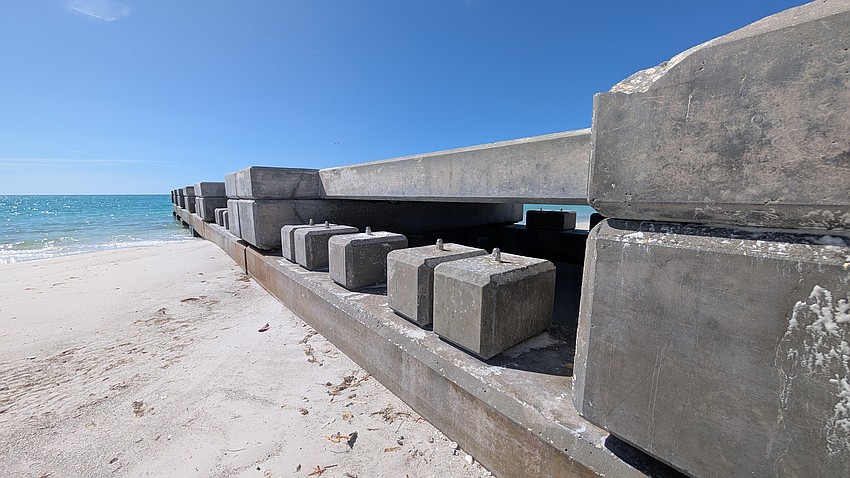
“They’re concrete blocks that bolt into the runners. You have legs coming up, you have runners going between the legs and you have a deck on top and there’s two layers of runners,” Mopps explained. “You can add blocks to the top and bottom of those to fill in the gaps.”
In the 2021 beach renourishment, groins were part of the beach renourishment. And in 2028, groins are also planned.
The seven permeable rock groins, if permitted, will reinforce what is now one of the most erosive areas of Longboat Key: Gulfside Road.
“Gulfside Road remains one of the real hard challenges for maintaining the beach width and upland shore protection here on the island,” Browder said.
Gulfside Road is just south of where the other groin field would be and starts at a famous Longboat Key landmark: the Ohana seawall. The groin field would end at a property that has garnered headlines more recently: the Half Moon House, named for its semi-circular seawall that once extended into the Gulf.
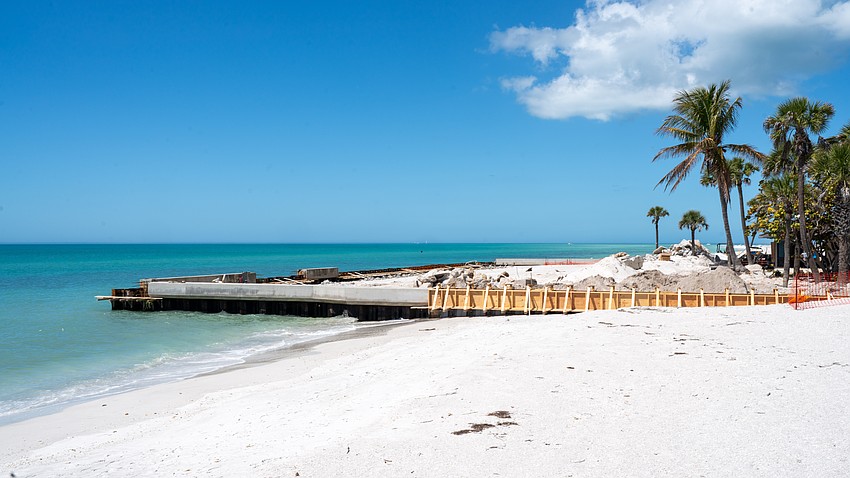
Mopps said that while the Ohana seawall does play a part in the high erosion rates of the Gulfside Road portion of the beach, it isn’t the only cause. The location of Gulfside Road and the homes that are on that road make the renourishment a necessary task.
“We have got to protect those houses,” Mopps said. “If you look at the topography of all the houses in this stretch, all the houses west of Gulfside Road, they were all built more seaward than any other house in this stretch. So if the Ohana seawall were there or not, it would still be an erosive problem. We would still have to correct it.”
Other factors that increase erosion are downshore effects from Longboat Pass and the hard bottom of the sea floor off of Gulfside Road.
Without the groins, the sand south of the Ohana seawall washes away at rates quicker than the rest of the shoreline. To protect property and recreation area in between major beach renourishments, the town has done interim renourishments just at Gulfside Road. More than 84,000 cubic yards of sand were placed during a project last year that cost $2.8 million.
“We got the grants from the state and we paid nothing, but those opportunities don’t come up,” Mopps said. “You can’t factor for those opportunities. You can’t assume you’ll get them.”
Doing those area-specific projects in between the island-wide renourishment projects isn’t good business. The economy of scale is very real for projects that involve sourcing and distributing sand in a well-regulated and environmentally protected area.
“We have shifted from a beach nourishment strategy, which has proven to be kind of a repetitive, expensive process unless the state helps us out, to a structural stabilization (strategy) following the model of what was done at the north end,” Browder said. “There are slightly different conditions here, but the general gameplan is the same.”
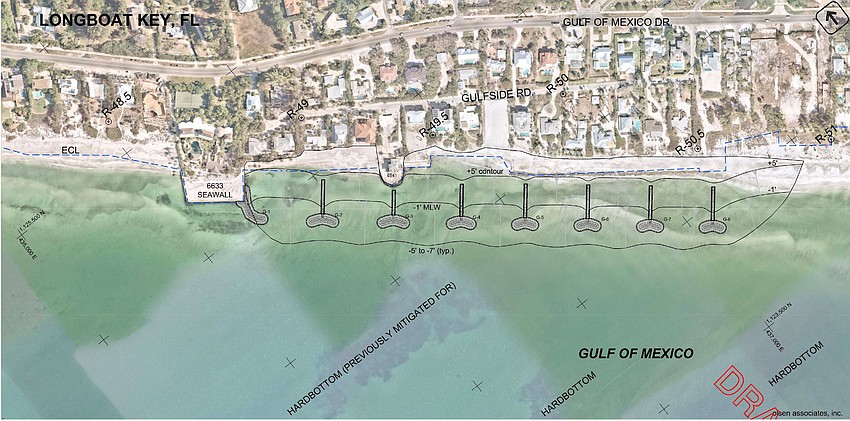
The groin field is being designed to reduce erosion to the point where renourishment is only necessary when the rest of the island is being renourished.
“(We want to) keep its renourishment interval on a manageable level, something around the order of seven to eight years instead of one to two years,” Browder said.
The seven groins could cost anywhere from $6 million to $10 million.
Whether the project can be permitted is an important question yet to be answered. Florida Department of Environmental Protection and Army Corps of Engineers would need to sign off on any groin project. The town is in the midst of that permitting process.
“Right now we’re doing modeling to show what are the impacts to the downdrift beaches,” Mopps said. “The state won’t permit structures if it’s going to have a negative impact to a neighboring beach.”