- July 15, 2026

-
-
Loading
Loading
A common refrain by those who don’t recycle is “it all just ends up in the landfill, anyway.”
That’s often true, but the journey of a plastic water bottle, for example, can be a lot more complicated than going from shelf to recycling bin to landfill. A bottle can live a whole new life as a different product, extending the material’s useful life from five minutes to 10 years or more. Your feet could be resting against a plastic bottle right now, or you could be wearing one.
Plastic bottles are made of polyurethane (or PET), a popular plastic with a wide range of uses.
According to the National Association of PET Container Resources, nearly 2 billion bounds worth of plastic bottles are collected each year in America for recycling.
In Sarasota and Manatee counties, PET is mixed with various other recyclable materials and placed into recycling bins that are pulled out to the curb next to the garbage bins. That’s the beginning of an elaborate operation to extend the life of “single-use” plastics, cardboard and other materials.
Recycling has changed since the widespread adoption of the practice that occurred alongside rising environmental awareness in the 1960s.
Now, Artificial-Intelligence-powered “optical sorters” are used to separate recyclables rather than leaving the sorting to consumers who would place recyclables into separate bins.
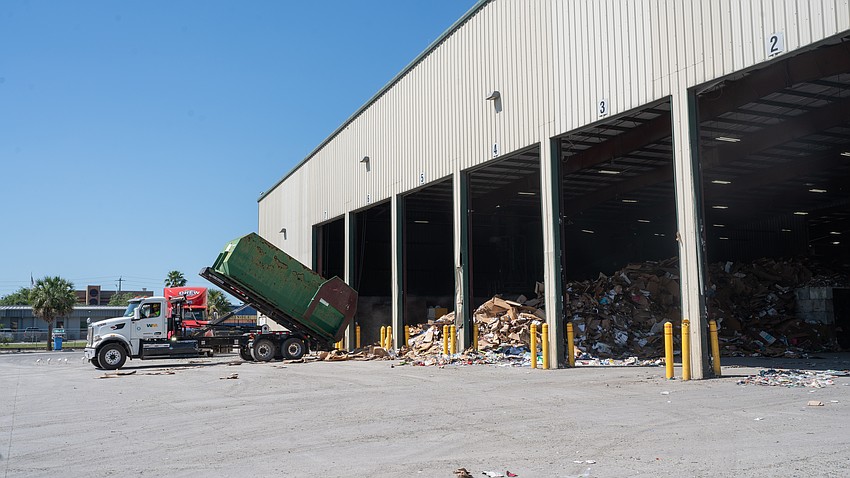
Locally, the company Circular Services is contracted to process and sell curbside recyclables picked up by both Sarasota and Manatee counties. Doing so diverts tons of recyclable materials away from local landfills, extending the lifespan of the facilities which are costly to cap and maintain once they are at capacity.
The elaborate separation of recyclables in Sarasota and Manatee starts at the tipping room floor of Circular Services’ materials recovery facility off Myrtle Street and North Orange Avenue in Sarasota.
Circular Services Operations Manager Andrea McCauley compares the facility to the Mouse Trap board game.
“There’s so many different levels and things it all has to go through,” McCauley said.
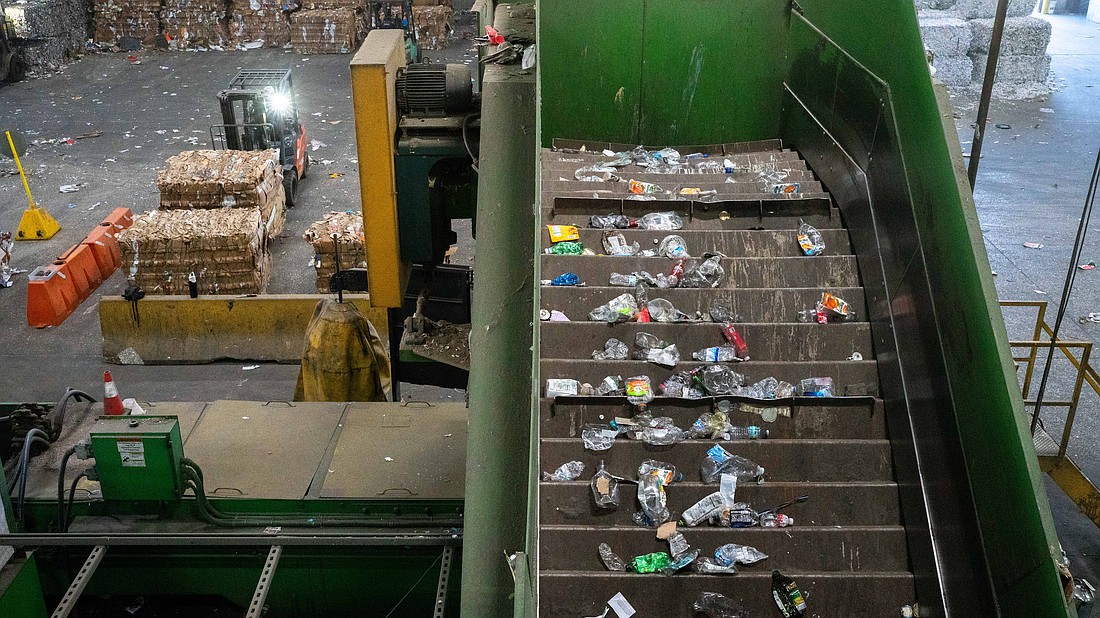
Truckloads of recyclables are dumped onto the facility floor that resembles a warehouse and then are pushed onto a conveyor belt. Workers (the facility has 70 employees) stand on the conveyor line looking for “contaminants” like plastic bags that could damage mechanical sorting equipment, batteries that can cause fires and other non-recyclables that make their way to the facility.
The conveyor belts travel quickly in places, which help to automatically separate materials, with heavier objects like HDPE being catapulted past a tube below where lighter products fall.
“Basically, we’re relying on force and gravity,” said Circular Services facility manager Chris Massey. “We’ve got spinning wheels that essentially move fiber one way and they let containers go another way, they let them drop down.”
There’s mechanical separation, separation by employees and then there are the optical sorters, which McCauley compares to a grocery store product scanner. The AI-equipped camera measures the heat signature of items and as they reach the end of the conveyor belt, a burst of air catapults them into a separate chute.
At the end of a day’s work at the MRF, Circular Services has converted the thousands of pounds of recyclables into bales of separated materials. The products are put out to bid and purchased by manufacturers.
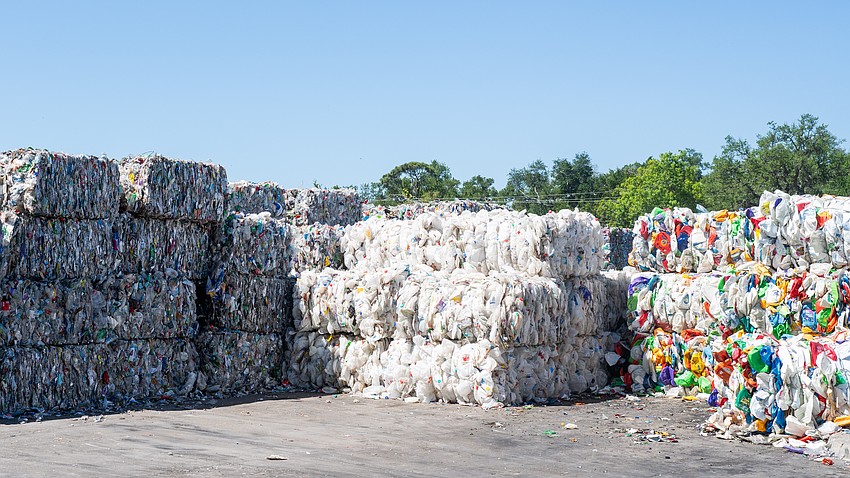
Circular Services would not disclose the companies who purchase PET or other materials, but McCauley said “we are business partners with all the main players” and that a vast majority of its product stays in America.
In northwest Georgia, Mohawk Industries could be considered a main player when comparing manufacturers that use recycled PET. The flooring manufacturer purchases around 6 billion plastic bottles per year, according to Mohawk’s Senior Director of Sustainability Jonathan North.
Once a truckload of PET bales arrives to Mohawk’s Summerville, Georgia manufacturing facility, the bottles are put through what is essentially an industrial sized tumble dryer. This breaks apart the bales back to individual bottles. Any remaining non-PET contaminants are removed in another round of decontamination. That process is a financial lift for the company, North said.
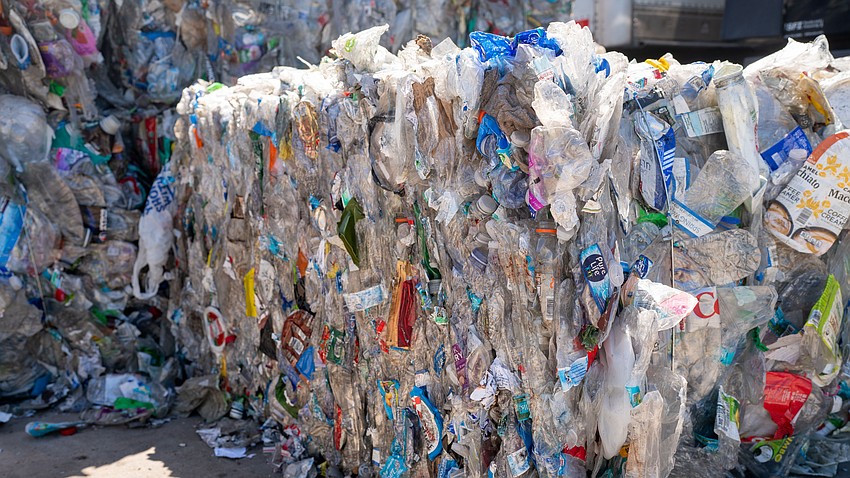
“We’ve invested a tremendous amount of money in that facility in equipment to sort and separate, to remove any contamination, to wash those materials, to flake them, to do all the sorting and separating to get to the purity of material that we need,” North said. “That is a very capitally intensive business.”
After processing, the bottles are chopped up, melted down and formed into pellets, which are then melted down and spun into carpet fibers for residential uses.
“The bit that you as a consumer interact with, the bit you sit and stand on, is primarily PET fiber,” North said. “And then we use a little bit of it in certain commercial applications as the cushion on the back of those commercial flooring products.”
According to Mohawk, it takes about 63 plastic bottles to produce one square yard of carpeting.
Mohawk makes a wide range of flooring products with different materials. Nylon is the typical product used in commercial applications because it’s more durable than PET. The company also purchases “virgin PET,” produced using oil, which has a volatile price.
“The price of recycled PET and the price of virgin material is volatile, and those numbers change on a weekly basis,” North said. “We’ve been very steadfast in our commitment to and our use of recycled content.”
The flooring company is also looking at how to expand its environmentally conscience efforts by researching ways to extend the life of the product they sell, explains Mohawk Sustainability Manager Preston Poag. The idea is to collect carpet the company has produced years after it has been installed to reuse it once more, extending the life of the carpet that was produced using a plastic bottle even further.
“What we’re working to do is eventually close the loop,” Poag said. “Eventually we’re looking at how can we bring material at end of life, bring it back to our manufacturing facilities, process material and make new material out of it.”
Doing so is a large ask, and the process isn’t feasible yet.
“We’ve got to shred it and apply technologies to extract, ideally, the nylon and the PET and all the components that have gone into making the carpet so that we can extract as much value for that material and feed it back into the process again,” North said. “That is an emerging area. It’s an emerging opportunity, and one that we are intensifying our efforts in.”