- March 10, 2026

-
-
Loading
Loading
Caliente is a fuzzy-headed, gray kitten that was adopted from the Humane Society at Lakewood Ranch last weekend.
When the 2-month-old kitten first arrived at the shelter, he was with his litter of five. Caliente and his siblings were too young and too sick to be put up for adoption.
The litter was covered in fleas and diagnosed with giardia (an intestinal infection) and coccidia (a parasite). Two of the kittens died, and the other three had to be taken to the emergency room.
After three days, all three kittens had recovered, but the medical costs totaled $4,999.
To adopt a kitten under a year old from the Humane Society costs $85, or $255 for the three of them. That amount is just 5% of the cost it took to save the kittens.

That’s just one case.
Medical expenses are a $90,000 line item in the Humane Society’s budget this year, $20,000 of which will be covered by a grant from the Bill and Maryann Vinall Fund, which is administered by the Manatee Community Foundation.
At the end of December, MCF awarded $200,000 to 14 organizations that help animals in Manatee and Sarasota counties.
Not all animals are as costly as Caliente, but every cat, dog and rabbit put up for adoption by the Humane Society at Lakewood Ranch has been checked out by a veterinarian to be sure they are healthy, spayed or neutered, up-to-date on vaccines and microchipped.
Last year, the Humane Society at Lakewood Ranch took in over 400 animals and spent $94,000 on veterinary bills.
“We’re willing to take an animal that otherwise might be in pain and not be able to be treated out of the county system because they’re not set up to do that,” board member Cindy Jackson said.
The only reason the Humane Society at Lakewood Ranch won’t take an animal is behavioral issues.
“There are behaviors we’ll work with,” Shelter Director Danielle Ziegler said. “But I’m very careful with what aggression we take on, on purpose.”
The environment has to be safe for volunteers and paid staff, however, Jackson noted that volunteers make up 98% or more of the shelter’s staff. In any given week, volunteers put in roughly 250 hours.
“Volunteers are our life blood,” she said. “We’re just a group of people who love animals, and we’re doing such good work.”
The volunteers and staff have to raise $464,000 this year to keep the shelter running.
Because of their dedication, senior and disabled animals have a forever home, even if they’re not adopted. However, rigorous screenings usually lead to the right matches.
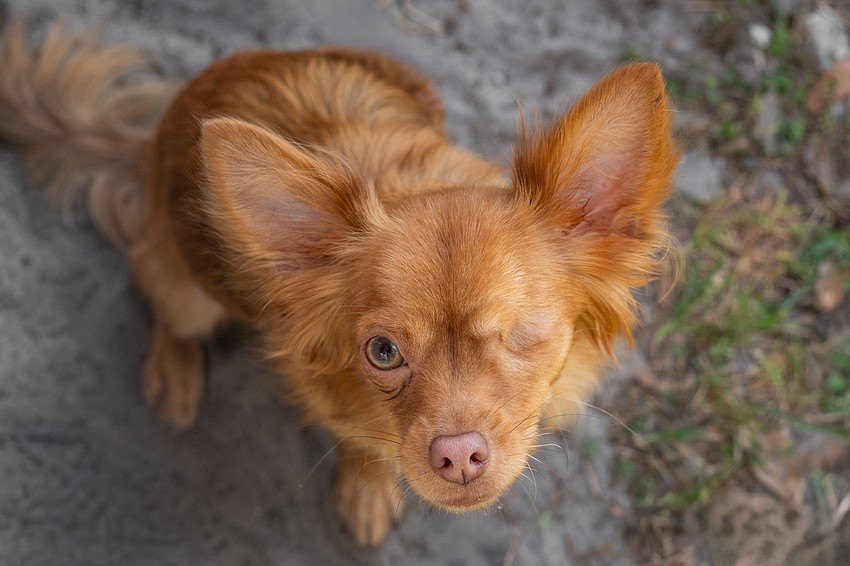
Faze is a 1-year-old puppy who was brought to the Humane Society from Manatee County Animal Welfare.
The injury to his left eye was apparent — there was a scar, and the eye was cloudy. Faze was in pain. He had a ruptured corneal ulcer, and the eye had to be removed.
During the process, the veterinarian suspected cardiac disease, too. Faze underwent echocardiogram and doppler blood pressure testing at the Blue Pearl Pet Hospital in Tampa. His diagnoses were a congenital heart defect and cardiac disease.
Faze was put on a prescription and put up for “special adoption” after several months of recovery in a foster home. He’s since been adopted by a couple, who both have medical backgrounds.
Faze’s medical bills cost $2,270.
Jackson said working with multiple veterinary partners helps keep the costs down. The partners offer generous discounts, and they know they’ll be shopped.
Each partner has been vetted, so whichever estimate comes in the least expensive is where that animal will be treated.
The Humane Society at Lakewood Ranch doesn’t have its own vet onsite. Giving medical care is not something the shelter is set up to do.
However, Jackson argues that it’s just as financially efficient because of the strong partnerships the shelter has developed over the past 15 years. The discounts are substantial.
Jackson noted that it might be a little harder not to have a vet onsite because of all the scheduling and driving it entails, but the shelter has built up a reliable crew of volunteers that are always willing to transport the animals.
“Some of these animals might be sitting in Manatee County Animal Services for maybe ever,” Jackson said. “So if it’s ever, it’ll be ever here.”