- February 27, 2026

-
-
Loading
Loading
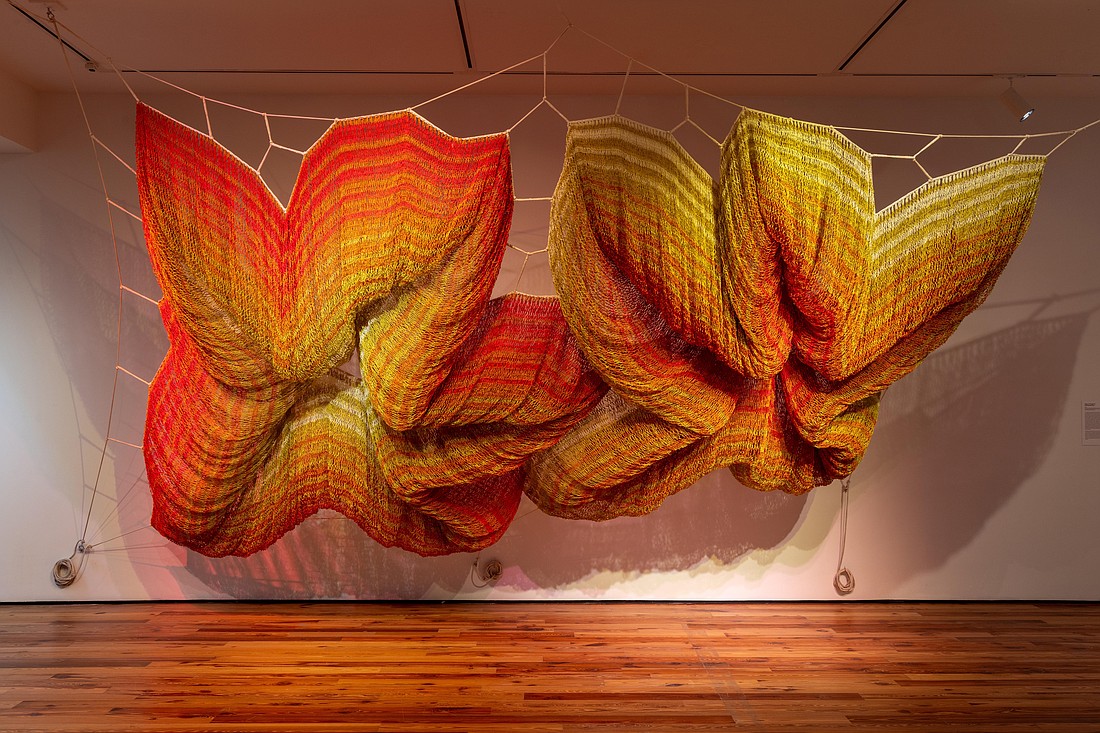
“Janet Echelman: Radical Softness” at Sarasota Art Museum showcases four decades of Echelman’s ethereal sculptures and abstractions. Curated by Lacie Barbour, this show tracks the artist’s evolution from painter, to media magician, to a world-renowned sculptor of air and light.
Echelman’s artwork is impressive, whatever form it takes. Even more impressive? Her adaptability and relentless drive. Fate repeatedly blocked her creative path. She always found a way around it. Whatever the obstacle, Echelman got back on her path. This ambitious exhibition reveals where it took her.
Begin at the very beginning.
The show begins in the Suhler Gallery. This section reveals Echelman’s earlier, two-dimensional works. If you’ve seen the spatial complexity of her recent net sculpture, it feels like you’ve stepped into Flatland.
But look closer. Textiles and real-world artifacts ripple across their surfaces. These images are multilayered, not flat at all. Thanks to a fire that destroyed most of her first creations, they’re also rare.
“David’s Clothes #1” (2025) is one of Echelman’s most recent fiber works. A collage of clothing, snippets stitched together. It’s a garment without a body; clothes without the man. The man who isn’t there is the artist’s late husband. She tucked his photo in a vest pocket to honor him.
“Supernova” (1988) is one of Echelman’s first batik canvases — a deft application of Javanese dyeing techniques. It’s a ball of joyful energy.
Both pieces are kinetic and energetic. Their components seem alive — like they’re struggling to enter 3-D space. They’re not, of course. It’s really the artist’s struggle. And not her only one.
Fate kept trying to break Echelman. It didn’t. She kept seeking a fresh visual vocabulary, a breakthrough, a new artistic dimension. After a series of setbacks and disasters, she found it.
Inspired by the nets of Indian fishermen, Echelman experimented with the artful possibilities of nets. This led to “Bellbottoms” (1997) — her first net-sculpture series. She’d successfully entered a new dimension — the third dimension. Her soaring, new pieces weren’t merely 3-D. They took to the sky.
Echelman’s art followed that flight path in the years ahead.
The Stulberg Gallery showcases Echelman’s spatial voyages. Her art in this section is recent — and many pieces are big. The gallery can handle it. It’s a 2,498-square-foot exhibition space.
Echelman’s recent work spans the media spectrum. Here, you’ll see cyanotype prints, a video installation and gigantic net-sculptures created for outdoor spaces. Public art, in other words.
But the artist’s diaphanous webs are far from the norm. Sculpture in parks and green spaces typically hugs the earth. It’s monumental, heroic and heavy — and wants to impress you. Echelman’s sculpture seems to fly through the air. It wants you to feel joy. And celebrates the incredible lightness of being.
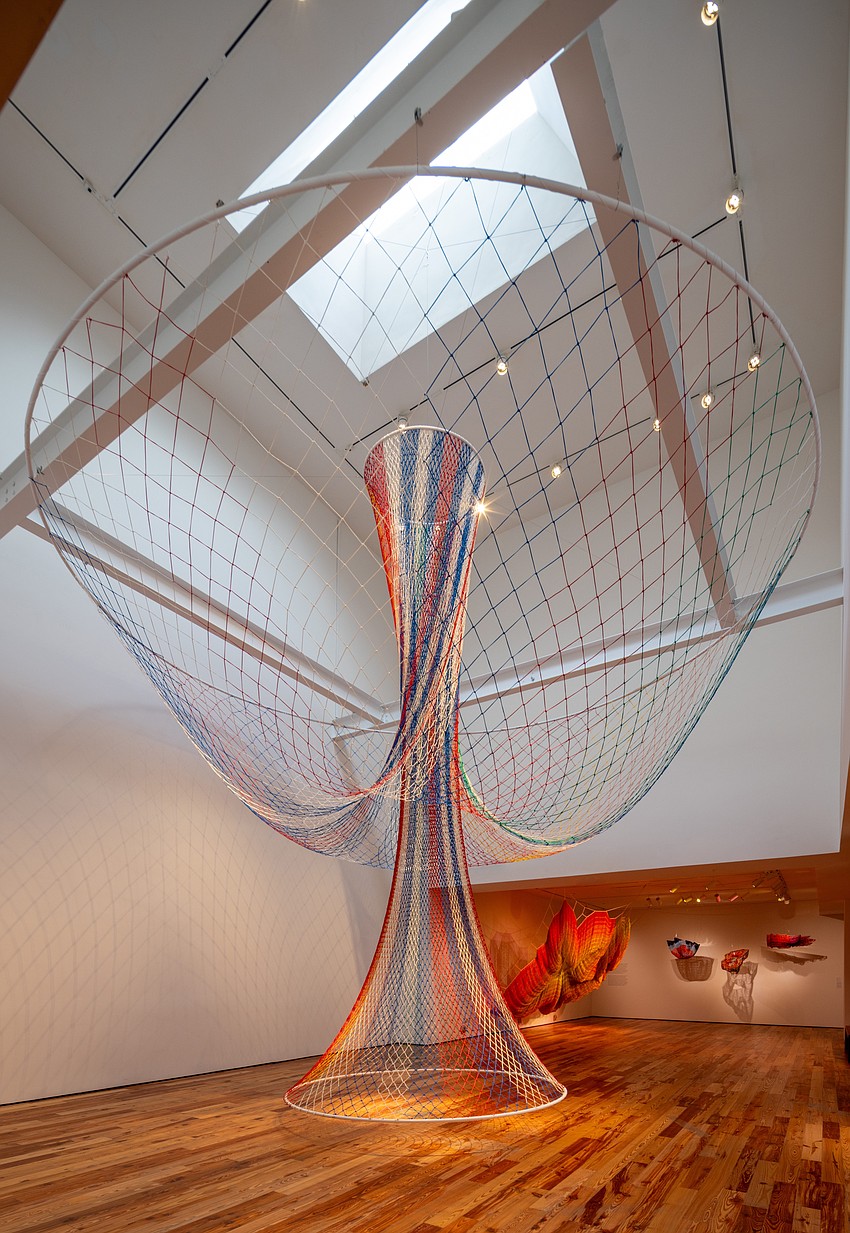
Echelman’s “Expanding Club” (2007) dominates this space. Her 25-foot net-sculpture is beautifully translucent. It takes the form of a parabolic solid, laced together from countless multicolored, high-tensile threads. It arcs up from the floor, then balloons into a donut shape below the ceiling. It’s pretty — like a jellyfish or psychedelic spider’s web.
But don’t be fooled by good looks. It’s really a mushroom cloud. The sculpture’s title is a pun — with dual meanings. The “Expanding Club” is the growing cohort of nuclear nations. It’s also the atomic version of a caveman’s club. Pretty or not, it’s a mordant reminder of human folly. Stanley Kubrick would love it.
“Butterfly Rest Stop” (2024) is a 1:9-scale maquette of a massive installation in Kaleidoscope Park in Frisco, Texas. The full-scale sculpture spans 9,090 square feet, sheltering 3,000 blossoming milkweed plants below. It’s located on the flight path of monarch butterflies on their seasonal migration to Mexico. (The sculpture’s title isn’t whimsical. It really is a butterfly rest-stop. And monarch butterflies really like milkweed.)
Echelman’s net supports life but doesn’t catch it. This small-scale model grabs your eye with the luminous hot pinks and oranges of its high-tech fibers. And evokes the psychedelic spectacle of the real thing.
“Remembering the Future” (2025) offers a synesthetic snapshot of 20,000 years of climate data from the last Ice Age to the Digital Age. (It also hints of heavy weather in Future Ages.) This waveform net-sculpture is a literal network of colored threads — woven, braided, and knotted together.
Stepping from left to right, you move forward in time. Shifts in thread colors mark changes in temperature and sea levels over the centuries. With each step you take, the colors shift from cool to hot.
“Noli Timere” (“Do not be afraid”) (2025) is a gravity-defying video installation. It’s a 29-minute sample of a 60-minute dance, which Echelman created in an ongoing collaboration with choreographer Rebecca Lazier. This looping video is the short version — a vignette of dancers bouncing between two hanging nets.
They cavort and fight for balance like rookie astronauts learning to move in freefall. (The dancers aren’t truly weightless. The artist designed the nets to support them.) It’s a clever mix of choreography and tensile engineering. And yet another fusion of softness and strength.
“Radical Softness” is brimming with such beautiful work. Echelman’s art grabs your eye — and forces you to think.
What’s this artist up to? What’s she really saying? Tough questions.
Echelman’s hard to pin down. I haven’t yet. But I think I know her message.
“Radical Softness” captures Echelman’s conviction that hard words, rigid minds and sharp barriers have miserably failed our species. Softness — material, structural, environmental, emotional — is what humanity needs right now. What if we embraced our gentle side?
What a wonderful world this could be.
Echelman says it in a whisper. You have to listen carefully.
Abstract art is visual music. Music was Janet Echelman’s first art, so that seems like a natural choice. But abstract doesn’t always equal non-representational.
Much of her work is a visual representation of data. Not like an infographic in USA Today or an editorial cartoon. More like imaginative pictures for your mind’s eye. She makes complex events like climate change visible. She lets you see what can’t be seen.
Echelman also strikes me as a latter-day structuralist. Her net creations echo the particle tracks in cloud chambers, the architecture of spider webs and the forking paths of living networks.
Her art’s not an imitation of life’s organic forms. She follows life’s structural logic — and it takes her to the same beautiful place.
She creates organic beauty. It makes you value life’s beauty. Her webs don’t spell out the message like the spider in E.B. White's children's classic, "Charlotte’s Web." (SOME PLANET!) She doesn’t have to. Your imagination connects the dots.
Echelman’s airy art appears effortless. It isn’t. Her net-sculpture is the result of superhuman patience and countless hours of hard work. Not just her own work. She collaborates with architects, planners, physicists, choreographers, software designers and computer scientists. A lone-wolf artist she isn’t.
Her embrace of indigenous methods might be mistaken for nostalgia. Net sculpture? That seems so old-school. But Echelman’s pieces are actually high tech. She threads her nets with ultra-high-molecular-weight polyethylene — rope that’s strong enough to tether the Mars Rover.
Echelman draws on the latest 3-D modeling software to create her nets. And builds and tests them digitally before lifting a finger in the real world. (With a little help from her cutting-edge friends, of course.) Echelman’s also developing her own new software. But not all of her pre-visualization is digital.
The artist also creates miniature scale models of her net-sculptures. Her hand-made maquettes are practical and physical. With very, very tiny nets.