- March 16, 2026

-
-
Loading
Loading
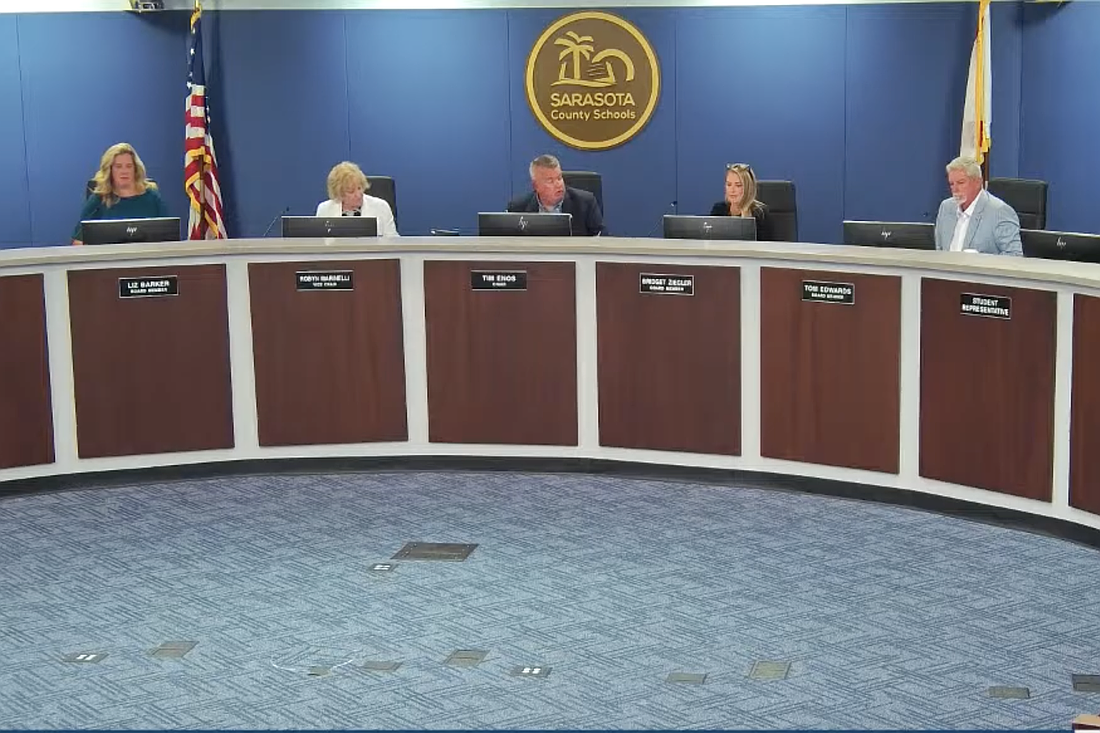
Numerous members of the public turned out during a July 22 Sarasota County School Board meeting, as the board voted 3-2 to approve for advertising an amended version of its student code of conduct.
Speakers criticized revisions that remove the enumeration of specific protections for students in categories that include race, sex, sexual orientation, gender identity and gender expression.
The new code of conduct emphasizes discrimination, as well as bullying and harassment, will not be tolerated under any circumstances, and states that it covers "any protected classification recognized by state or federal law."
The wording includes, "Sarasota County Schools strictly prohibits ANY form of discrimination, harassment, or retaliation by or against students. EVERY student has the right to learn in an environment that is free from bias, exclusion, or unfair treatment."
Attorney Patrick Duggan told meeting attendees the decision was made from a "risk management standpoint" to put the district in a position to be compliant with state and federal law, and ensure it will not unnecessarily lose funding.
In a June 17 board workshop, Duggan had stated the district receives about $30 million in federal funding from the Department of Education, and must ensure it is in compliance with its policies.
He said there was a basis for the action in "the current stance coming out of the administration in Washington, D.C., which is now in symmetry with what's going on in Tallahassee."
"I don't have a crystal ball; I don't know how the U.S. Department of Education would view non-compliance with their regulations, but my goal when I'm advising you is to put you in risk-averse situations so you don't have to deal with those liabilities and those distractions," Duggan had said during the workshop.
Four board members expressed support for the decision, although board member Tom Edwards ultimately voted against the new version.
"When I look at the 'all' piece, it's all. It's everyone," said board chair Tim Enos. "To me, there's no delineation to say that it's you're this or you're this or you're this, because also, that same thing that was said, is about putting people into categories."
Board member Bridget Ziegler said there were no protections being removed, and that she agreed with the idea that "words matter," referencing the time when gender and gender identity were added to anti-discrimination policies.
"The fact is that whole process and that whole trajectory led public education across the United States to be completely undermined, and the lack of trust, and the parental rights movement, and I’m very proud to be a part of it because I believe in it," she said.
Board member Tom Edwards said he did not feel "for a moment" that students were unsafe based on the policy, stating he was convinced the administration was equipped to handle bullying and that much of the problem was occurring online.
However, Edwards stated he would be voting against the change to avoid the perception that he was aligned with Ziegler's viewpoints.
"I was really trying hard, to the 'every' and 'all,' and the reference to the statutes, to really try," he said. "When Mrs. Ziegler said what she said, I didn’t want anyone to misunderstand that I was on that page because I’m not, and I never will be…”
Board member Robyn Marinelli said she found it "really sad" that the conversation was necessary and said the move was not political.
"I believe in it because it's all kids, and it's all staff, that should never, ever be picked on, bullied, or harassed. And like I said, I don't need a piece of paper to know that that's the right thing to do."
Dissenting from the majority was Liz Barker, who thanked district staff for their work on the proposal, which she said also spelled out school and district-based areas of concern, and for listening to her continued pushback.
She said her research clearly showed that districts with specifically enumerated protections had better outcomes for students' wellbeing.
"In the last several weeks, I have gone back and forth and thinking to myself, why is it that this isn’t sitting right with me, why can I not just get on board with 'all'? And I said, 'Well, why can’t we just make the student code of conduct, ‘Everyone be nice to each other’? There’s a reason.”
During the meeting, students and community members took to the podium, with many students sharing experiences of bullying, and all but two speakers voicing opposition to the change.
"I want to tell you all about an old adage that I'm sure you guys have heard many times over," said student Kennedy Cole. "If it ain't broke, don't fix it. It seems easy enough to understand... Yet, despite this, it seems like a very simple rule that this board just can't follow. Today, the board seeks to change the Code of Conduct, despite no prompting to do so and no need to do so. Is it broken? No. Yet, this board seems poised to fix it."