- August 13, 2026

-
-
Loading
Loading
Langston Hughes’ “Black Nativity” has been a cornerstone of Westcoast Black Theatre Troupe for more than two decades. Nate Jacobs is the troupe’s founder and artistic director. Hughes’ Christmas story is near and dear to his heart. But as living theater — not a historic relic. In 2025, Jacobs reimagines this gospel classic with new music, fresh design and a renewed cultural urgency. The result is a fresh holiday celebration that’s rooted in joy, history and community. In the following talk, Jacobs shares why that matters more than ever.
I’ve staged “Black Nativity” since 2003, shortly after WBTT began to grow. It quickly became an annual gateway for young performers (including my own daughter) to step into our artistic family. Parents got involved; kids became part of the community; and audiences embraced it. It remains one of our biggest draws for African-American theatergoers. And it still moves me today.
“Black Nativity” is a classic of Black theater — our equivalent of “The Nutcracker” during the holidays. Langston Hughes shaped it during the Harlem Renaissance — a time when Hughes and artists like Zora Neale Hurston insisted that Blackness was beautiful, intelligent and worthy of celebration. His version looks at the nativity story with a Black cultural lens, and it’s powered by gospel music. Hughes’ original script included a handful of gospel standards that he personally selected. I still use several, including his theme song, “Wasn't That a Mighty Day,” which gave the play its early title.
Not really — my appreciation has only deepened. Hughes understood that Black culture, particularly the Black church and its music, is foundational. Gospel music shaped everything: identity, artistry and community life for African Americans.
When I first studied “Black Nativity,” that truth came through immediately. Gospel is a root system for music around the world — especially music created by people of color.
Absolutely. Representation is still radical. From the Harlem Renaissance onward, Black artists have fought to affirm that we’re intelligent, beautiful, creative, important and here. That message is just as vital now. And gospel music never loses its power. You can crank up “Wasn't That a Mighty Day” — a song from Hughes’ original production — and the whole room transforms. That’s why “Black Nativity” continues to be produced around the world. Its impact is timeless.
I wrote several new musical moments. The opening number, “The Greatest Story That’s Ever Been Told,” is mine. Mary and Joseph now share a duet, “Here I Am.” Herod and the high priest also get a new musical scene. We’ve added original choreography and brought in extraordinary new talent.
Eustace Williams, who plays Joseph, is making his WBTT debut and he’s phenomenal. Mary is played by Maicy Powell — who came to us at age 14 through our education program, then studied at Howard, and returned as a rising star. Her understudy, Amillia Lorraine, came through our Stage of Discovery and will perform several shows herself.
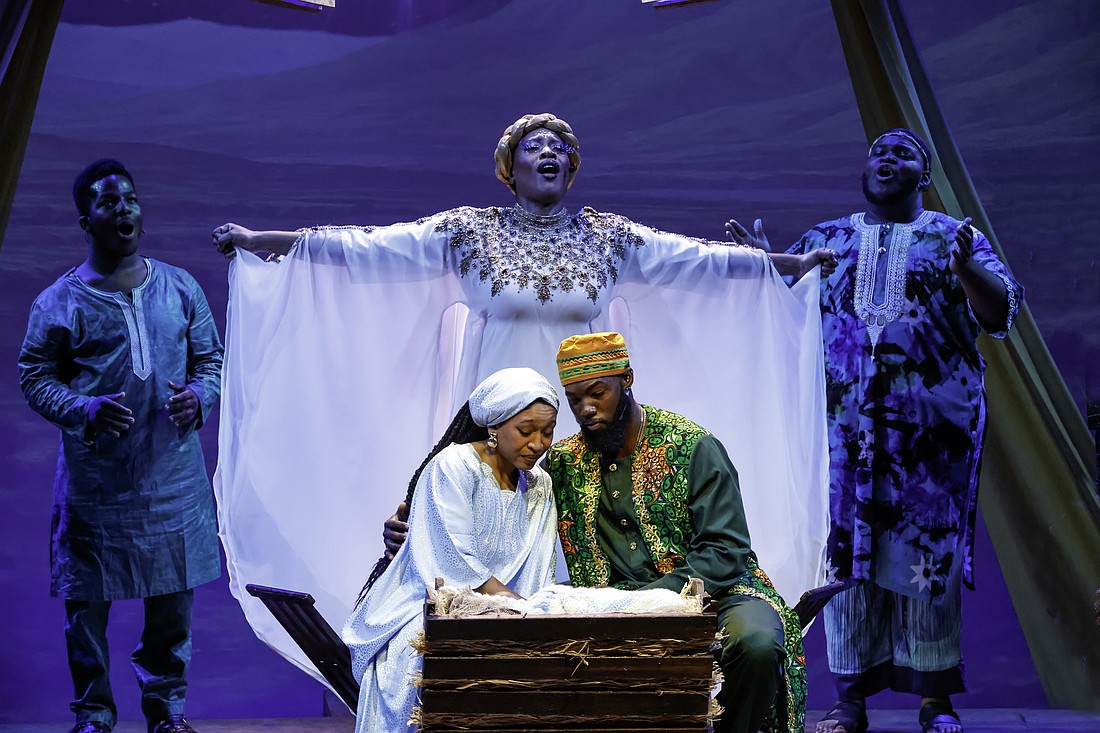
The design team is new as well. Set designer Shartoya Jn. Baptiste — an African-American artist — created a stunningly elegant visual world. Our new costumer Christopher Vergara also brings vivid Afrocentric patterns and color. Every artistic choice is intentional: the look, the sound, the movement and the cultural grounding.
Everything comes through an African-American lens — musically, visually and spiritually. The score moves from traditional gospel to contemporary gospel, from high-spirited praise to quiet, jazzy moments of reflection. We’ve kept two of Hughes’ original poems from the 1961 production. The dialogue and dialect reflect Black storytelling traditions. Our costumes use African textiles and patterns, and that reinforces the cultural identity of the piece.
They’ll encounter the familiar Nativity story — Mary, Joseph, angels, the manger — but through a creative, deeply emotional interpretation. Mary is portrayed as the young girl that she was; Joseph is the man chosen to stand beside her; the angelic presence is a transformative force. The birth scene around the manger is one of the most beautiful moments in the show. And, yes — joy is at the heart of this journey. Some numbers will absolutely bring the roof down.
Inspirational. Celebratory. Rejuvenating. Deeply moving. Gospel music has that power — when it hits, the atmosphere in the theater changes instantly.
We blend African dance, modern dance, and theatrical jazz. Those three vocabularies form the physical language of our production.
I preserve the core: his poems, his framework, and the gospel songs he chose. The narrator still carries the story, with the other characters speaking only briefly.
The title remains “Langston Hughes’ Black Nativity” because his authorship and legacy matter. We might also include lobby displays about him. My additions — new songs, new movement, new design — don’t replace his foundation; they build on it.
At a time when Black history is being removed from classrooms and libraries, “Black Nativity” has become even more vital. If organizations like WBTT don’t celebrate and protect our culture, we contribute to its erasure. Our purpose in this community is to preserve and uplift a unique cultural heritage. In a moment when many voices are being silenced, we must raise ours louder.