- August 5, 2026

-
-
Loading
Loading
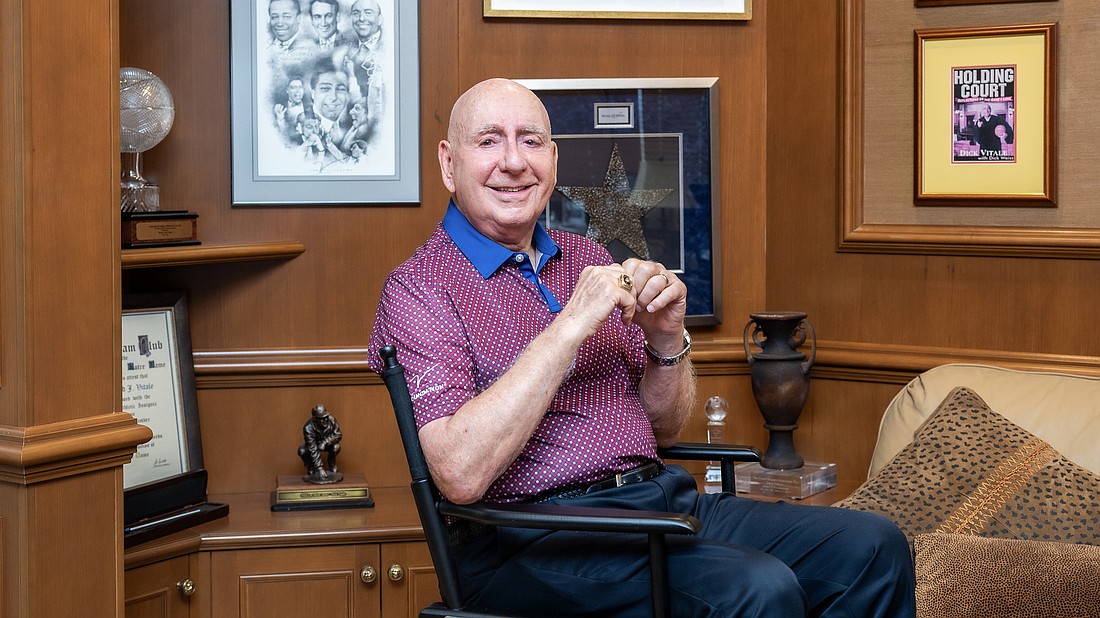
White cards hung on the backs of 15 chairs. On each of them, printed in bold, black font was the name of a pediatric cancer survivor, indicating seat designations.
Those triumphant individuals filled the front two rows for the press conference at this year’s Dick Vitale Gala, held at The Ritz-Carlton, Sarasota.
It felt intentional — arranged as such so Vitale and his fellow speakers could see his All-Courageous Team, without having to strain their necks to search the crowded corridor.
Those 15 survivors are the “why.” Each and every one of them represent living, breathing proof that pediatric cancer research is a life-saving cause.
Behind them, and in support of Vitale amid his fifth cancer battle, hundreds of people rallied at the 21st annual gala May 1. They raised $21 million for pediatric cancer research, benefiting the V Foundation, by the time the evening ended.
This year’s effort nearly doubled last year’s $12 million and approached the all-time record of $24.8 million, set in 2024. That wildly successful night included a $12 million donation from Mark and Cindy Pentecost, who had pledged to match the total funds raised.
Fundraising isn't always what it's made out to be. Sometimes a good portion of donations don't end up directly flowing to a cause.
But this event — Vitale’s national championship — has always been as advertised. It’s entirely authentic, just like the legendary college basketball broadcaster whose name it so proudly bears.
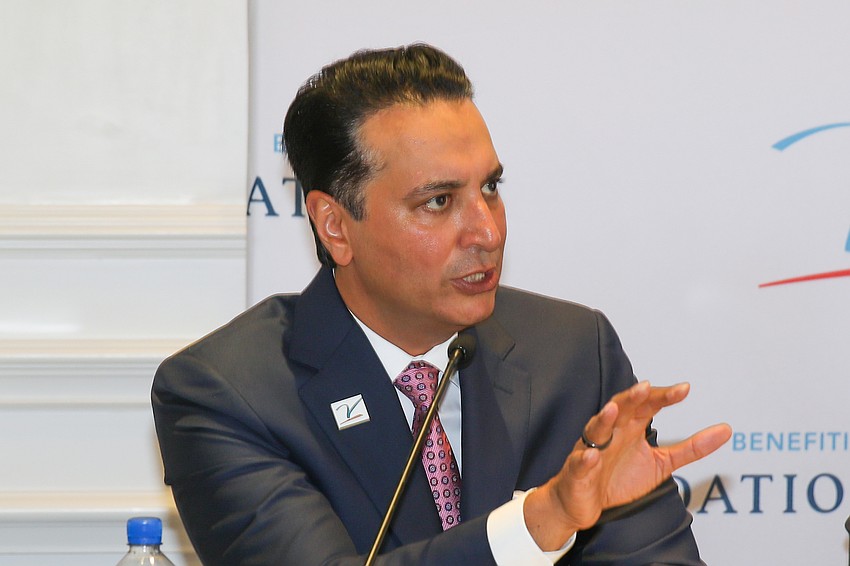
“No matter what he is dealing with, first and foremost, the conversation is about how we continue to raise dollars for one single purpose,” said Kevin Negandhi, an anchor for ESPN’s SportsCenter. “That is pediatric cancer research.”
Whether it be sadness for the children lost, or anger toward the disease that carves such a destructive path, it was impossible not to feel something.
Tears were encouraged just as much as cheers. Emotions flowed freely when research grants were presented in memory of Luke Ticola and Aubrien Jimenez, who died from brain cancer and esthesioneuroblastoma, respectively.
Another tug on the heartstrings? Surely that was felt by the audience when Vitale opened up about his melanoma diagnosis. He poured out his soul on stage for everyone to see — a scene not dissimilar from the speech of his late, beloved friend Jim Valvano at the 1993 ESPY Awards.
He’s leveraged the success achieved over a hall-of-fame, 46-year career with ESPN into something much, much bigger than any basketball game he’s called.
“When it happens to people really young… when you see 3-year-olds, 4-year-olds, 5-year-olds (battling cancer),” said Geno Auriemma, the Connecticut women’s basketball coach. “It makes winning and losing less meaningful.”
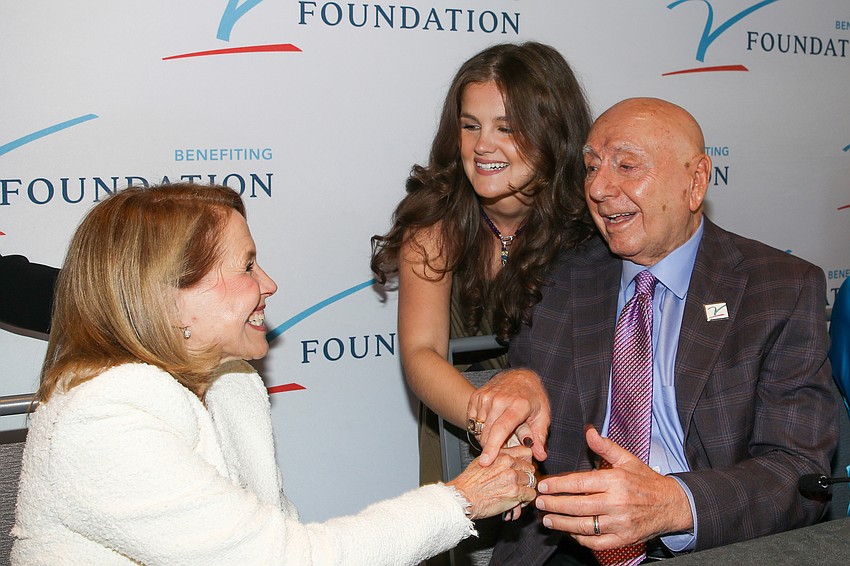
Vitale’s All-Courageous Team was the ultimate honoree of the night — more so than any of Auriemma, Tom Izzo, Kelvin Sampson, Katie Couric or Jamie Valvano, who were all formally honored and gave acceptance speeches.
They’re the reminders not only that pediatric cancer research genuinely makes a difference, but also that continued investment in the cause is paramount.
It’s staggering how little government-allocated cancer research funding is put toward pediatric cancer. That number is a miniscule 4%, per the National Cancer Institute.
The roughly 9,680 U.S. children ages 0-14 expected to be diagnosed with cancer by the end of this year, per the American Cancer Society, are a statistical needle in the haystack of the 3.6 million babies born here in 2025, per the U.S. Centers for Disease Control and Prevention.
But we don’t act on statistics alone, do we? These kids are more than numbers on a spreadsheet in some government office.
“There’s a real brain drain in this country,” Couric said. “As a community, it’s incredibly important that we band together and keep our eye on the prize and make sure that we support science.”
Here’s another statistic — an estimated 9,680 pediatric cancer patients this year translates to 26 or so families per day being told, “Your child has cancer.”
The five-year survival rate for children with cancer is 85%, per the American Cancer Society. That’s a considerable improvement relative to the average of 58% in the mid-1970s.
Proof of progress isn’t a reason to withdraw funding. Rather, it should encourage even more, creating trust between the V Foundation and its donors that money is, in fact, being put toward all the right places.
More than a few people believe in this cause. Look no further than the over $126 million raised since the gala was first held in 2005.
“Hope — that’s an important word, isn’t it?” said Sampson, the Houston men’s basketball coach. “If somebody was to sit down and say, ‘What’s the most important word in the Bible?’ I would think it’s hope, because without hope, what do we have? That is what (the gala) is about.”
Research grants funded by the V Foundation’s Dick Vitale Pediatric Cancer Research Fund helped give those 15 members of Vitale’s All-Courageous Team hope.
Even in their darkest days, when they felt like cancer might defeat them, they had an advantage children before them didn’t — more advanced treatment.
That was the power of May 1 in Sarasota.
“People are living that didn’t get a chance to live before,” said Izzo, the Michigan State men’s basketball coach. “That means we’ve really done a hell of a job, and we have a lot more work to do.”