- March 30, 2026

-
-
Loading
Loading
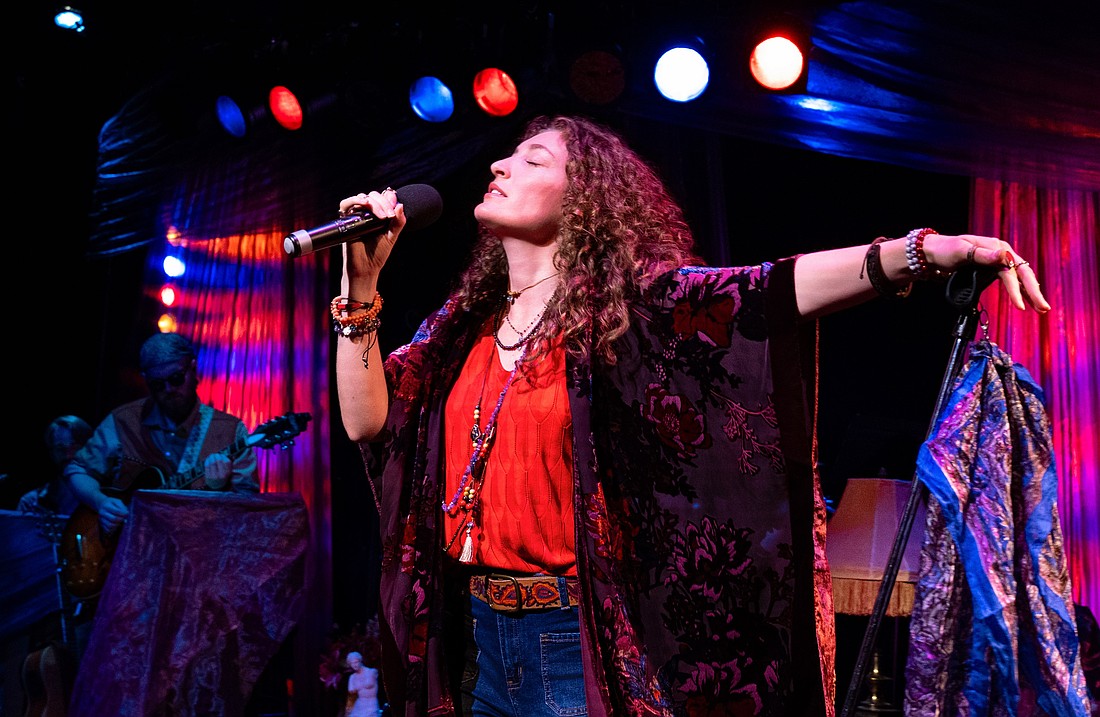
Randy Johnson’s “A Night with Janis Joplin” at Florida Studio Theatre is the closest you’ll get to a Janis Joplin concert without a ticket and a time machine.
That’s not hyperbole. You’ve stepped into Joplin’s final concert on Aug. 12, 1970. Not a farewell concert. Just another night on the road — until it wasn’t. Laura Frye slips into Joplin's skin on the night of this review. She alternates with Francesca Ferrari as the show's lead.
After introducing Joplin's All-American childhood, the first act draws heavily on Joplin’s powerhouse vocals for Big Brother and the Holding Company. Sam Andrews’ “Combination of the Two” rattles your bones and raises the roof. It’s a rowdy celebration of how Joplin joined forces with Big Brother and the Holding Company.
George and Ira Gershwin’s “Summertime” is a fragile echo of African American spirituals and lullabies in the slavery era. It’s a mother’s soothing promise of protection and liberation to her baby. She knows it probably won’t be kept — and it’s heartbreaking.
“Down on Me” is a traditional spiritual dipped in a Summer of Love acid bath. “Looks like everybody in this whole round world is down on me…” The original was about endurance; Joplin’s is about defiance.
Jerry Ragovoy and Bert Berns’ “Piece of My Heart” is a cry of pain. Originally soul, Joplin transformed it to explosive blues-rock. Another heartbreaker.
The second act leans into the Full Tilt Boogie Band era of the “I Got Dem Ol’ Kozmic Blues Again Mama!” and the posthumous “Pearl” albums.
Speaking of which: Buddha said, “Desire is suffering.” If you’re alive, you’re going to want things — and that wanting will hurt. Getting the blues is the price for living? So be it. You’re going to have to pay — so you might as well sing. Joplin and Gabriel Mekler’s “Kozmic Blues” says, “Amen.”
Kris Kristofferson’s “Me and Bobby McGee” was a rambling country road song. Joplin turned it into love’s dead-end road. (It’s got one of the most haunting lines of all time: “Freedom’s just another word for nothing left to lose…”)
Ragovoy’s “I'm Gonna Rock My Way to Heaven” is the penultimate song. It’s gospel-inflected, defiant and ecstatic — a quintessential Joplin tune, though I don’t remember hearing it.
Poignantly, that’s because she never sang it. It was on the set list for her recording session for “Pearl” — but Joplin died before the session. If you want to hear it, this is the closest you can get.
The show ends with Joplin, Bob Neuwirth and Michael McClure’s now classic drinking song, “Mercedes Benz." A mock-gospel plea for consumer goods, it skewers the American conflation of spirituality and shopping. But it’s loving, sympathetic satire, not a snobby sneer.
That’s just a sampling of the show’s songs. The real Joplin sang from the heart; she also shared a piece of her mind in long rap sessions.
In this show, these include her surprising origin story as a college-bound middle-class girl in Port Arthur, Texas, who fell in love with soul and the blues. She also shares her debt to the Black soul and blues legends who came before her.
In an imaginative leap, the playwright puts Chantel (Katie Porter), Aretha Franklin (Jannie Jones), Etta James (Briana Brooks), Odetta (Jasmine Lawrence), Nina Simone (Jones) and Bessie Smith (Lawrence) on stage.
You hear their originals and Joplin’s covers — and it puts Joplin's raw, honest, fearless music in context. Outstanding work by all four performers — who also appear as Joplin’s back-up singers.
The Full Tilt Boogie Band was Joplin’s final ensemble. Their FST reincarnation is equally outstanding. It consists of drummer Christian Allen, keyboardist Nathaniel Beliveau (FST’s resident music director), bass guitarist Faun Holley and lead guitarist Travis F. Welch. His soaring solo on “Combination of the Two” hits the stratosphere.
Director Ben Liebert frames this show as part concert, part character study. Joplin’s larger-than-life persona comes through. It’s not a put-on; it’s a 200-proof distillation of her true self. Under Liebert’s direction, the real Joplin shines through in Frye’s performance. And what a performance it is.
Frye’s full-tilt characterization burns the stage with Joplin’s red-hot passion. The real singer never did anything halfway. No mask, no act, no filter. With Joplin, what you saw is what you got and she gave her audiences everything.
Frye channels her unpretentious presence and unapologetic sexuality. Emotion aside, she also conveys Joplin’s often overlooked intelligence.
"A Night with Janis Joplin" is quite an experience — and not a nostalgia trip. Joplin’s songs are mostly sad songs. The blues are a lament, after all. That’s easy to forget — because the blues are also so joyful.
Joplin understood that pain/pleasure paradox. In the show, her character says, “People, whether they know it or not, like their blues singers miserable.” It’s a quote from the genuine article. Who had her share of joy and misery.
Joplin died of a drug overdose at age 27, like other members of the "27 Club," which include Jimi Hendrix and Jim Morrison. Unless you just fell off the turnip truck, you know that.
The script doesn't elbow you in the ribs to remind you of Joplin's untimely death. In the second act, you see her taking periodic hits off a Southern Comfort bottle. That hint of self-destruction is enough.
But though Joplin's life ended too soon, this show's no bummer. "I'm Gonna Rock My Way to Heaven" offers the promise of a happier hereafter while a singalong to "Mercedes Benz" leaves the audience rockin' on their way out the door.
Johnson's show keeps its eye on Joplin’s music. Not just her performances, but the artistry behind them. “A Night with Janis Joplin” is a portrait of an artist. That’s what the playwright’s trying to create and what FST's talented team is trying to do too. And they succeed.
It's a night you won't soon forget.