- March 31, 2026

-
-
Loading
Loading
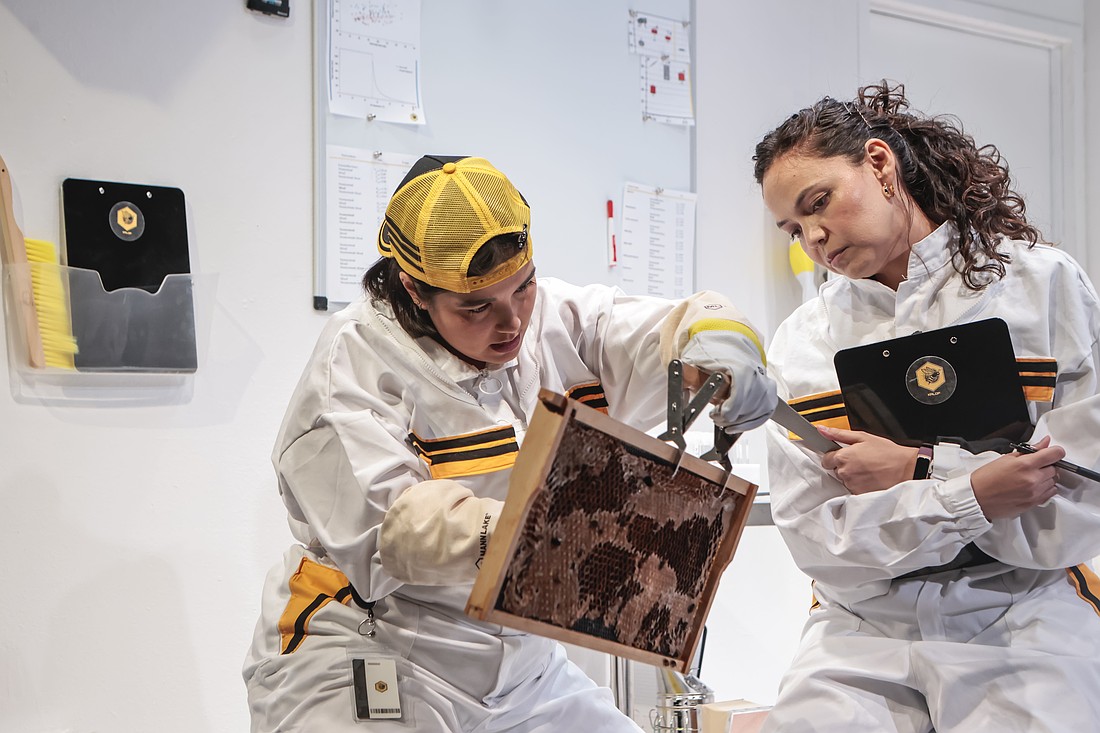
Kate Douglas’ “The Apiary” is buzzing at Urbanite Theatre. The play is black comedy — science fiction-style. It’s set in the not-too-distant future — 2048, to be exact. Earth’s ecology is ailing. Many species have been wiped out. And bees are buzzing at the edge of mass extinction.
Wild bee hives don’t exist anymore. No more pollinators — which means no more flowers, no almonds and almost no fruit. The only surviving bees reside in a handful of apiaries in scientific facilities, usually corporate.
“The Apiary” unfolds in one such lab, a basement facility. Bees aren’t thriving in this ersatz, artificial apiary. They’re shriveled and sexless and slowly dying off. Two lab assistants are fighting to save their remaining bees. And they’re also fighting to keep the Kalop Corporation from pulling the plug on their failing project.
Zora (Dekyi Ronge) is a newly hired, overqualified PhD who goes by the book. The plucky Pilar (Christina Mei Chen) looks on the bright side of life.
Their boss, Gwen (Ariel Blue), just wants results. Her corporate overlords don’t see the profit in this do-gooder project. They lean on her; she leans on the lab assistants. It’s not going too well. They live in constant tension with upstairs management. It looks like all hope is lost.
Then Cece (Terri Weagant), a lab assistant who mysteriously walked off the job, shows up and provides a solution. It’s a gnarly solution. (Spoiling it would violate the critic’s code, so I won’t.)
Let’s just say if this wasn’t a black comedy, it would be body horror. Humor or horror, there is a way to save the bees. It’s unthinkable and unspeakable. But Cece proved it. The hard way. How far will the Kalop scientists go to save the bees?
Highly educated professionals calmly think about Cece’s unthinkable solution. Then they execute it. And go far beyond her initial suggestion. Their surreal, unethical problem-solving is weirdly hilarious. And it reminds me of … We’ll get back to that.
Many directors are tone-deaf to science-fiction. Summer Dawn Wallace isn’t. She stages Douglas’ story with deadpan sincerity. She tells a tangled tale with several characters. It happens to be set in the future — so what? Wallace is a lucid storyteller. Storytelling’s the point, not the time, place or genre.
Douglas’ characters are sharply defined; each speaks with their own voice. The Urbanite actors do them justice. Ronge’s Zora is driven and hyper-focused. She wants to heal the collapsing ecosystem by any means necessary.
Her intensity borders on fanaticism. She’ll push ethical boundaries — but she won’t violate the scientific method. That’s where she draws the line.
Mei Chen’s Pilar is the lab’s uneasy conscience. But she’s the first to cross the ethical line when an unethical answer drops in her lap. Blue’s Gwen is under pressure and stressed out. She initially seems like the bad boss archetype, then gradually shows her human side.
Weagant’s Cece provides the solution to the bee-pocalypse. The scientific method didn’t reveal it to her. Cece comes from a family of beekeepers, with a long folk tradition of talking to the bees. And that’s how she found out. Weagant’s also great as three other characters caught up in the experiment.
Jeff Weber’s set design is a hoot. He’s created a bland corporate hallway leading up to the actual theater space. (Some theatergoers thought this was permanent.)
Ethan Vail’s lighting and Louis Vetter-Torres’ sound cleverly turn the bees into another character in the play. A single hive-mind, of course. Frank Chavez’ baggy white jumpsuits and lab coats emphasize the fact that the scientists are corporate cogs.
“The Apiary” is savvy satire. It reminds me of Stanley Kubrick’s style in “Dr. Strangelove.” The characters are smart; they’re bottled up in a controlled environment; the stakes are existential; they’re rationally discussing unthinkable/unspeakable options. Kubrick’s film and Douglas’ play have much in common. With one big difference …
Kubrick’s characters are driven by paranoia, ego and blinkered ideology. Douglas’ characters are driven by good intentions. And that changes the nature of the play.
“The Apiary” isn’t just a black comedy. It’s also an allegory about humanity’s relationship to nature. Douglas doesn’t spell it out but her meaning is clear.
Animals (including bees) aren’t organic machines to be used. Humans aren’t either.
In the end, the bees reject Kalop’s unthinkable solution — on ethical grounds. But they offer a more humane solution. The scientists find it out when they take Cece’s advice and talk to the bees. After that, the bees are happy to help — and willing to fight for us.
It seems the bees are more human than we are.