- March 27, 2026

-
-
Loading
Loading
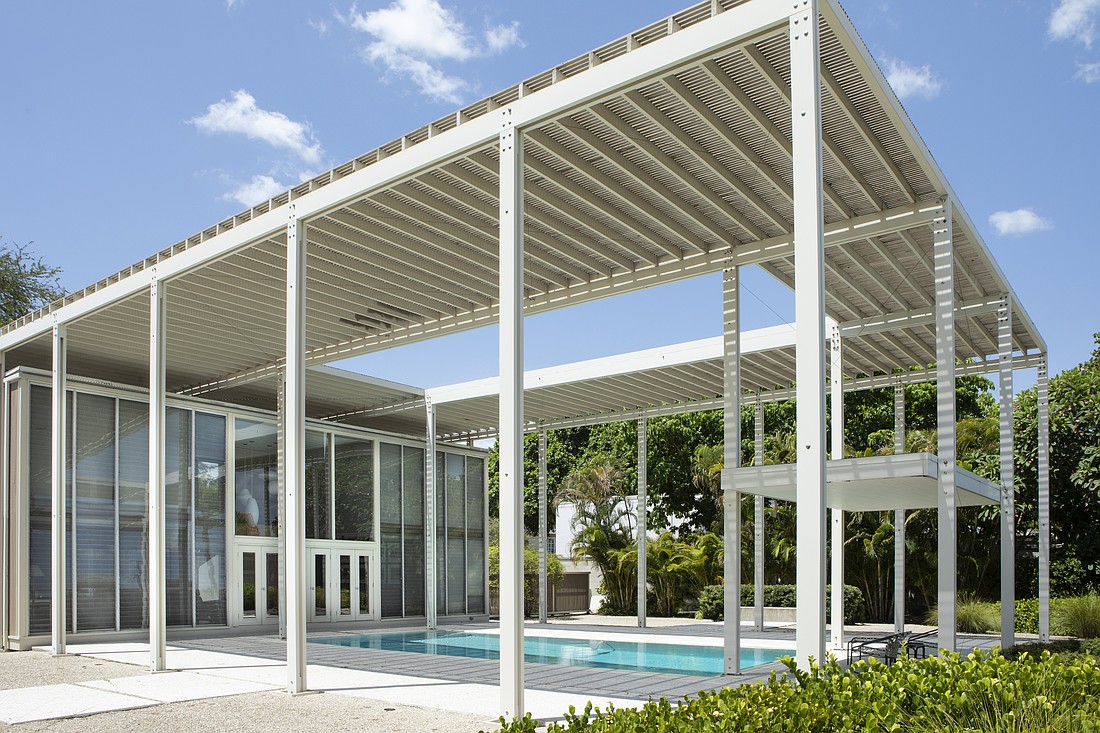
In 1953, Paul Rudolph’s new Umbrella House was the jewel of Lido Shores, Philip Hiss’ mid-century modernist residential enclave on north Lido Key. Major architectural magazines featured it as cover stories. Rudolph’s residence enjoyed 15 minutes of national fame — followed by five decades of local neglect.
The Umbrella House had once been called “the house of the future.”
But by the dawn of the 21st century, demolition was its probable future.
Improbably, the house that Rudolph built still stands.
Credit for that goes to Anne and Bob Essner, whose painstaking restoration made it possible.
The restoration has now drawn international recognition. The World Monuments Fund considers it a “model” restoration. This global nonprofit works to preserve culturally significant sites, like the Umbrella House. The award, introduced this year, recognizes exemplary stewardship of modernist residences whose preservation protects architectural history while keeping these homes viable for contemporary living. The WMF recently recognized the Essners’ restoration with its inaugural Stewardship Award for modernist homes.
The Essners, who both worked in the pharmaceutical industry — Bob retired as chairman and CEO of Wyeth Pharmaceuticals in 2006 — purchased the Umbrella House in January 2015. They bought it from Vincent and Julie Ciulla for $1.6 million. For Anne and Bob, it was not a difficult decision.
“Buying the Umbrella House was a no-brainer for us,” Anne says. “It was a stone’s throw away from our home; we both loved Rudolph’s work; we both felt responsible to complete the Ciullas’ restoration for future generations. To do that, we had to make the house our own.”
Where does this sense of responsibility come from?
Love, actually.
The Essners share a passion for Lido Shores’ architectural legacy — Paul Rudolph’s work especially. In 2012, the couple fell in love with the architect’s Harkavy House — and made it their home. Rudolph’s Umbrella House was right across the street. Naturally, they fell in love with it, too.
And with great love comes great responsibility.
After buying the Umbrella House, the Essners saw how great it was.
But while Rudolph’s modernist masterpiece wasn’t a ruin when the Essners took possession, it was a work in progress. The previous owners had restored the interior, installed a new HVAC system and replaced part of its sunshade. It was an important first step. The Essners knew how much challenging work remained. They needed a project leader and immediately called Greg Hall, a preservation architect.
Hall shared their love of Sarasota School architecture. He’d impressed the Essners with his work on the Harkavy House. Did he want to work with them on the Umbrella House? Hall didn’t hesitate. The answer was yes.
After doing his research, Hall assembled a dream team of specialized contractors. They were ready to get to work.
Where to start?
The “umbrella” that gave the house its name — the iconic wooden sunshade above the pool. Hurricane Alma had savaged it in 1966. It was long gone by 2015. As Bob Essner put it, “An Umbrella House without an umbrella is just not interesting.” Replacing it would be the first priority. Not an easy job.
Hall had the plans for Rudolph’s original wooden sunshade. Making an exact copy wasn’t an option. Old-growth cypress lumber wasn’t on the shelf at Home Depot anymore. Building codes had also gotten tougher. Any new “umbrella” had to stand 150-mph winds. A wooden sunshade would get blown away; Hurricane Alma had proven it. Aluminum uprights solved the problem, a different material but visually faithful to Rudolph’s design.
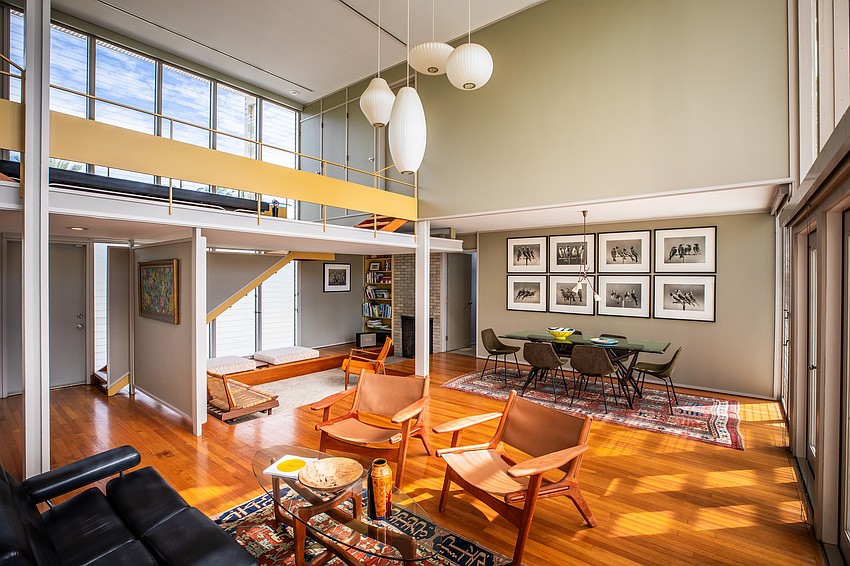
By October 2015, the Umbrella House had a new umbrella. The biggest job was done. But a long list of small jobs remained. Most were in the interior.
Hall’s team repaired walls, updated the electrical system, fine-tuned structural elements but performed no major surgery. Why not think big?
“Because it’s a very small house,” Anne explains. “You can only change so much before you turn it into something else.”
The restoration team stayed true to Rudolph’s vision. From start to finish, its meticulous work took only nine months. The Umbrella House was reborn in late fall 2015. From start to finish, the work took less than a year. The Essners unveiled the reincarnated structure at the 2015 Sarasota MOD Weekend. The architectural tourgoers who saw it for the first time couldn’t believe their eyes.
The Essners had successfully turned back the clock.
That never comes cheap.
In addition to the purchase price, the Essners invested between $350,000 to $400,000 to reconstruct the “umbrella,” landscape the property and stabilize the structure.
Was it worth it?
On a human level, absolutely. The Umbrella House isn’t the Essners’ primary residence. Although they don’t live there, it’s essential to their lives. They use it for lectures, receptions, tours, family gatherings and Thanksgiving dinners. “This isn’t a fragile historical artifact to us,” Anne says. “It’s an amazing resource for the here and now.”
Financially, the restoration increased the home’s equity. But resale value was never the Essners’ motive. Anne makes that clear.
“We’re not going to sell the Umbrella House,” she says. “We take good care of it because we love it. Nobody else is going to do that. Because nobody loves it like we do.”
Morris “Marty” Hylton, the president of Architecture Sarasota, works side by side with Anne. He shares her sense of stewardship — and knows what a difference it makes.
“Our region’s extraordinary modernist architecture survives because of individual owners like Anne and Bob Essner,” Hylton says. “They see themselves as stewards, not just occupants. They understand that when you own a significant home, you’re holding a piece of Sarasota’s story in trust for the next generation. That kind of vision keeps our architectural legacy alive.”