- March 13, 2026

-
-
Loading
Loading
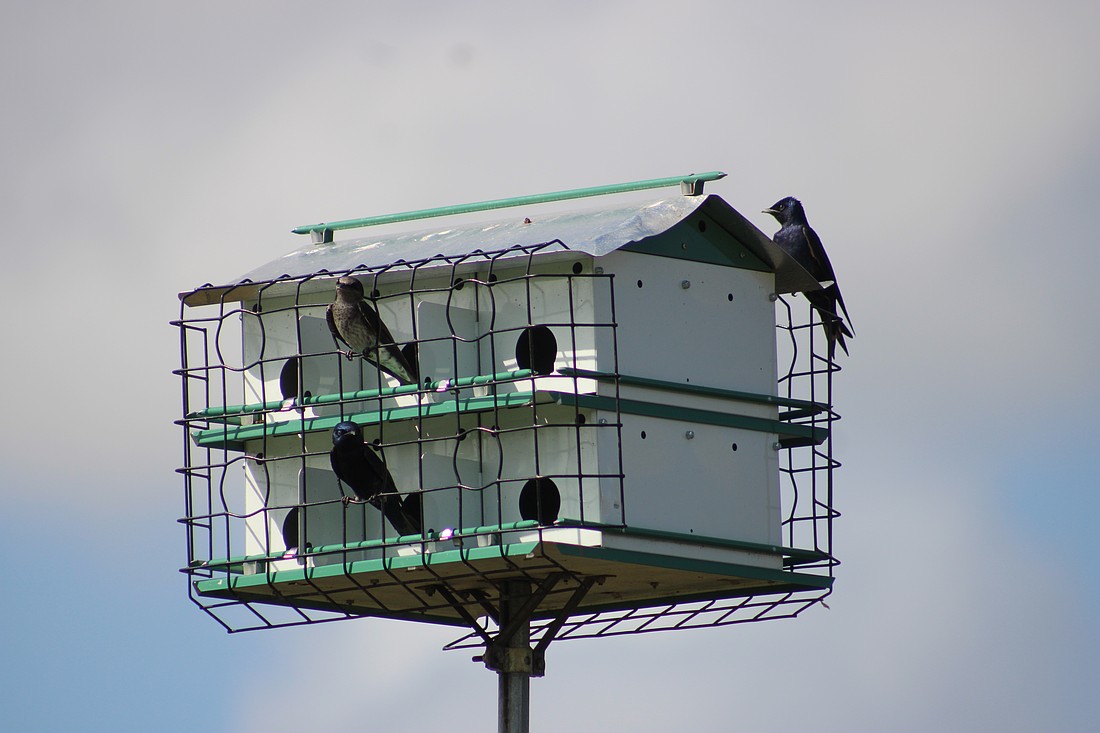
Brian Beckner was sitting near a golf course's fairway, directly under a bird box he had made for purple martins, who all were tucked inside the structure, out of sight.
Even so, their presence was evident. Purple martins' calls have been described as throaty chirps and creaky rattles. It was loud.
A couple of golfers approached Beckner in their cart.
"What are you doing?" one of the golfers asked.
"I am watching the birds," he replied.
"But there are no birds," the other golfer said.
Beckner just shook his head.
"What do you think that sound is?" he shot back. "The screeching of the brakes on your cart?"
Just behind the hole No. 8 tees on the Ritz-Carlton Members Golf Club in Lakewood Ranch last week, purple martins darted in and out of their bird condo entrance. The passing golfers would have no trouble seeing that the bird box designed by Beckner was in full use.
The purple martins' bird box is one of 15 on the course that was designed and built by Beckner, who owns Native Bird Boxes of Estero.
Beckner founded Native Bird Boxes in 2013 after a 17-year career as a golf course superintendent. He wanted to pursue his passion for protecting bird habitats. He now manages thousands of bird boxes across southwest Florida.
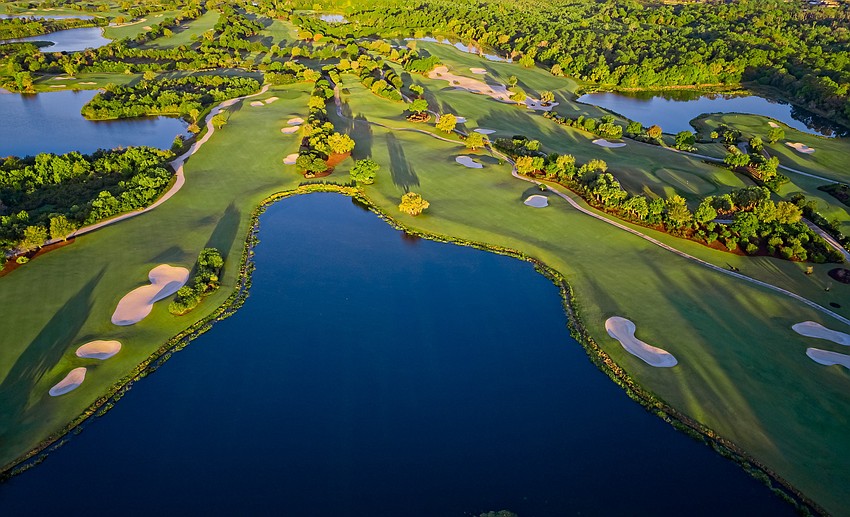
He found a willing client in the Ritz-Carlton Members Club, which just received its recertification through 2028 by Audubon International’s Cooperative Sanctuary Program.
It should be noted that Audubon International is not associated with the Audubon Society, but is concerned with overall environmental stewardship and not just birds.
Its mission is "through education, technical assistance, certification, and recognition, Audubon International puts environmentally sustainable management practices in place around the world."

Audubon International noted that it was recognizing the Ritz-Carlton Members Club of Lakewood Ranch's continued commitment to environmental stewardship and responsible land management. It is one of approximately 900 courses in the world to hold such a distinction.
"They have gone beyond the call of duty," said Scott Turner, the director of Audubon International's Cooperative Sanctuary Program.
Beckner agrees.
"This is an amazing property," Beckner said of the Ritz-Carlton course. "This is five-star for the environment."
As part of its commitment to protecting the environment, Ritz-Carlton hired Beckner to build and maintain the bird boxes. Beckner also monitors each bird box and presents the course with data related to the birds that occupy them. It is all part of the course's commitment to maintaining its standing with Audubon International.
Dalton James, the superintendent of grounds for the Ritz-Carlton Members Golf Club, said it is just one part of the course maintaining its standing as a wildlife sanctuary.

"It is about environmental planning," James said. "We have the bird boxes. We do a lot of data on the chemicals we use (on the course). Our shorelines are naturalized."
James took his position in 2024 after moving from Myrtle Beach, South Carolina, where he worked at a golf course. He said his previous course was not filled with the kind of wildlife he has experienced in Lakewood Ranch.
Shortly after he arrived in 2024, he was sitting just off hole No. 11 when he looked over into a wooded area. A bobcat was looking back at him.
"I didn't see any of that on my last course," he said.

But at the Ritz-Carlton Golf Club, it is a common sight.
"Our goal is to be environmentally friendly," James said. "We want to protect our community."
Much of the environmental work includes the chemicals used, or not used, to keep the course looking pristine. The course property is 160 acres, and of that, 120 acres are mowed. The other 40 acres are naturalized areas that require little maintenance.
To meet the sanctuary requirements to reduce nitrogen and phosphorus levels, the Ritz-Carlton Club went to different chemicals, such as micronutrients, that would keep the course pristine, but were more costly.
James said a big part of maintaining the club's status with Audubon International was keeping meticulous records of water use and quality. But he said that concern has been done ever since the course opened in 2005.
The course utilizes the Toro Lynx Central Control System which is a "software-driven, irrigation management platform designed for golf courses to monitor, manage, and optimize water usage in real-time. It provides intuitive, map-based, site-specific, control which enables superintendents to track watering amounts."
Particular attention is paid to aquatic vegetation, which can act as a natural filter for water that runs off the course.
James said the club's environmental plan is to do the best it can with the least amount of fertilizer. That can be a hard task at times when the members expect the course to be pristine year round.
Turner said having Beckner involved is "an enormous asset" for the club, which he said has done a great job of documenting its achievements. He said Audubon International's last site visit to the club was in January, and the club's commitment hasn't wavered since it was first certified in 2008.
Turner also said that while the effort to earn certification might initially seem costly, over the long run the nonprofit's research has indicated that the courses invoved actually save money.
"There is a return on investment," he said. "Our research shows that 90% of the golf courses that have been certified showed their costs stayed the same or were lower."
He said that is something to consider considering that "many golf courses have a black eye (when it comes to the environment)."