- March 12, 2026

-
-
Loading
Loading
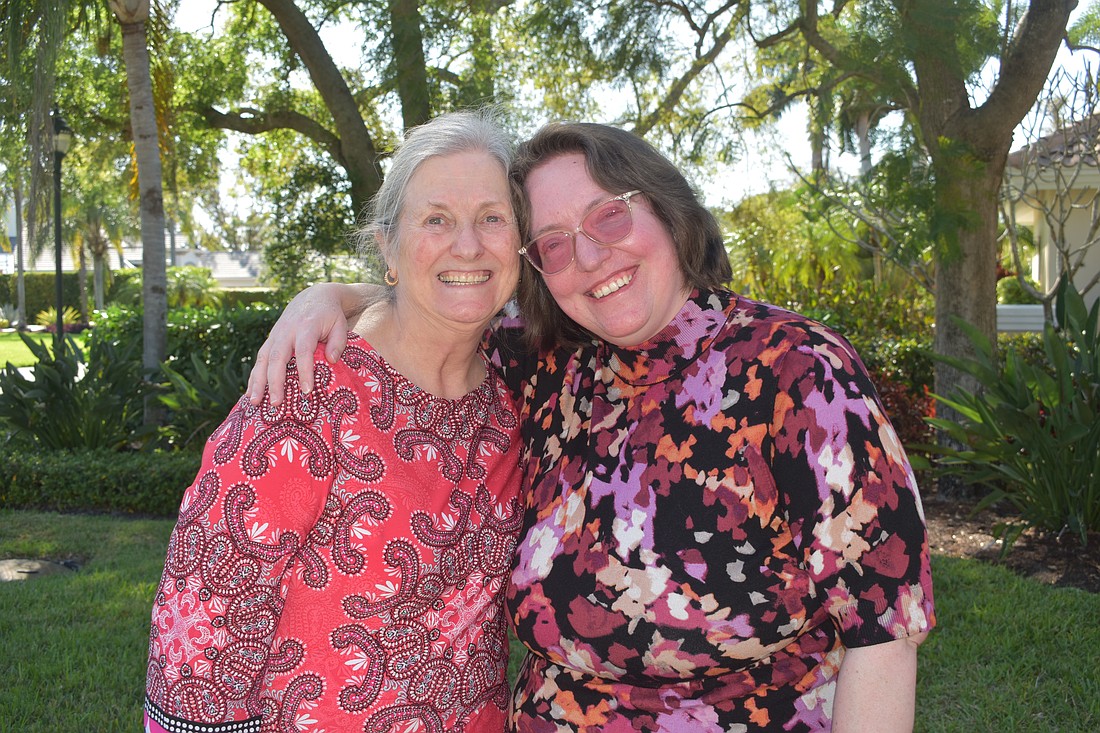
At the time Margaret Johnson’s daughter Rebecca Johnson was born, the United States was celebrating its bicentennial anniversary.
Margaret began thinking that it would be important for Rebecca to know her family history.
That coincided with a family reunion, during which Margaret was given a historical document about her family. Although it contained errors, she says her background in information technology made her well-suited to genealogical research.
She was interested to learn about the role of her third great grandfather, Thomas McMicking, who she was able to confirm came to North America from Scotland in 1774, just before the American Revolution.
“I had stars in my eyes as a beginning genealogist, and I wanted to be a part of the Daughters of the American Revolution,” she said.
But years later, she found something she didn't expect, when other documents confirmed McMicking was in fact loyal to the British crown, having spied on American troops.
“Unfortunately, there went my DAR recognition,” she said. “Forget it, I discovered something so much more meaty and interesting.”
Johnson says her participation in genealogical organizations has helped open up opportunities to trace her family history, with one such organization being the Genealogical Society of Sarasota.
Nancy Johnson (no relation to Margaret Johnson), the society's president for 14 years, says today, the group exists to support others involved in genealogical research, as in one case where a member began questioning the identity of a person in her family tree.
“It all made sense, so I think she felt a lot better when we were done talking, that she had found the right person,” she said. “It's a second pair of eyes, but in this case, it was five extra pairs of eyes looking at it.”
In the past, the society had met at the Selby Public Library.
However, after the COVID-19 pandemic and due to parking difficulties downtown, it moved to Gulf Gate Library.
Since then, all meetings have also included the option to attend virtually. She says meetings tend to draw 25 to 30 people, although prior to the pandemic, numbers had ranged from 50 to 65.
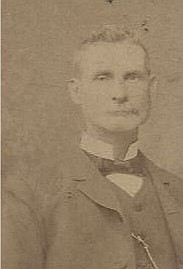
Special interest groups within the organization also allow members to discuss topics that range from brick walls to DNA research.
According to Johnson, one of the advantages of the virtual meetings has been the ability to obtain speakers from across the country without the need to fund transportation.
The next meeting, set for March 14, will feature a webinar by Thomas MacEntee, a well-known genealogy speaker who is now retired.
However, it will also include a discussion around “skeletons in the closet" highlighting Johnson's family.
“The important part is, you don't just tell the funny story," she said. "You tell how you found it, and that's what's critical is, what research did you do that came up with that?”
She says it will serve as a model for how members can present their own such stories next year.
Since she retired from her role as a pharmaceutical company executive, Johnson has spent about 24 years researching her family history.
She says she has identified more than 8,000 individuals, focusing only on direct lineage and children.
One of the stories she plans to share at the next meeting involves her great grandfather Michael O'Brien, who came to the United States from Ireland in 1853 during the Great Irish Famine.
She says his history presented a contrast with the character of her father, something she thought was amusing, although he did not.
“I used to jokingly call my father the last of the great Puritans,” she said. “I mean, I never heard a foul word out of his mouth, nothing."
A Civil War pension application, from O'Brien's wife in 1912, contained an interesting admission.
“She was, like me, too honest, if that's possible to be, and she admitted that he had been a bigamist,” she said. “When she married, it was not a legitimate wedding because he still had a wife, and she didn't know that until like five or six years later, that he had done that.”
That also posed a challenge in finding out the identity of his parents. His death certificate listed his father's name as James O'Brien.
“Well, it turns out that wasn't his name, so he must have lied to his second wife about his dad's name, even,” she said.
She says a distant cousin living in New Jersey, who belonged to a Facebook group about Philadelphia, ultimately steered her in the right direction.
Johnson says those who aren't interested in sitting in libraries and performing research won't find genealogy appealing. What inspires her interest in the field is her love of learning history.
“I have proven relatives that fought in the War of 1812, so I learned a lot more history, proving it, so that's what I love about it,” she said. “It isn't just learning who my family was or wasn't. It's also the actual history, not only U.S. history, but then when you go back in time to where they came from, you're learning history in their towns.”
Margaret Johnson has researched about 6,000 relatives.
Initially, she had no notion that Thomas McMicking was a loyalist, but she uncovered his leanings over a 10-year span.
It started with the discovery that his brother belonged to the loyalist military unit, Butler’s Rangers.
She began researching correspondences, finding confirmation in the papers of Swiss military officer Frederick Haldimand in The National Archives in England.
At one point in time, she said, McMicking began petitioning for land grants in the area of what is now the town of Stamford, Ontario.
However, he was requested by Mohawk military leader Joseph Brant to remain in the Schoharie Valley area, to provide information on the movement of American troops and offer provisions to British troops.
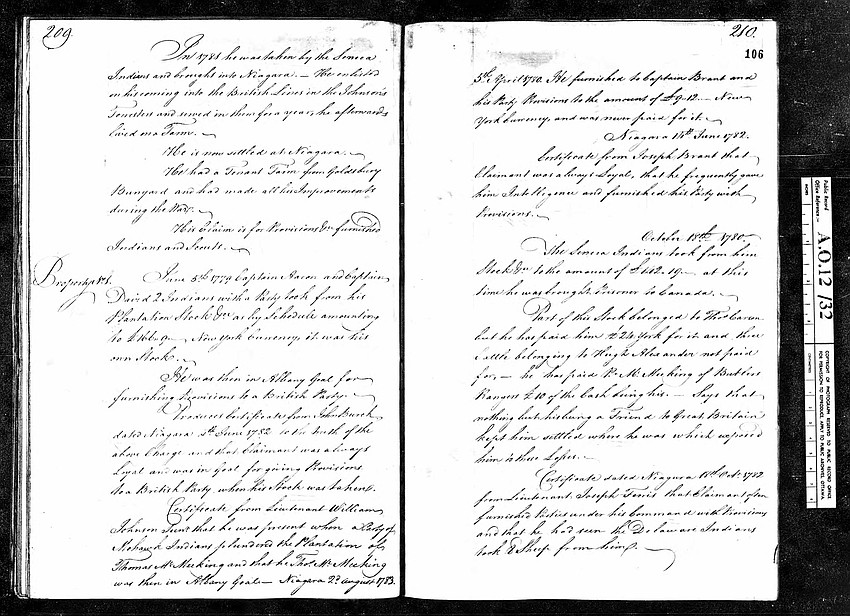
She says as a result, McMicking remained through the worst battles and massacres that took place in the area. Then, in about 1780, he was jailed, due to the town suspecting him of being a Tory.
He was probably turned in by neighbors, she says.
Ultimately, however, he did make it north to the Niagara area, initially farming for the garrison there, then gaining the land grants, which cover an area that contains a power station today.
A road leading down an escarpment to the river is one that he and his sons cut by hand, so that ox wagons could be take there for water, she says.
McMicking is listed on one of the first maps of the area created for John Butler, in about 1782, making him one of the its founding members, she says.
She notes that a street in the area is named for him, while the First Presbyterian Church of Stamford sits on land given by him to the town. His mother, Janet Mulwain, is the first burial in the churchyard, where McMicking and his wife, Isabella Gass, are buried.
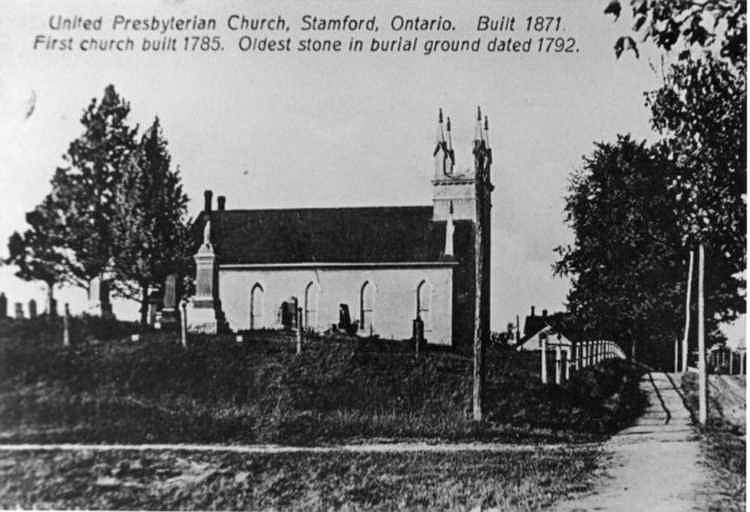
She says she doesn't resent the fact that McMicking was a loyalist.
“I'm rather blown away by it,” she said. “I do feel that being a United Empire Loyalist was just a different viewpoint, and I admire his tenacity. In the end, this poor man just wanted to be a good farmer, and he finally made it, and so to me, it's a really heroic success story, but one of perseverance."
Currently, she's working on growing her writing skills to create professional writings detailing her family history, as well as finding out more about his marriage to Gass.
She says her daughter enjoys hearing the stories and assisting her with the writing aspect.
“All these stories are in my head, and I figured the only way I'm going to do these people justice is to get them on paper, and that's what I work toward," she said. "I want to tell the story that I now know about Thomas McMicking, because it's better than any fiction that could have been made up about it.”