- March 5, 2026

-
-
Loading
Loading
Lingering doubts remain over the willingness of Sarasota County to participate in funding.
Uncertainty hovers over whether Florida voters will have a chance to reform property taxes up to and including elimination them for full-time residents.
If those critical financial ambiguities were not at top of mind for Sarasota city commissioners with regard to a new Sarasota Performing Arts Center, they loitered in the background on March 2 as they received a presentation of the facility’s proposed “Concept 2.0.”
It had been nearly a year since commissioners sent the Sarasota Performing Arts Foundation and architect Renzo Piano Building Workshop back to the drawing board with several directives of the then-proposed $400 million-plus project. They included:
“Every single line item that was in my memo back in March (2025) saying, ‘Please address these concerns,’ you addressed every one of them,” Mayor Debbie Trice told the delegation representing the foundation.
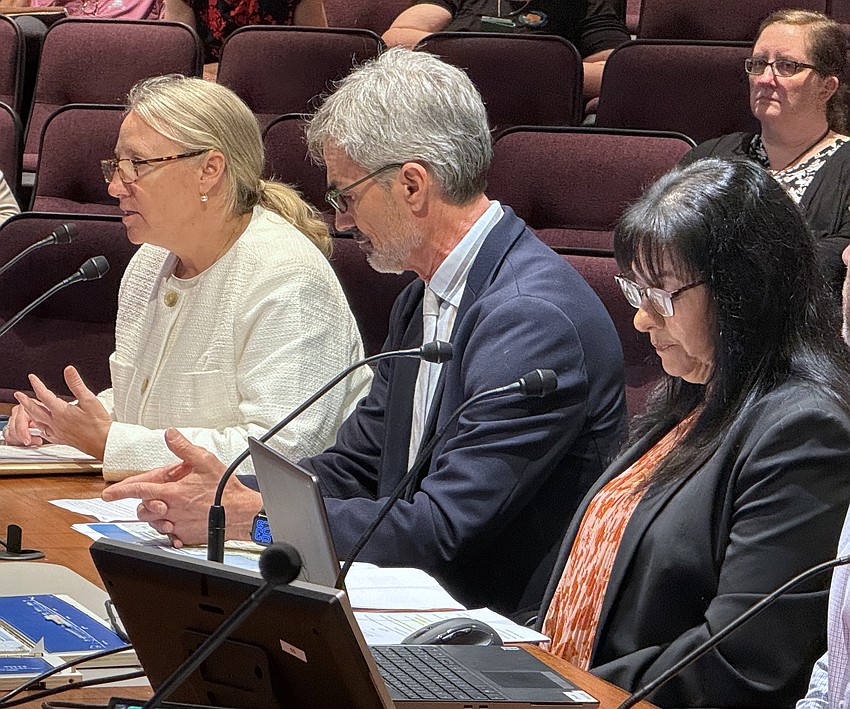
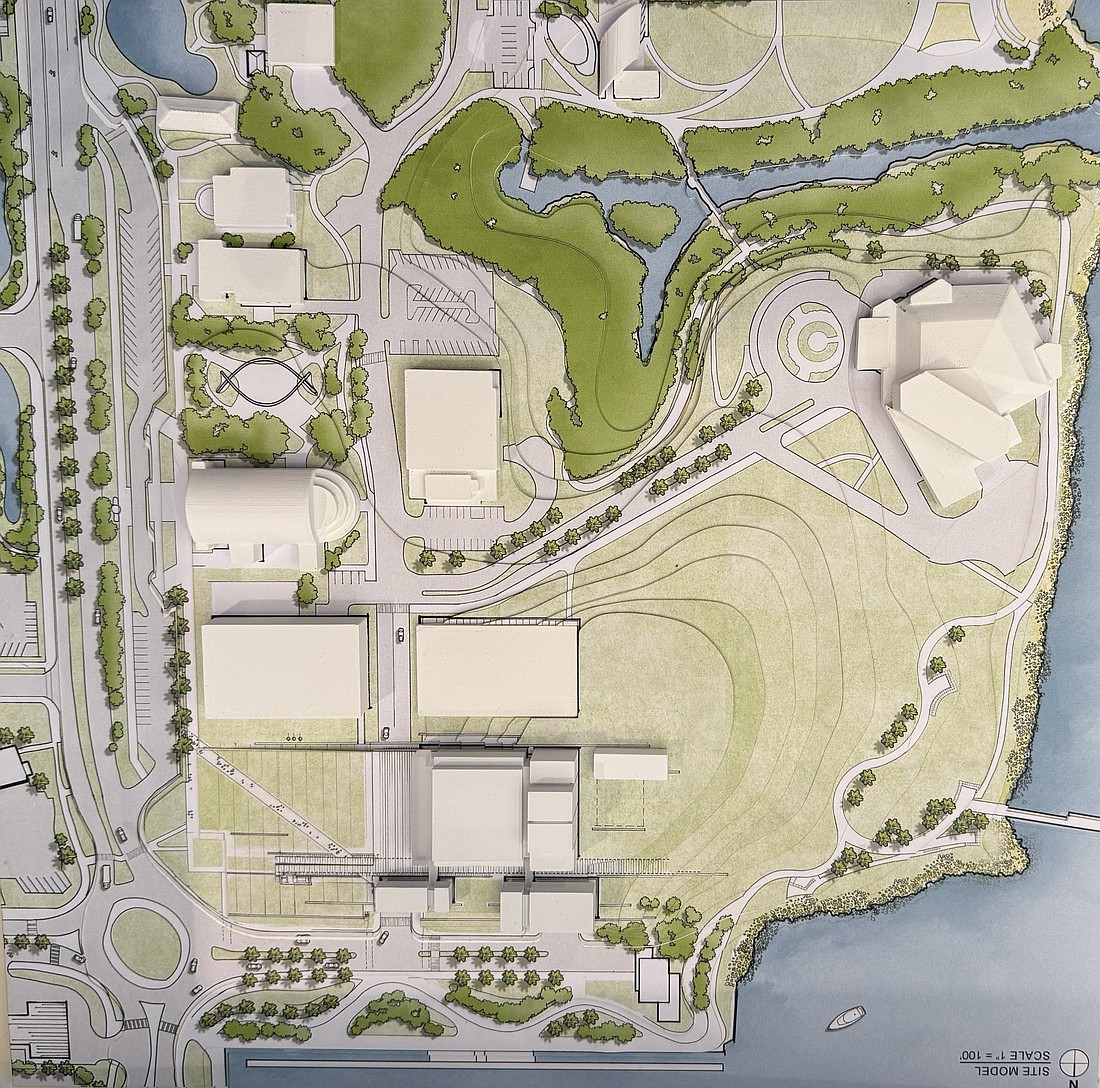
Concept 2.0, Sarasota Performing Arts Foundation CEO Tania Castroverde Moskalenko told commissioners, is the result of a year’s collaboration between her organization, city staff, Renzo Piano architects and the Bay Park Conservancy. The new Sarasota PAC would occupy a prominent spot in The Bay park at the northeast corner of what is now the Van Wezel Performing Arts Hall parking lot, which the BPC intends to convert into storm-resilient and elevated green space, a portion of it above new parking space.
“Concept Design 2.0 is a direct response to your feedback and the feedback from the community,” Castroverde Moskalenko said. “Our intent has been to deliver a concept that is financially sound and unified, one that meets our community needs, honors the park master plan, reduces cost without sacrificing quality and demonstrates a fiscally sound framework. It also strengthens coastal and building resiliency.”
The original PAC concept, which priced out at an estimated $425 million, addressed resiliency by placing a four-building complex atop 20-foot piers and spreading them across the canal at the 10th Street boat launch along North Tamiami Trail.
That raised concerns regarding reduction of vehicle and trailer parking in Centennial Park — which is being enveloped by The Bay park — in addition to the cost. At a Feb. 11, 2025 workshop, commissioners requested the complex be moved entirely to the south of the canal, but into the view corridor Renzo Piano architects attempted to avoid in its original concept design.
A second attempt, which was presented in March 2025 as both sides worked toward approval of an implementation agreement for the project, reduced the project to two buildings with the same number of main theater seats, still elevated and located as far north as possible south of the canal to avoid the view corridor. The cost estimate was reduced slightly to $407 million.
That prompted the commission’s directive and set off the yearlong collaboration, resulting in a single building, the resilience elevation provided by the BPC’s plan to gradually raise the current parking lot toward North Tamiami Trail as it converts it to green space. Consolidating the complex into one structure built at ground level and taking out 500 seats reduces the cost estimate of $260-$295 million, toward which the foundation has committed to raising between $172 million and $207 million, depending on the final tally.
The public portion of the project, currently estimated at $88 million, comes from tax increment financing district revenues dedicated toward development of The Bay park and structures within it. That cost does not include two proposed parking decks that would largely replace the current 800-space parking lot.
“The main goal of the park was to raise elevation for resiliency, not just for the park, but for the city itself, and to provide room for stormwater treatment,” said project consultant Adam Gelter of Iterum Consulting Group of Cincinnati. “What this plan does is fits the performing arts center into that resiliency plan. It also stays under the view corridor easement, which is a key component that we're working against.
“The design team did a great job of starting from that elevation down and figuring out how to fit everything underneath it.”
That view corridor easement prohibits any structure to exceed 99 feet in height.
Bay Park Conservancy Founding CEO AG Lafley had previously worked with Gelter when, as chairman and CEO of Procter and Gamble, he and Gelter worked together on park development projects in Cincinnati.
Lafley said the location and design of Concept 2.0 is compatible with the BPCs plans to further develop the resilient shoreline between the Van Wezel and the canal, where a new floating day dock was recently completed.
“We have a site for a design concept that could and should work in the master plan that the City Commission has approved for the entire site,” said Lafley, who joined the meeting remotely. “That’s important because we're trying to put together a lot of different pieces of the Rubik's cube here.”