- March 4, 2026

-
-
Loading
Loading
After this week, there is one week remaining to the normal Florida legislative session. That means this week has been the scene of the typical scramble for Florida’s 160 lawmakers trying to get their pet-project legislation to the House and Senate floors for final votes.
Of the 1,800 bills filed, most are aimed at small segments of Floridians. But among those are two worth noting now — primarily because they will and could touch all Floridians more than any other legislation: the annual budget and a proposed constitutional amendment that would eliminate the ad valorem tax on homesteaded properties, excluding the school property tax.
The Legislature has only one mandated job each year: adopt a balanced budget. And at the end of each legislative session, the dance is always the same — House and Senate members squabbling and horse-trading over who gets to keep or lose what spending in their respective budgets.
But in this year’s horse-trading, it’s worth noting this extraordinary circumstance:
If Republican Speaker Danny Perez and his House members prevail in the next two weeks, they will have accomplished a feat rarely, if ever, done in a state Legislature: Two consecutive years of spending less money than the previous year.
Try to find a legislative body anywhere in this country that has ever achieved such a thing when the economy is not in recession or a depression.
Not only is the House budget proposal $1.2 billion less than the current state budget, it’s also $4 billion less than what Gov. Ron DeSantis proposed.
The House isn’t just slashing for slashing sake. Indeed, if you look at the accompanying table, you can see the House budget would increase spending over the current fiscal year in four of six categories — in particular in education and human services.
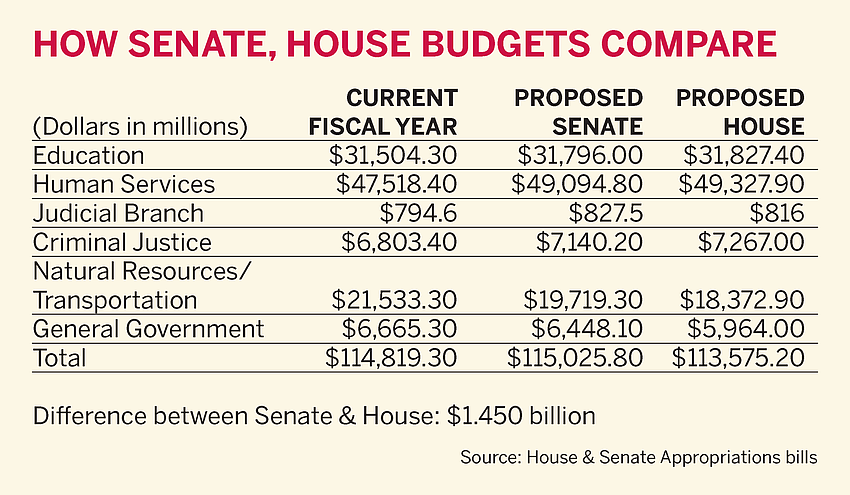
Compared to the current fiscal year, the House cuts would take $2.3 billion out of the Transportation Department and $232 million from the Consumer Services Division in the Agriculture Department, or 14.6% altogether. From general government, the House wants to cut $65 million from the Department of Commerce, or 10.5% altogether.
Those are remarkable reductions.
It’s not likely the Senate will go along with the House. The two sides, as always, will fall somewhere in between.
If Perez’s lower spending prevails, he should go into a legislative Hall of Fame.
Unfortunately, such fame is fleeting. In the past 50 years, not one speaker has gone on to become governor. Two former speakers made it to the U.S. House and one to the U.S. Senate and now secretary of state.
But the bigger point is this: Speaker Perez has demonstrated a lesson for all elected officials: that restraining and cutting government spending can be done and constantly should be done.
HJR 203 was one of six bills that addressed Gov. Ron DeSantis’ challenge last year to the Legislature — to figure out how to eliminate Florida’s property tax.
DeSantis, you may recall, made the beef that Florida homeowners don’t really own their homes. Because of local property and school property taxes, Florida homeowners are actually just renters.
Speaker Danny Perez took up the challenge and appointed a special committee that worked over the summer through the end of 2025 to come to the 2026 legislation session with proposed constitutional amendments.
The House cut its six proposals down to one. That one proposal would eliminate the property tax for homesteaded properties, except for the school portion of the tax. It also would mandate that every county and municipality keep funding at the 2025-2026 levels for all first responders.
The House passed the bill and sent it to the Senate, where is waiting for Senate President Ben Albritton to decide what to do with it. He could either assign it to go through the standard process of committee hearings or just let it die.
As of this writing, Albritton and the Senate have not touched the issue. Asked why not, Albritton told the Observer Gov. DeSantis has stated property taxes should be considered in a special session.
“As we work together with the governor and the House toward consensus on a bold, meaningful, broad-based proposal that voters will be excited to support, I’m certainly open to addressing property tax relief at a later time,” Albritton said via email.
“Major revisions to our property tax structure are a big deal. We owe it to Floridians to devote the time necessary to get this right. The substance is more important than the timing.”
Nevertheless, you can credit Perez and the House subcommittee members for attempting to address this major issue and problem. Perez and the House did what Perez said it would do.
At the same time, Albritton is also correct — not to vote to put HJR 203 on the ballot. Elected commissioners and council members in Florida’s 67 counties and 412 municipalities have been fretting for nine months, worried that voters overwhelmingly would approve cutting their property taxes, but doing so without really understanding the unintended consequences.
Another case of the “seen” and “unseen.”
While the House subcommittee crafted a way to cut Florida’s property tax, it didn’t address how the consequences would be or could be managed. Counties and municipalities primarily fund their services via the property tax. If you take away that source, local governments inevitably would turn to other taxing mechanisms.
Watch for a special session on property taxes this summer.
Historically, the Florida Senate takes a more cautious, conservative approach than the House to dramatic changes. On this issue, great care is required. When your doctor prescribes medicine, you want to know the side effects before you swallow the pill.
Floridians need to understand the consequences before voting on a constitutional amendment.