- July 1, 2026

-
-
Loading
Loading
Looking out at the teal-blue Gulf waters from Longboat Key could give some the impression of a remote island.
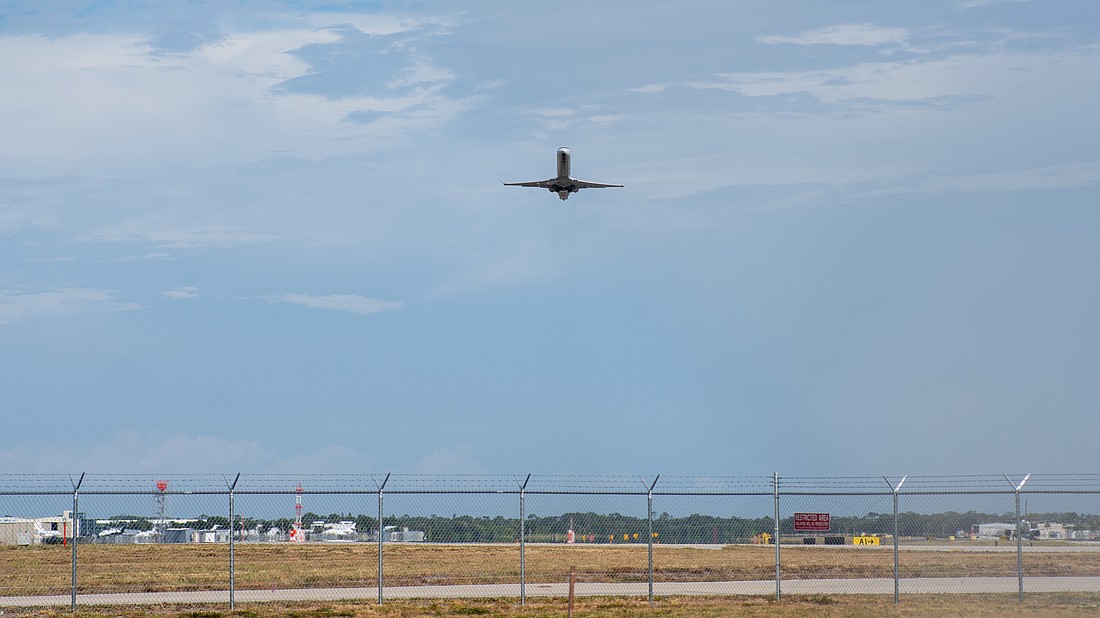
But then the soothing sound of crashing waves is broken up by the rumble of a truck unloading construction equipment, the buzz of a Weedwacker or the roar of a Boeing 737 passing overhead. Longboat Key is paradise, but it’s not a remote island, and residents are worried about the impacts millions of annual visitors to the Gulf Coast may have on the exclusive barrier island on their way in and out.
A recent study commissioned by the town determined particulates that have been popping up on patios, vehicles and other surfaces is most likely not from planes passing overhead.
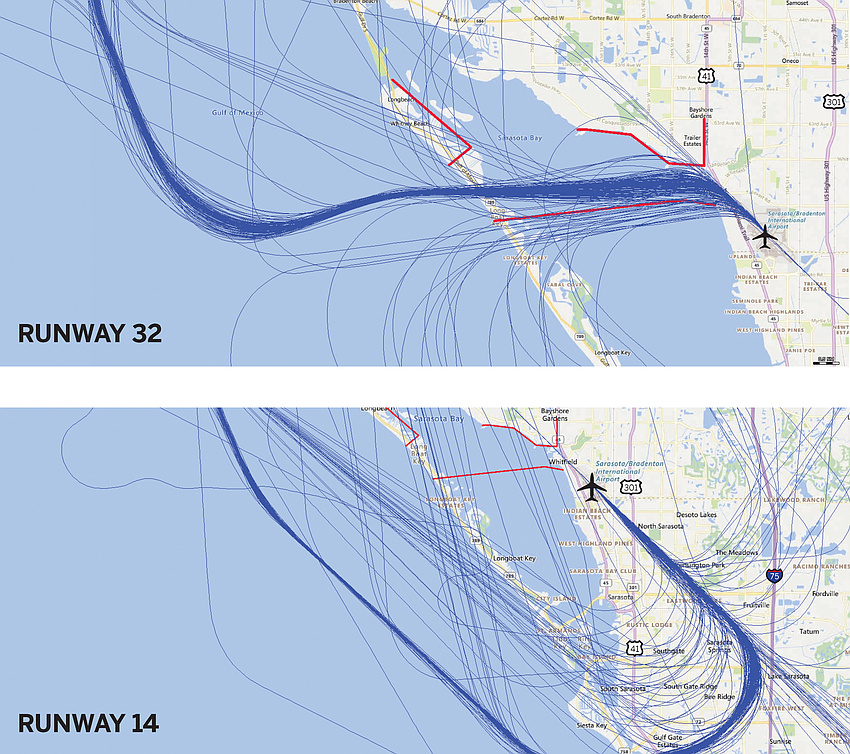
Flight paths from the Sarasota-Bradenton International Airport were changed by direction of the Federal Aviation Administration in 2024, meaning planes departing the airport now fly over Longboat Key about a mile farther north than they used to.
With that change came new complaints from residents beneath the new flight path. Longboat Key Mayor Debra Williams, who lives at the Positano Condominium Complex and serves as the condominium association’s vice president, said she heard concerns from residents at her complex after the flight path change about noise and particulates accumulating in common areas of the complex, and she has seen it herself.
“What we typically see is a very fine, black matter. It’s almost ashy,” Williams said. “If I go out there and just wipe down a piece of the furniture or even the tile on the balcony, it’s black. It’s a very fine black dust. You wash the balcony down and then not even a week or two later you still have this black grit.”
Bill Emling, a maintenance worker at a Longboat condo complex, said a fine black dust gathered on patio furniture and could be seen in the water he sprayed to periodically wash off the roof of the complex. Emling, who previously worked at an airport in Ohio, said he believed the dust was from planes passing overhead.
Town Manager Howard Tipton said the town received reports of the black dust appearing on patio furniture and vehicles.
“We needed to find out where it was coming from and so we contracted with Vertex to do the study,” Tipton said.
After Longboaters raised concerns about the potential impacts, town leaders decided to determine the source of the reported particulates.
In January, an initial test of air quality was performed at the Positano condo complex. Town Engineer Jennifer Fehrs said the $2,744 contract with Air Quest Environmental determined that airborne lead concentrations “were not detected at levels of concern” and were “substantially below” health-based ambient air criteria. Ambient air criteria is a benchmark set by the Environmental Protection Agency that determines when levels of certain elements in the air can cause health issues.
That test was rudimentary compared to a second, more recent study performed by Vertex Companies.
The town paid Vertex $28,000 to perform environmental monitoring on three days between April 17 and May 1 at five separate locations.
On Longboat Key, monitoring was done at the Positano condominiums, the Longboat Library and from Sandhamn Place near Joan M. Durante Community Park. Two off-island locations — one next to Interstate 75 at Tom Bennett Park and another at the Sunny Shores Park neighborhood in Cortez — were also monitored to provide comparison data.
Vertex National Technical Lead of Healthcare Mark St. Marie said the samples Vertex gathered were not collected off surfaces, but gathered from the air.
“You lose some resolution when it’s been sitting there,” St. Marie said. “With rain and the material that’s just sitting there, you can lose some of the chemicals that kind of leech out really quickly so it can be misinformed when you do surface testing.”
The devices deployed by Vertex collected particulate samples, gasses, and volatile organic compounds. It also measured noise levels.
“That noise monitoring is really to associate the particulate load with aircraft that are passing overtop,” St. Marie said. “We’re not looking for noise in the community. What we’re looking for is to associate the particle drop as the aircraft are passing overhead.”
Flight pattern data was also incorporated in the study.
The Vertex report concluded the particulates measured by Vertex were likely not from aircraft.
“Overall, the monitoring results did not identify conclusive evidence of sustained or uniquely elevated aircraft-related particulate impacts within the monitored areas during the study period,” the report states. “Real-time particulate and gas-phase monitoring identified transient environmental variability consistent with normal atmospheric fluctuations commonly observed within coastal urban environments.”
One of the determining factors in drawing that conclusion was because of the size of the particles collected. Small airborne matter are broken down into three size categories: PM1, PM2.5 and PM10. For reference, a PM10 particle is the largest size, about 10 microns in diameter according to the Environmental Protection Agency. In comparison, a human hair has the diameter of about 50 to 70 microns and a grain of sand is 90 microns in diameter. PM2.5 particles are two and a half microns in size and PM1 particles are 1 micron.
“What we found is more of the larger sized particles, the PM10. Typically, when we see aircraft emissions, we would see the reverse of this. We would see what we call the ultrafine particles around PM1. We didn’t see that here,” St. Marie said. “We didn’t see a direct correlation of particulate monitoring that was associated with the aircraft.”
The report also concluded the elements and airborne metals detected did not include the “distinct combustion-related signatures” typically associated with aircraft emissions like chromium or cadmium.
The source of the black dust that accumulates around Longboat Key likely originates not from the sky, but possibly from Gulf of Mexico Drive and landscaping activity.
“We did find particles that were falling, but it was not associated with the aircraft,” St. Marie told the Commission on June 22. “The likely contributor in our professional opinion is roadway traffic and marine activity or local regional combustion activities like golf course maintenance, things like that that are in the area. These are all local, and that’s just based on the size of the particle that’s being generated. They don’t travel as far. The larger particles stay local.”