- April 6, 2026

-
-
Loading
Loading
Longboat Key has plans to spend about $7.5 million over the next 14 years on fire trucks, ambulances and other police, fire and EMS equipment.
There’s a slight problem, however. The revenue stream the town mainly uses to pay for replacement equipment isn’t expected to cover everything on the town’s wishlist. According to a presentation made to Longboat Key’s Citizen Tax Oversight Committee, there’s a $6 million imbalance between projected infrastructure surtax revenue and planned expenses.
Both Manatee and Sarasota County have an infrastructure sales tax. In Manatee, a half-cent sales tax is levied. In Sarasota County, a one cent tax.
The money levied is then distributed to the counties and municipalities within them based on population. For Longboat Key, that has been about $1 million per year the past three years from Sarasota County and $300,000 from Manatee County. The town uses projections for what revenue will be for the duration of the tax collection period to make a 15-year capital improvement plan. That plan at the moment calls for spending $6 million more than what is expected to be collected on the Sarasota County side.
Of the $15.1 million, about half is earmarked for public safety vehicle and equipment purchases, the biggest planned expense for the infrastructure surtax funds.
Longboat Key Fire Chief Paul Dezzi shared recent price estimates with Town Commission during a workshop meeting in late March.
“How much do you think an ambulance costs? I’ll tell you: $370,000 with nothing in them. Nothing inside. That’s just the nice pretty lights and the nice truck,” Dezzi said. “Marine units cost $100,000. A ladder truck is $1.7 million. These are not cheap equipment, and these are all non-equipped.”
Finance Manager Sue Smith said increasing prices of equipment are leading to higher spending estimates than originally anticipated.
Smith said in some instances, the prices for equipment have doubled in the past five years.
The good news is adjustments can be made to the capital improvement plan to avoid pulling from other funds to pay for the replacement of equipment. The town’s budgeting process, which began with a goals and objectives workshop Monday, will allow the Town Commission and staff to come up with a strategy to come up with alternative ways of funding infrastructure needs in addition to the infrastructure surtax.
Smith said one thing that could be considered is financing replacement vehicles and apparatuses.
“One thing we can do is we can maybe lease finance fire trucks going forward,” Smith said. “We might have to pay a little more interest, but if we have to push it out and pay it over time or over the life of the asset instead of trying to pay for it all in one year, that’s how we can do some of that.”
Another potential solution for the shortfall is removing 10% of the spending pie: canal dredging. As the town continues to discuss the possibility of enacting ad-valorem assessments on properties to pay for the project, that could free up $1.5 million in the town’s infrastructure surtax spending plan.
“If we can use that canal money and use it toward public safety, that might fill the gap seeing that we have another funding source for canals, or eventually will have one,” Smith said.
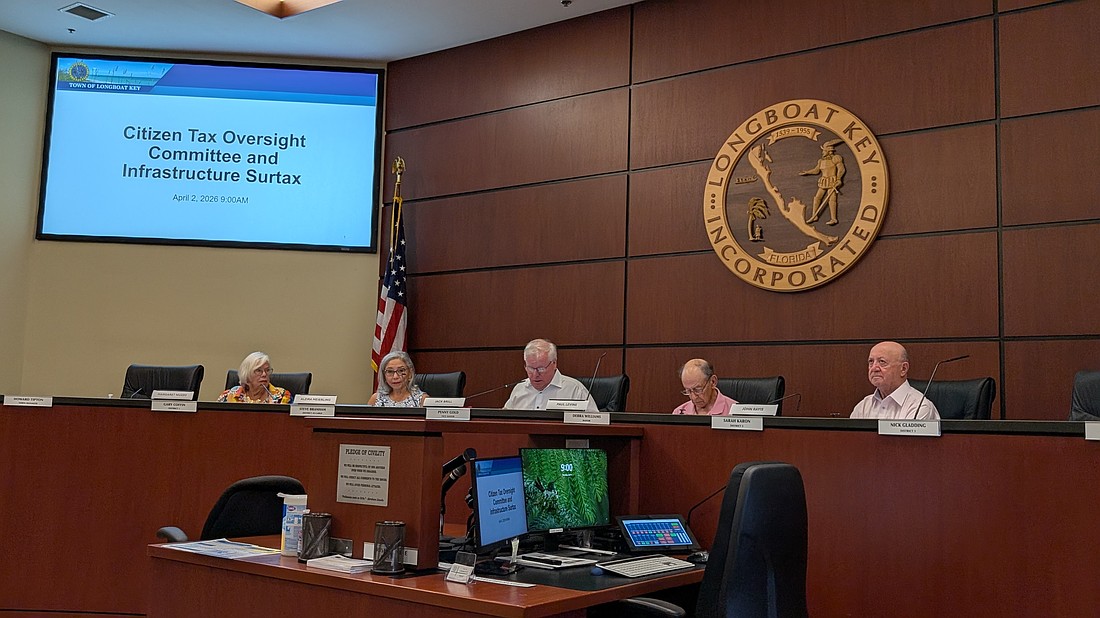
On Thursday, April 2, the town’s Citizen Tax and Oversight Committee met at Town Hall to evaluate the town’s infrastructure surtax expenditures past and future. The meetings required by law result in a memo to Town Commission explaining the previous fiscal year’s operating results. In 2025, the first year of phase IV of the infrastructure surtax, expenditures exceeded revenues by $239,190. That reduced the infrastructure surtax fund balance to $1.2 million.