- April 1, 2026

-
-
Loading
Loading
Any urban planner will tell you that mass transit is the most effective way to reduce traffic.
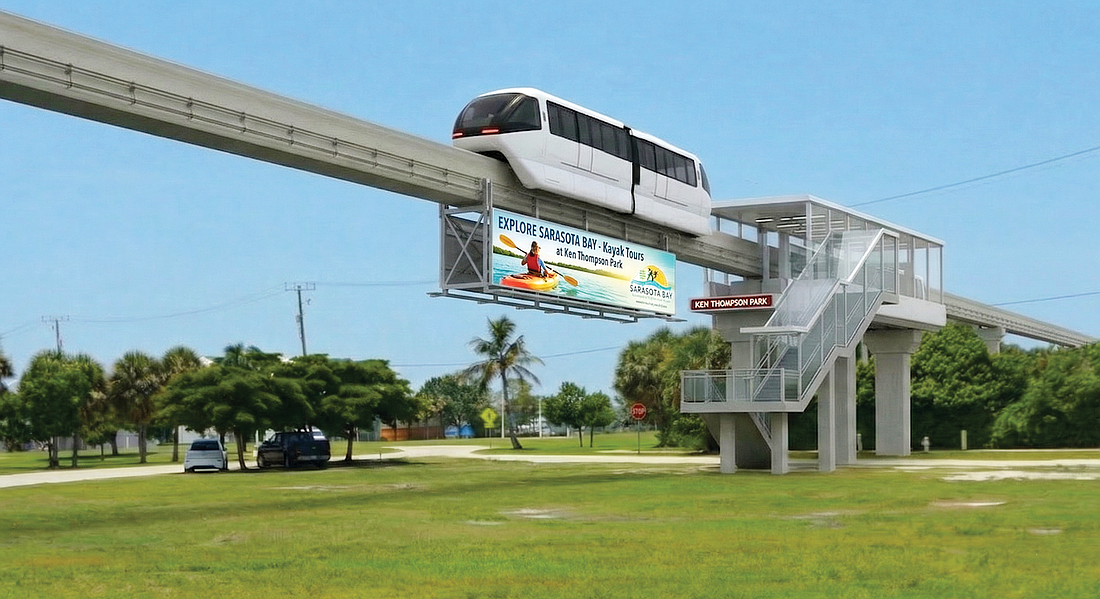
And after a $14.8 million traffic solutions study, the state is moving forward with a mass transit program just for Longboat Key that will be as unique as the island — an elevated monorail.
The $645 million monorail is a public-private partnership using federal transportation grants to supplement private investment in the project. The $275 million in private funding comes from a reclusive billionaire who has called the island home for 22 years, Lewis Waltzberger, and retired aerospace engineer John Brooks. The two have secured bank loans to fund the project, leveraging their extensive antique car collection as collateral.
“I won’t need those money pits anymore anyway,” Waltzberger said. “Monorails have always been a fascination of mine, and my miniature scale models weren’t scratching that itch anymore. I thought why not do something that will help the island that I’m passionate about in retirement?”
The plan is a 10-car monorail with four stops on the island and one stop across the pass. Ken Thompson Park will serve as the main boarding station for the monorail, with stops throughout the island at popular locations. Right now, four stops have been confirmed at St. Regis, Publix, Bayfront Park and the public beach access at Broadway Street.
The monorail will fit 15 people per car and will make stops twice per hour at each stop. The CRX-90M electric-powered monorail will reach top speeds of 45 mph. Admission costs are $15 per day or $150 for a three-month season pass.
Town leaders are all aboard, noting that the monorail perfectly fits the town’s plans for Gulf of Mexico Drive to become a “Complete Street.”
“Solving pedestrian problems on Longboat Key will be so much easier now,” said newly picked mayor Henry Palmer. “With less cars on the road, we can finally do construction projects during peak season. And the monorail pays for itself.”
Palmer is referring to the most contentious part of the monorail plans, which Waltzberger and Brooks are confident will get a thumbs up from the town because of the traffic problems the monorail will solve.
“Monorails, by their very nature, are elevated. They’re also very expensive. Our plan is to use the space under the platforms for advertising space,” Brooks said. “We have already contracted with two major companies to help fund this project.”
Below the monorails will be 36 advertising billboards. The cost for each will come at a premium and will fund maintenance and staffing for the monorail.
“Listen, I worked for NASA. I know what I’m doing. Monorails are nothing,” Brooks said, somewhat defensively. “I have walked in space. I think I can handle a simple monorail.”
The monorail will be built 20 feet above Gulf of Mexico Drive, with support beams planned in the median divider area of the road where traffic is not allowed.
“We believe the support beams of the monorail will serve a public safety purpose,” said Palmer. “Drowsy drivers drifting into oncoming traffic will be a problem of the past. Those support beams will put an end to it.”
Groundbreaking is expected after a sign code amendment is approved by the town to allow the billboards.
“I don’t see that as a big roadblock,” Waltzberger said. “They’re just billboards.”
Happy April Fools’ Day from the Observer! This story is not real news. Hope you’re as relieved as we are!