- March 19, 2026

-
-
Loading
Loading
As journalists, we often keep our eyes focused on the future.
It's simply the nature of our business to keep moving forward with the community we cover.
But that is not without an understanding of what has taken place in the past.
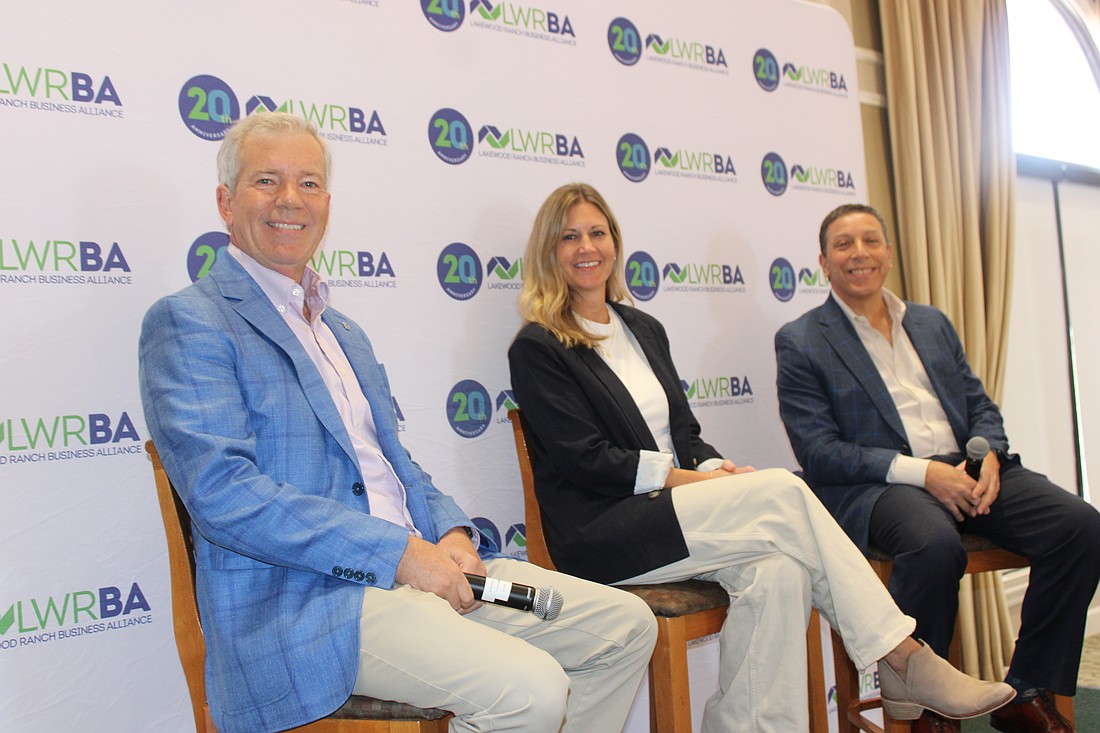
So when an organization like the Lakewood Ranch Business Alliance hosts three longtime members of the business community to talk about the origins of their enterprises at the Lakewood Ranch Country Club, we pay attention.
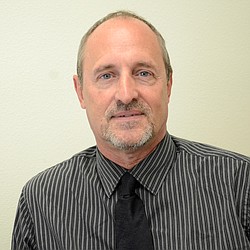
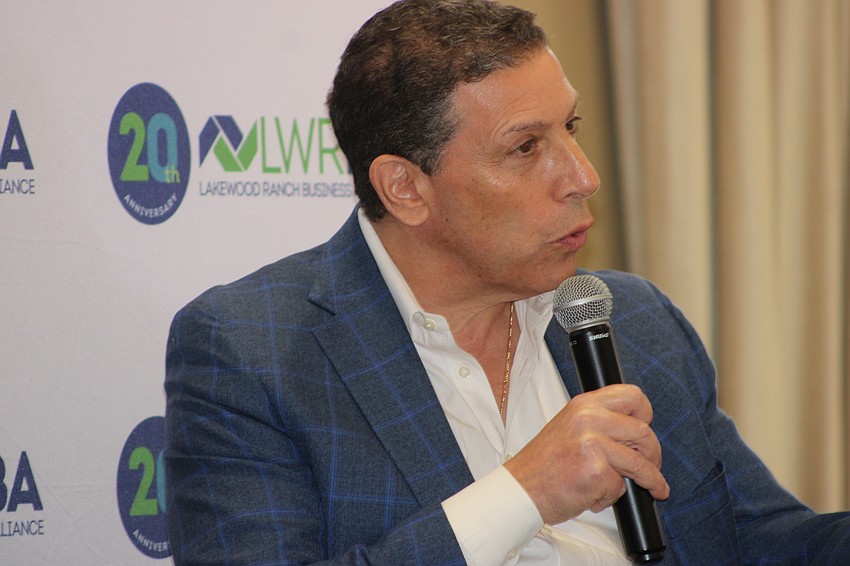
Such was the case Sept. 16 as David Sessions, the chairman of Willis Smith Construction, Joseph Najmy of Najmy Thompson Attorneys at Law, and Andrea Saputo Cox, president and owner of Gold Coast Eagle Distributing, spoke about their past, and the future, in Lakewood Ranch during "Pioneers of Progress: Founding Businesses of Lakewood Ranch."
Before I talk about their past, I might note that these cornerstones of the Lakewood Ranch business community have the same concerns that you and I do about the future. It's not a hysterical meltdown that the end of the world is coming and that our overdeveloped area will disappear into a sinkhole of out-of-control growth. It's rather a confidence that if the same care Schroeder-Manatee Ranch used to develop Lakewood Ranch over the past 30 years continues in the future, we should be just fine.
"There is a wonderful quality of life here, and we want to keep it that way," said Sessions, who not only does business in Lakewood Ranch, but lives here as well. "It used to be that we would have to travel (to shop or to go to find a restaurant, entertainment or services). Now you can find anything you need here. SMR's vision was not just about building rooftops, and it's fun to see how it has evolved. With the interstate so busy, there is a sense of real happiness being here."
That's an interesting statement because, indeed, SMR's vision was not to build a bedroom community where people would just sleep after a long day's work somewhere else. It was to build a self-sustaining community that actually could become a destination where — let's call them "outsiders" for fun — could come to feed the businesses within.
It's a viewpoint that can be hard to grasp for homeowners because of the way this community was constructed. If you think about it, SMR goes to work by developing the infrastructure to support the homes first, then builds the homes and gradually attracts the services that allow the homeowners to have much of what they need without needing to travel 10 miles. When the homeowners moved in, there was less of everything than there was likely to be in the next five years.
So when that new Outback opens its doors on State Road 70, local residents can view it two ways. One would be they can worry that another restaurant is going to attract more traffic and clog the road system. The other would be that such a business gives residents another choice and another reason to find what they need without venturing far from home.
Certainly, it's a delicate mix, but one that has been in place for the past 30 years.
"The growth has helped our practice grow," Najmy said. "But Lakewood Ranch still has that small-town feel. That's what makes it extraordinary to me. You have the influx of new clients, and that is rewarding, but it still does feel like a small town. You have to credit the plan and the community concept."
Saputo Cox said it will take careful planning to keep that small-town feel.
"It will take smart growth," she said. "With transportation, you don't want it to be frustrating for people to come out here. And the people here want a peaceful place to live."
In the early days of Lakewood Ranch, which last year celebrated its 30th year, it was peaceful because not much was here. Businesses were taking a gamble because the future of the community was uncertain.
"When we bought our lot (on Lakewood Boulevard), there was a lot of uncertainty and fear," Sessions told those who gathered for the luncheon. "We actually scaled our building back. In hindsight, we should have built a larger facility.
"In those arly days, it always was a can-do approach. You had to deal with SMR, but they always broke down the bureaucracy it took to get something going. The attitude always was 'How can we get this done?'"
While some homeowners might have worried about incoming businesses and more homes, Willis Smith Construction saw it as confirmation it had made the right decision.
"Lakewood Ranch has elevated our brand significantly," Sessions said. "I remember there was a tremendous amount of excitement, almost like a new beginning. For us, it was a quantum leap forward. We knew this was the start of something big. We have grown 400% in annual revenue."
Najmy was a young lawyer working at a firm in Bradenton that suggested he work this new, fertile ground.
"I was a young lawyer who agreed with any plan (the partners) had," Najmy said. "So I was coming out here one day a week in 1999. We didn't know if clients would make the trek all the way out east, and I was only working with clients who lived out here. They wanted (a lawyer) who lived near them. By 2003, I had accumulated a client base and I made the big decision to practice out here full time. It was one of the best decisions I ever made. Our growth is four times where we were in 2009. It's been amazing and a testament to the area.
"We were part of the genesis of a city. Every time SMR opened a new development, it was a celebration."
Saputo Cox said SMR originally turned down Gold Coast Eagle's request to build in Lakewood Ranch because they didn't want the trucks, but with connections to the Uihlein family, which formed SMR to manage its 48-square mile property, Gold Coast and SMR worked out a deal and the distributor moved into the area in 2008.
"It was an upscale area and we built our building to mimic that," she said. "We built a community room because we wanted to be part of the community."
The space has been valued for years by area nonprofits who use the room for meetings and events.
Saputo Cox said if Gold Coast knew how it would grow in Lakewood Ranch (from 4 million cases delivered in 2008 to its current 6.5 million cases), it would have built its building "taller."
"The automation out there is taller," she said.
Like Sessions and Najmy, she remembered the excitement of the time.
"There was a sense of community and everyone wrapped their arms around projects," she said. "Everyone wanted (Lakewood Ranch) to succeed."