- March 14, 2026

-
-
Loading
Loading
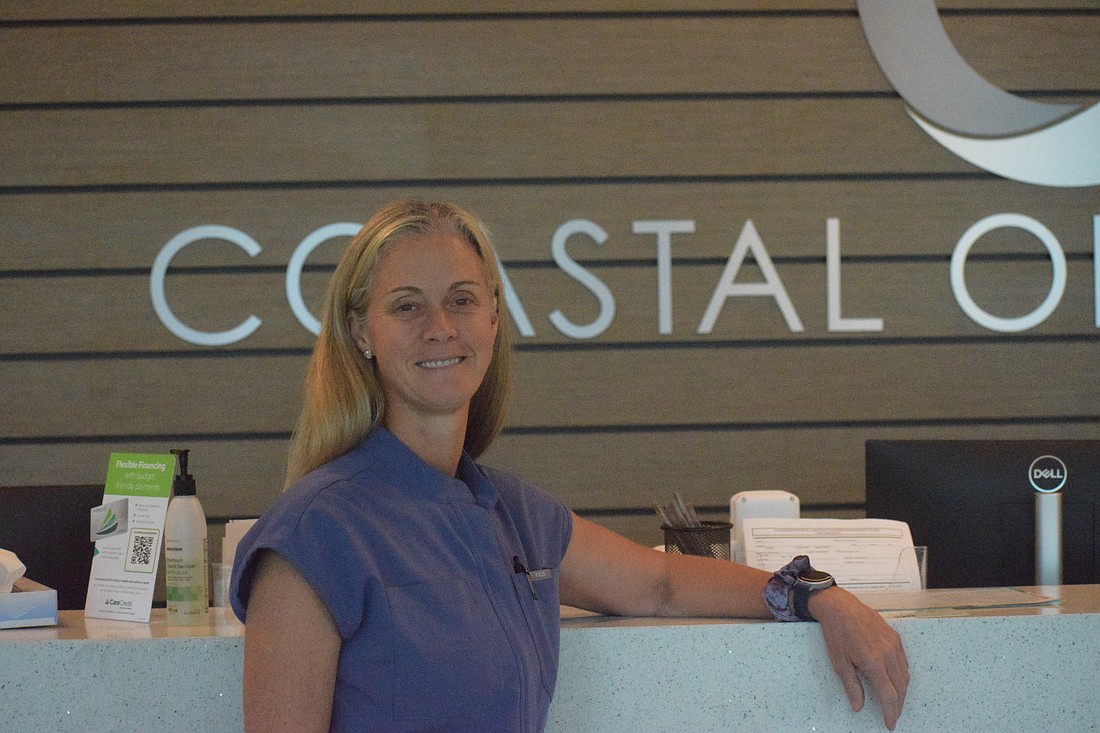
Cool, calm and collected. That’s what we expect of surgeons when we trust them with the most complex procedures available in modern medicine.
Such qualities are often evident in the manner these miracle workers carry themselves outside the operating room. They are, after all, caretakers at their core.
Dr. Sara Simmons doesn’t quite belong to that bunch.
The orthopedic surgeon’s enthusiasm for her work is not restrained. Her presence fills up a room when she steps through the door. Naturally, client well-being is her primary concern, but that hasn’t stopped her from channeling the younger version of herself who was perpetually prepared for competition.
“I was always crazy about sports. I’m super energetic,” Simmons said. “I was a gymnast for 10 years because my poor parents couldn’t keep me from bouncing off the walls.”
The Hand and Wrist Specialist at Coastal Orthopedics is headed to the World Rowing Masters Regatta in Banyoles, Spain, from Sept. 10 to 14. Formerly a world-class rower, she’s back in the boat and eyeing the finish line once more.
Her schedule is rigorous, including races in the quad, four, double, mixed double, eight and mixed eight. But all of them are without the high stakes synonymous with the global stage — the same stresses that pushed her out of competitive rowing decades ago.
Simmons is journeying across the Atlantic purely for the love of the game.
“Part of it is just getting back into it and re-emerging as my own self,” Simmons said. “It’s almost like amateur sports at its best again. So much about sports these days, I feel, is not what it’s supposed to be.”
Featuring 3,700-plus athletes hailing from over 700 different clubs, the 2025 running of the regatta ranks as the second-largest in its 51-year history. Qualification is not required while crews of all ages, weights and nationalities are welcomed.
This year’s participants range from 27 to 96 years old. Simmons, 53, will be part of a mixed eight boat which includes four participants in their 50s, two in their 60s and another two in their 80s.
Few sports encourage or even accommodate lifelong activity. Even fewer give athletes something to strive toward when their playing days are behind them.
Look no further than the famed “Big Four” here in the United States. Football, basketball, baseball and hockey attract the lion’s share of our athletic interests, but how many viewers can go out and play those same sports regardless of age?
Some can. Many can not.
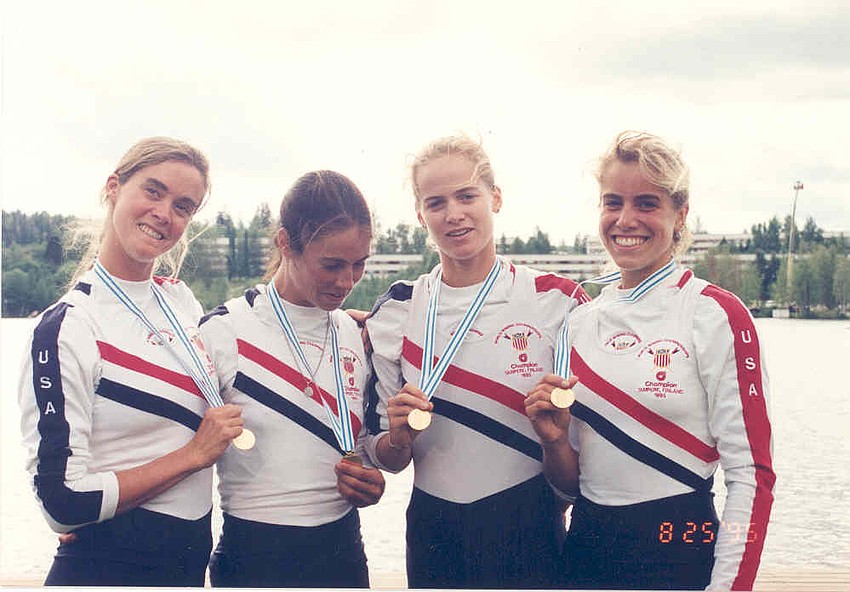
Simmons brought home gold in the women’s lightweight coxless four at the 1995 World Rowing Championships alongside Barbara Byrne, Linda Muri and Whitney Post, and a year later, captured bronze in that event. Gold at the 1995 US Collegiate Nationals and silver at the 1994 Pan American Games are further highlights on her resume.
But she eventually faced the dilemma in which most elite competitors comes to terms. Building a career around sport is rarely viable.
“It was hard, in one sense, because I was only 23 at the time when I stopped (rowing competitively),” Simmons said. “I always thought, ‘Maybe I’ll take a couple years off and try to make the 2004 Olympics,’ but your life consumes you.”
Across her first two years as a Biology student at Harvard, her schedule was dizzying. She would practice rowing in the morning, soccer in the afternoon and hockey at night — sometimes all in the same day.
She couldn’t help but overwhelm herself. Even in college, Simmons was that same bubbling ball of energy who, at a young age, yearned to have a soccer net in front of her or a balance beam under her feet.
The Belmont, Massachusetts, native and graduate of the Buckingham Browne & Nichols School actually turned down offers from Yale women’s soccer and Princeton women’s rowing despite no offer at all from Harvard Athletics.
Love for the oars, though, waned when Simmons elected to pursue the U.S. National Team as a prospective lightweight.
“Having to cut weight was not a fun thing. I did cut about 10 pounds, which was tough,” Simmons said. “I rowed on the national team for two years after college, and that was the end of it. It’s a lot of traveling, it’s a lot of living out of a suitcase. I lived at people’s houses in weird places in the country. You’re under a lot of stress.”
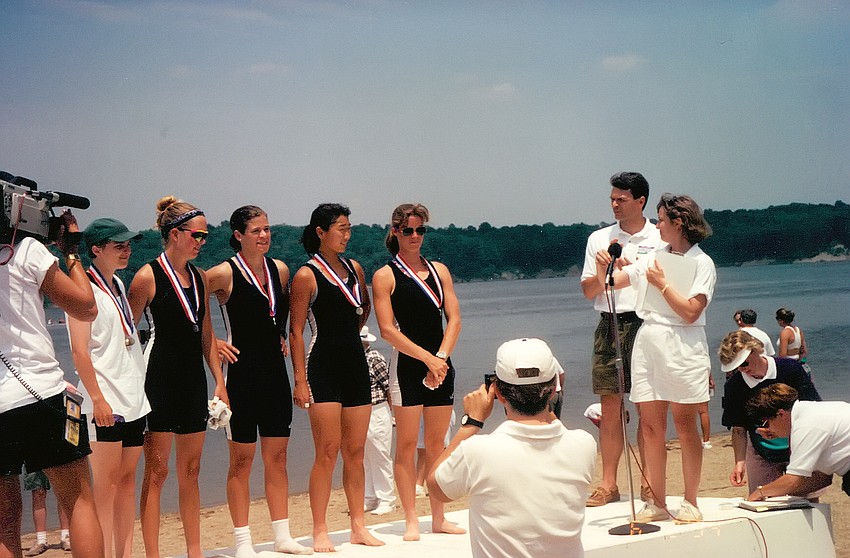
Rowing entered the rearview mirror. Her commitment to medical school took over, and before she knew it, adulthood had arrived in the form of a husband and kids.
That easily could have marked the end of her athletic career. She could have just allowed life to transpire and tabled personal pursuits for good.
But Simmons is back in the boat. And competition is on the horizon.
“If you come in last, who cares? You got there, you got in the boat — little steps,” Simmons said. “It’s been a long time. What other sport can you come back to at this age?”
No monetary amount or shining reward inspired such a return. Instead, she’s braving the waters again because of the calling she feels to the sport she never intended to leave forever. The right opportunity just needed to present itself.
In this new era of name, image and likeness — where once-amateur athletes have practically turned professional — hers is a refreshing perspective. Yes, sport is a multi-billion dollar industry in the U.S. alone, but never should it be construed strictly as business.
There's plenty of athletes out there who do it purely out of love.
Some gravitate to the baseball diamond. Others are attracted to volleyball nets.
For Simmons, it’s that meditative experience of being out on the water with a crew, working as one to cross the finish line.
She shows us it's no time to lose faith in the beauty of sports.