- March 19, 2026

-
-
Loading
Loading

Sarasota Bay Estuary Program executive director David Tomasko said he knew when he took the position in 2020 that his plan was to only head the organization for a set period of time. He poured his energy and passion for environmental remediation into the role, advocating for meaningful investments into improving one of the area's essential waterways. He is adhering to that pledge, passing the torch to incoming leader Ryan Gandy on Nov. 17, weeks after his fifth anniversary.
"When I interviewed for the position, I was pretty comfortable saying we could recover the health of the bay fairly quickly," he said in an interview.
He said he was confident with his claim based on the fact leaders had already done it in the past.
"This is one of the four oldest estuary programs in the state of Florida," he said.
The U.S. Congress named it an estuary of national significance in 1989. Tomasko said even in the '80s, community members were working to clean up the bay.
"This community has always been facing the problems head on," he said.
One significant move came in the early 1990s, when the City of Sarasota upgraded its wastewater treatment to reduce algae-boosting nutrients going into the water by about 80-90%, he said.
There have been gains and losses over the years, but Tomasko commended new pushes to keep up with the latest research on how to keep the bay healthy and swimmers happy.
Looking back on his tenure, he said he is proud of his efforts and glad to see significant improvements in Sarasota Bay.
Seagrass regeneration is up by 19%; the most damaging nitrogen levels are down by 20%, better than ever in the past 15 years; and the town of Longboat Key and city of Sarasota have invested in key infrastructure that should help maintain water quality for many years to come.
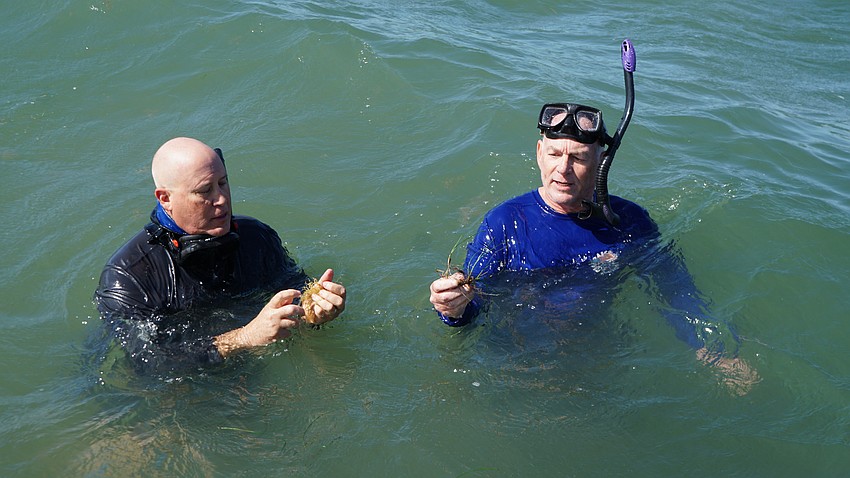
That progress was made possible through strong community connections, and as he prepares to leave his directorship, Tomasko shared in the interview how grateful he is for community members and elected officials who saw the value of those investments.
He gives credit to Longboat Key residents who recognize the value of quality infrastructure. Earlier this year, citizens voted in favor of installing a new subaqueous wastewater pipeline to replace a 50-year-old line, a $30 million undertaking.
Other interesting projects include the city's efforts to use bacteria to turn nitrogen — that could otherwise end up in waterways and boost algae blooms — into biologically inert gas.
"They first did that here back in the 1990s," he noted. "Tampa Bay converted to nitrogen-removal technology back in 1979. The very first to do it was Palmetto."
When the bay was experiencing water quality issues five years ago, Tomasko said he pointed to what had been done in the past to give members confidence to face the future.
"You just have to recognize the problem. You have to understand the solutions that are out there. And, you have to talk money," he said. "That's one of the things I was comfortable doing."
He said protecting the bay will always be an ongoing effort, and it is important to share the successes along the way.
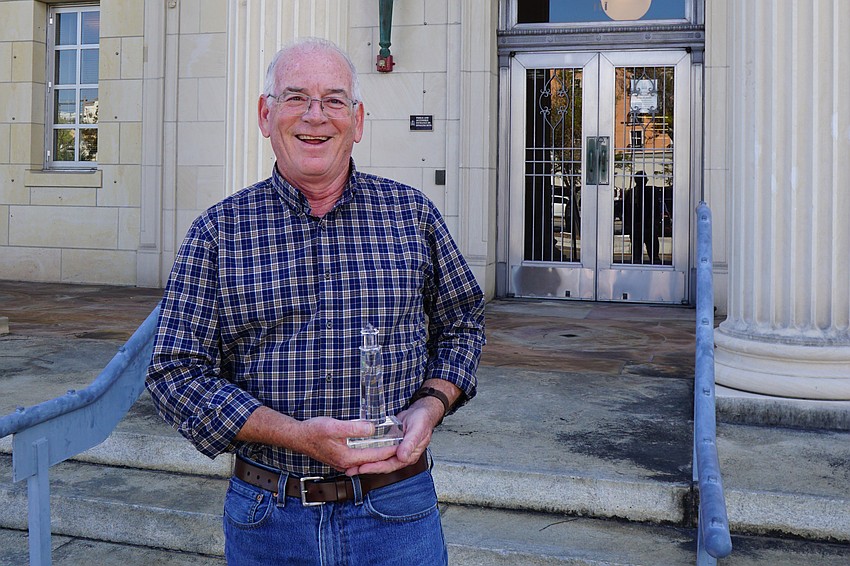
Tomasko received notable acclaim for his efforts while serving, including the 2024 Southwest Florida Climate Champion Award from the Climate Adaptation Center.
He said explaining to people the value of investing in water improvement was the easy part. After all, many of the issues are highly visible to residents.
When he first started in the early 2020s, the area saw some of the worst cases of red tide in decades.
"Red tides are natural phenomena made worse by human activity," he said. "It lingered and moved its way up the coast, and it came into our bay on incoming tides. It met a bay rich in nutrients, and it blew up."
Especially when residents started seeing manatees starving from seagrass losses on the east coast and other large-scale impacts on local habitat, he said, "It was really easy to make the case that we needed to do a better job of nutrient management."
"We needed the public to be informed of what's at stake, and to support the politicians who were going to spend hundreds of millions of dollars on wastewater and stormwater management," he said. "We also needed people to understand this wasn't something that could be fixed with $10 million. You needed a lot more. I think I was, at the time, the right person to make those arguments."
He said major credit for that success goes to the Sarasota Bay Estuary Program staff, which he will miss.
"They're spectacular," he said. "They're incredible, very talented people who are hardworking, creative and funny. I've had the easiest job of anyone, because I tell people where I would like to go, and they make it happen."
While he has appreciated the backing of local legislators, Tomasko said the same arguments for water quality have not always carried through to Tallahassee and Washington, D.C., and he hopes to change that.
"We're a good success story in Sarasota, and most of Tampa Bay is a success story, but Biscayne Bay isn't. Naples isn't. Pensacola Bay isn't."
The first step of enacting statewide change is admitting the problem's existence and scale, Tomasko said.
Now, he is turning his attention to the private sector with Environmental Science Associates in California, where he hopes to address pressing concerns.
Tomasko has more than 30 years of experience in water quality science and science-based management, and he worked in the private sector before taking up the directorship.
Though he is heading west, Tomasko hopes to retain a connection to his beloved Florida community.
He said the estuary program is in good hands with Gandy, a Sarasota native who joined the group last year.
"He is our science and restoration manager, so he has already been working on several restoration projects," he said.
"We're no longer in a crisis state," Tomasko said of the bay. "We have a plan to make sure the water quality doesn't degrade again, the Water Quality Protection Plan. We think it can continue to get better, absolutely."
There is always more to be done, and Tomasko said it will be even more imperative for local leaders to take action.
To learn more about getting involved with the program, visit SarasotaBay.org/Get-Involved.