- March 19, 2026

-
-
Loading
Loading
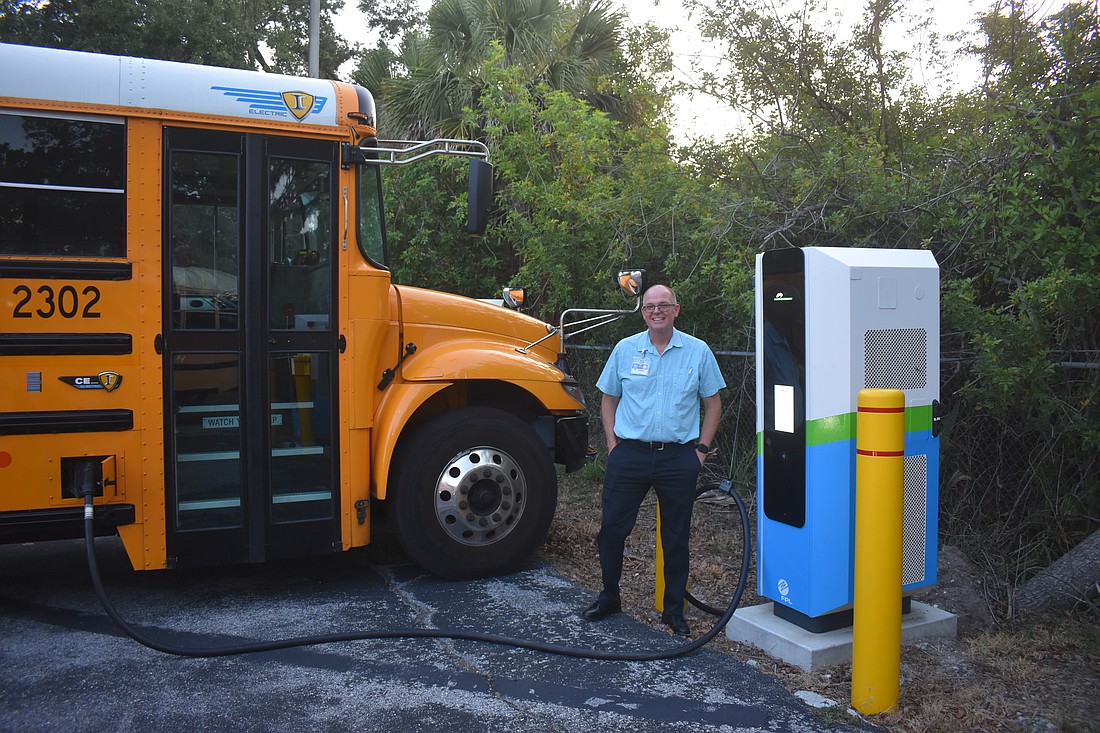
Jamie Warrington, director of transportation for the School District of Manatee County, has a love-hate relationship with electric buses.
He supports alternative fuel and getting away from using regular fossil fuels, but he doesn’t know if they’re quite ready yet for a commercial application.
“I was a little anxious when we embarked on (buying electric buses) just because of it being such new technology,” Warrington said. “Despite our few little issues, the drivers that have been driving those vehicles have indicated that they enjoy it.”
The School District of Manatee County has four electric buses — two buses with two batteries that can cover an estimated 130 miles and the other two that have three batteries and can cover approximately 200 miles before recharging. The most prevalent reason for the use of electric buses is that they are better for the environment.
“With zero emissions, it's good for the environment. It's good for the students, it's good for the community,” Warrington said. “The bus isn't making all that noise going through the neighborhoods early in the morning.”
Bradenton resident Ellen Sandels has been a bus driver for the Manatee School District for 12 years and is one of the drivers of an electric bus. Sandels said she doesn’t miss having to fuel the diesel buses. She said drivers have to be more aware when driving electric buses because they are so quiet and people in the vicinity, such as landscape workers and pedestrians, can be unaware of the bus’s presence.
Sandels described driving the electric bus as interesting, fun and challenging.
“Initially I was not sure the manufacturer had all the bugs worked out when they delivered the buses,” Sandals said. “There were various issues with getting the air conditioning and heat working, accuracy on battery usage, and some frustrations with getting the bus to charge at the charging stations.”
Warrington said the electric buses drive like a regular bus, but the startup process is a little bit different, with more indicator lights for various things that don't need to be checked on a diesel bus. He said the electric buses have a faster acceleration than a regular bus and compared them to a golf cart in that way. He said a diesel bus takes longer to get going.
Warrington said the electric buses have regenerative breaking, which means every time the breaks are applied, it recharges the battery by recovering kinetic energy and converting it into electrical energy. Due to that, the electric buses are taken into environments, such as Anna Maria Island, where there is fewer distance between stoplights. He gave Myakka City would be an example of a not-so-ideal environment for electric buses.
“There's no opportunity for the bus to generate or regenerate energy because the stopping isn't as prevalent out that way,” Warrington said.
Warrington said the cons right now would be the cost of an electric bus compared to a diesel bus and just not really knowing what to expect from it. He said he can purchase three diesel buses for the price of one electric bus. They have four electric buses that are each $460,000.
The school district has 20 working 60-kilowatt charging stations that were installed by Florida Power & Light at no cost. They use only four of them currently, one for each of their four buses.
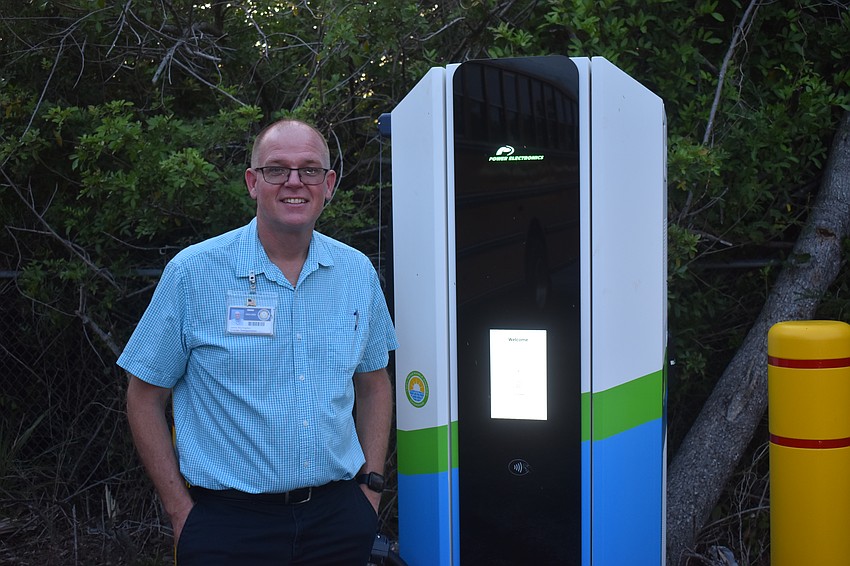
All of the charging stations are located at Matzke Support Center where the buses are located when not on the road.
“They're 60 kilowatt chargers, so they're not your average Tesla charger that you would have at home,” Warrington said. “You can't just plug them into a regular outlet, they require a lot more electrical current.”
The electric buses are plugged in every time they return to the bus compound. They can charge fully in three hours with the 60-kilowatt chargers, which is why they chose them over 30-kilowatt chargers, which would take four to six hours.
“I needed to make sure that the buses could be utilized both morning and afternoon,” Warrington said.
Between the four buses, the two that have less mileage on one charge have been experiencing issues with the batteries. The buses are under warranty, so the district doesn’t have to pay for those repairs.
“You can go and advertise that a bus will drive 120 miles on a charge, but that's a stripped-down bus,” Warrington said. “Once you go and you add your two-way radios and your video camera systems, all of that has to get power from somewhere, so that will deplete the batteries as well.”
Warrington said that the heat could be a contributing factor on why the batteries on the electric buses have had issues.
“Because the technology is just so new, there's really not a whole lot of data to support that as of right now,” Warrington said.
Warrington said when they the district was given the grant from the Florida Department of Environmental Protection’s Electric Bus Project to purchase up to 20 electric buses, the district was not in a position to accommodate the limited charge range for that many buses.
“We opted to go with four to start with, so that we could collect some data and make a decision whether we were going to pursue more,” Warrington said.
Warrington said any future purchase of more electric buses are on hold due to the issues they are currently facing as well as working to find a route that the electric buses could cover without issues.
“All of our routes cover three schools, typically a lot of geography, and most of them exceed or come very close to exceeding what the manufacturer says is the maximum range on a charge,” Warrington said.
Bradenton’s Susie DuDeVoire also drives an electric bus and has been a driver with Manatee for 19 years.
“I now appreciate the electric bus much more. They “get up and go” much quicker than diesel which makes me feel safer,” said DuDeVoire. “They are very quiet which allows me to converse easier with my passengers and co-worker on the bus.”
“All things considered; it has been a learning curve for everyone but now with over 29,000 miles driven I can say the bus has been rolling dependably every day,” Sandels said.