- March 13, 2026

-
-
Loading
Loading
Five years ago, the need to replace the lone wastewater pipe exiting Longboat Key was obvious, but construction of the new pipeline crossing the bay is yet to begin.
The town is inching closer to beginning work, with funding applied for and design work nearly done. Town leaders don’t expect ground to break on the underground portion of the project until at least mid-2026, though.
It’s been a long process to work through the many layers of red tape a project of this magnitude involves, including funding, permitting, designing and engineering. The landward portion of the project has already been completed, with the $2.3 million project replacing 1.1 miles of the aging pipe with new lining.
But 2.3 miles of pipe still need replacement, and with that portion being under Sarasota Bay, the cost is expected to be around $30 million.
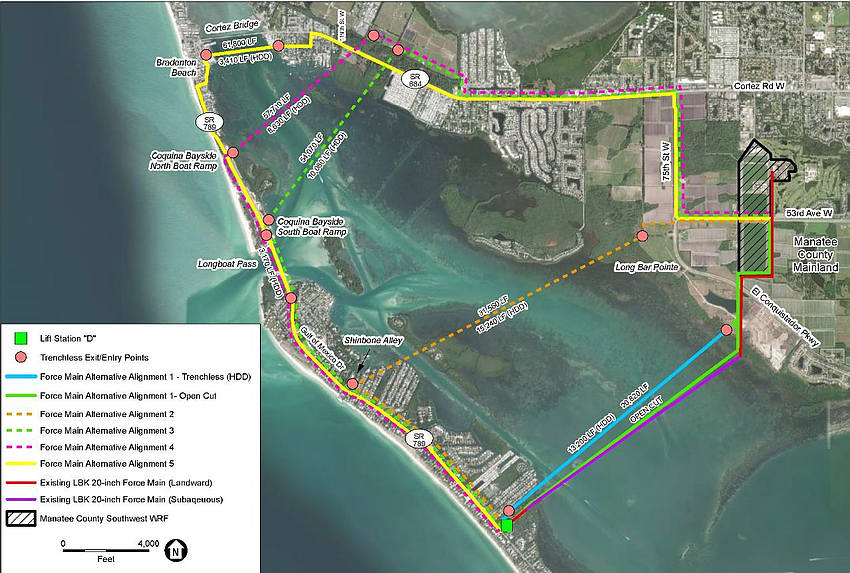
It took two years, but permits have been issued for construction of the underwater portion of the project including from the Army Corps of Engineers and the Florida Department of Environmental Protection. The 20-inch-wide plastic pipe will be laid into a 12,200-foot-long, open-cut trench just north of the current wastewater pipe. But there could still be some more permitting work, said town utility manager Jessie Camburn.
“Although the Town has an approved environmental permit, revisions are being sought to align with the final route and construction methods,” Camburn said.
Permitting, check (pending revisions).
In March, Longboat voters overwhelmingly supported (95% said yes) taking out a State Revolving Fund loan to fund the project, which is expected to cost about $30 million. The loan would fund a majority of the cost, which increased from $21.9 million to $30 million since original estimates.
Funding, check?
“That’s being worked on now by the engineers and our grant coordinator of getting that application in, but the voters approved that we would go for that as a funding source,” said town finance director Susan Smith. “It’s roughly a $27 million loan, possibly, but we’re also getting grants that we’re pursuing for that project as well.”
It’s rare for issuance of debt to go before the voters directly like it did in this instance, but Smith said it was because the State Revolving Fund Loan comes with contract stipulations that require the town’s general fund to act as a guarantee if the utility fails to pay for the project.
“Say if the utility doesn’t have the money, the general fund has got to produce the money to pay the debt payment, so that’s why it had to go to referendum to get approval. Our charter says so,” Smith said. “The general fund is guaranteeing that we will make these debt payments if the utility for some reason doesn’t have the money, the general fund guarantees we’ll make the payment.”
The state revolving fund incorporates federal and state grant money to provide loans to municipalities for infrastructure projects that protect waterways. The state revolving fund would have an interest rate of 2.89% instead of a typical bond rate, which would have at least 5% interest, saving the town millions in interest. The town currently pays about $5.9 million annually in interest for debt service. Camburn said grants and loans have already been applied for.
Next up is design, which Camburn said is “nearing completion.” Carollo Engineers is collaborating with the town to finalize the design.
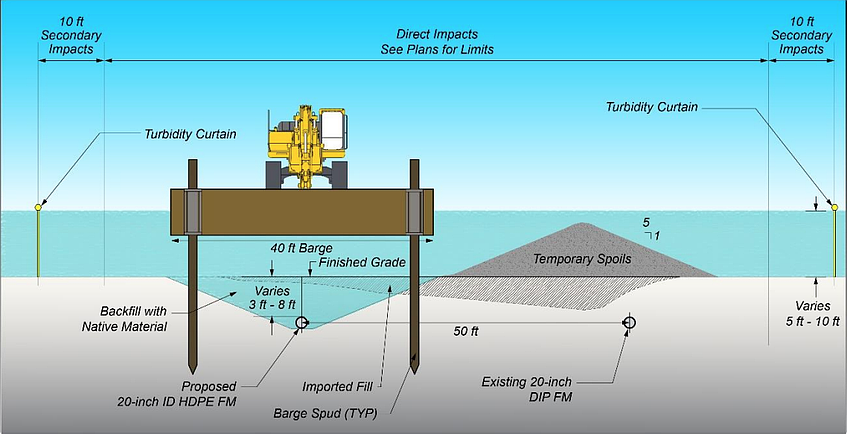
Once the design is finalized, ground can be broken (carefully). The permit support document detailing the construction process explains that temporary impacts to mangroves, seagrass and oysters are necessary to construct the pipe, but that efforts will be made to minimize impacts.
“With respect to the proposed project, impacts to wetlands and aquatic resources — primarily mangroves, sea grasses, and oysters — are a primary concern. However, it must be emphasized that any and all impacts to these resources caused by the proposed project are associated with project construction only — not long-term operation,” the permit support document states. “No components of the proposed project will result in a permanent loss of any ecological resources within Alignment 1; therefore, all impacts are considered to be temporary.”
The last step is building the thing. According to Camburn, construction may begin in mid-2026 and continue for a year.
“However, the schedule is highly dependent on permitting and funding,” he said. Garney Construction will install the pipe, using barges, excavators and cranes to dig a trench and bury the pipe.
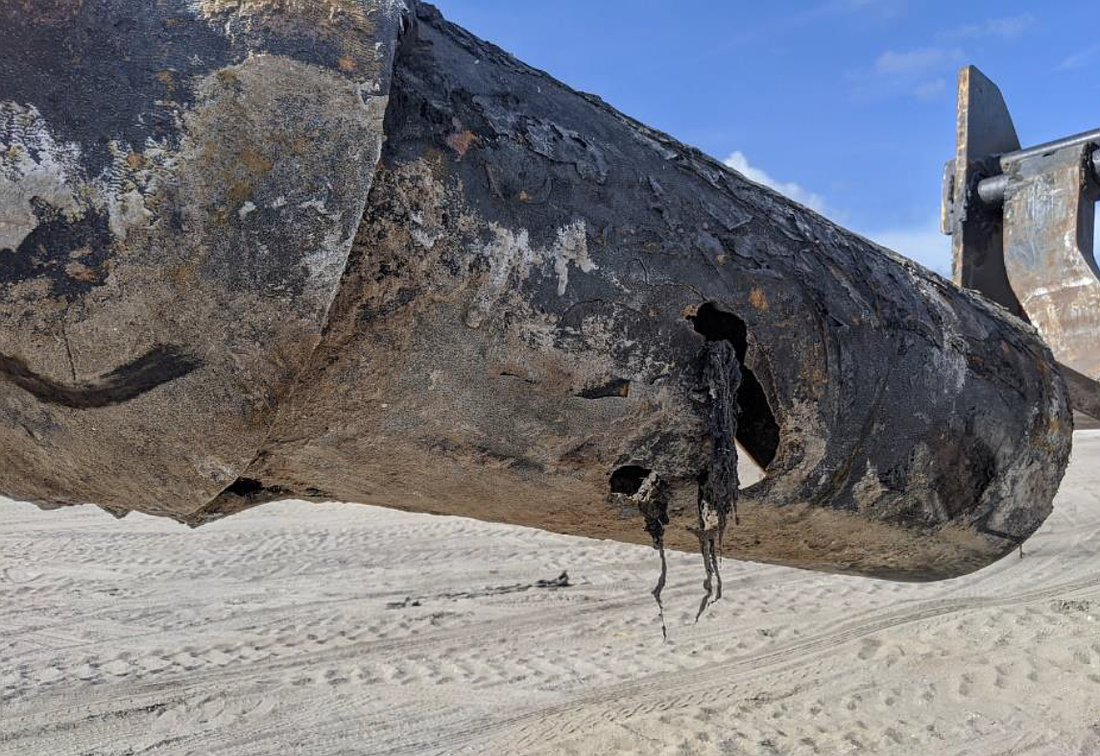
The old metal pipeline, which was constructed in 1973 and installed in 1975, will be replaced with a plastic (HDPE) pipeline, traveling under Sarasota Bay to a Manatee County treatment facility. In 2020, the 50-plus-year-old iron pipe ruptured, leaking about 11 million gallons of sewage “within the mangrove fringe” near Sarasota Bay, according to a permit support document commissioned by the town.
“The number one threat to the health of Sarasota Bay is wastewater pollution,” Longboat Key town manager Howard Tipton said. “So we are absolutely committed to making sure that we’ve got a safe system that transmits the flow to Manatee County. The only way to guarantee that is through this new pipe project.”