- March 19, 2026

-
-
Loading
Loading
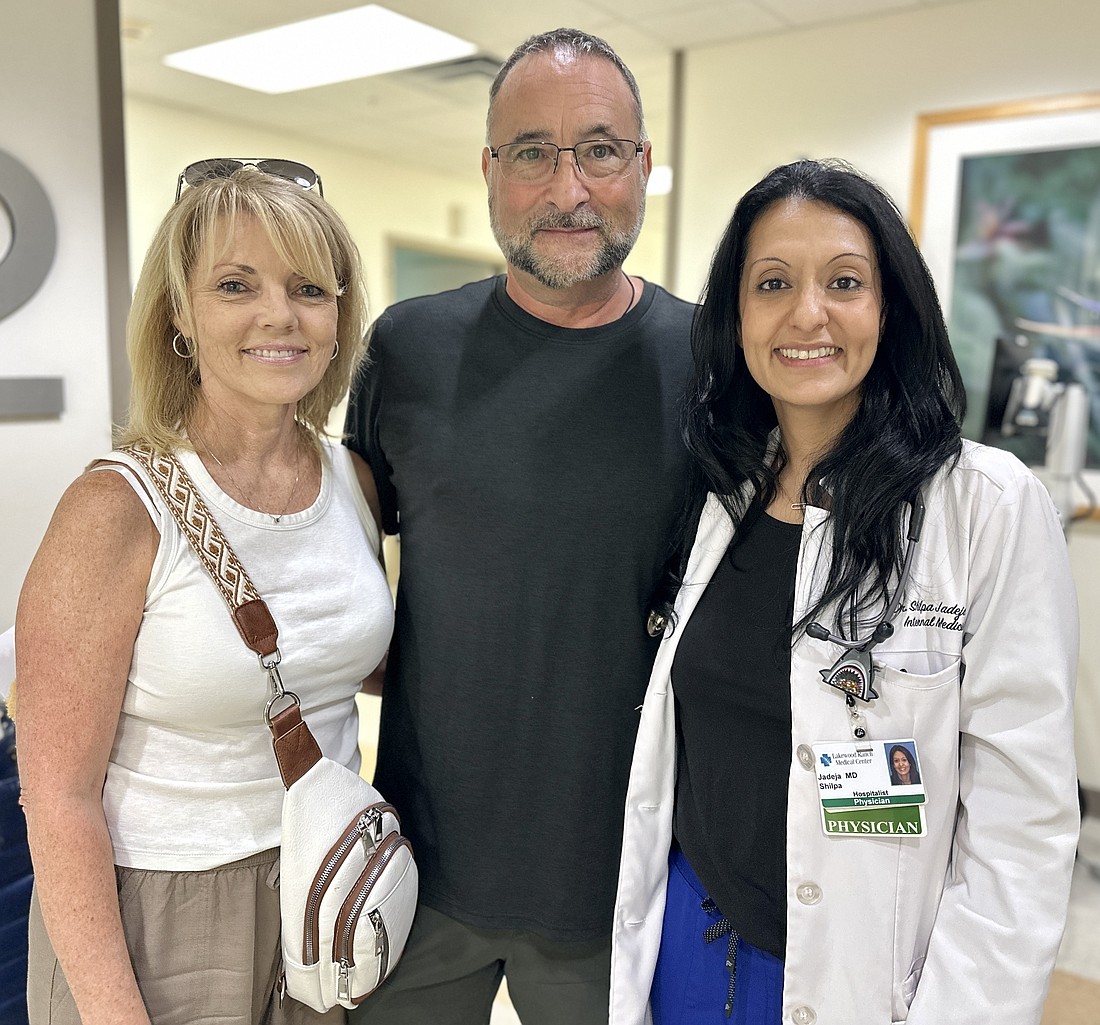
For Parrish's Mark Latcheran, living or dying came down to a flip of the coin.
Or in his case, the flip of his body.
As his body continued to shut down from his case of acute pancreatitis in March, Latcheran slipped into a coma at Lakewood Ranch Medical Center. The medical staff, led by ICU doctor and pulmonologist Dr. Ryan Dunn, worked feverishly around the clock to solve an illness that appeared to be unsolvable.
It came down to a decision that could have proved fatal if it didn't work, but one so simple in its nature. The medical staff had to decide whether to flip Latcheran over, leaving him prone, lying face down while receiving mechanical ventilation. Prone ventilation is used primarily for patients with acute respiratory distress. It is done to improve oxygenation.
But it also could have sent him into cardiac arrest, and in his state, that would have been the end of the story.
"We had to make a judgement call, and we thought the benefits outweighed the risks," Latcheran said. "We were slowly losing the battle. It was the moment of truth, and everything turned around."
While he was only conscious for part of his treatment, Latcheran said his family described to him the incredible care he received at Lakewood Ranch Medical Center that ultimately saved his life.
He was so impressed, and so thankful, he made a special trip to the hospital to thank the staff in person.
"I was a supply chain director (for hospitals) for 30 years," Latcheran said. "But watching (hospital workers) care for patients is one of the things you don't always get to witness. The communication they had and the caring attitude the nurses had were the reason I lived. That communication had to be phenomenal.
"Leadership and culture, if you don't have it (at a hospital), it could become a bad experience for the patient. I applaud their leadership, the nursing managers, and the nurses. They put the patient first, for real."
It was a story of success that you don't always hear about hospitals. More often than not, you hear the jokes. "I had to stop them because they marked the wrong knee as I went into surgery."
Ha, ha, ha.
But it is the nature of the hospital beast. People are hurting, and often not in the best of moods. If a nurse is having a trying day, and slips out of happy-face mode, it could be interpreted as indifference. I am sure you've heard the stories.
Lakewood Ranch Medical Center is a small hospital with 120 beds. That is going to increase to 180 when the new tower opens early in 2026. Certainly, it's still not a large hospital, which generally has more than 500 beds and more resources.
But what Lakewood Ranch Medical Center does, it does well. You can ask the 61-year-old Latcheran, or you can ask me. I had two surgical procedures early this year.
Like Latcheran, I was treated with respect and compassion from the moment I walked up to the front desk, to the time a volunteer showed me to the waiting room, to when I was prepped, and every moment after surgery until I was wheeled to the front door.
It's important to tell the success stories.
So here is Latcheran telling his story.
"It was Saturday, March 15 and I was working outside," he said. "That afternoon, I got a bad pain in the left side of my chest, under my ribs. Something was not right. I asked my fiancé (Denise Allen) for a pain pill, but it wasn't helping. She asked if she should call an ambulance, but hey, I'm a guy, so I said, 'Let's give it another 45 minutes.'"
Fortunately, Allen didn't wait another 45 minutes. She loaded Latcheran into the car and took him to Lakewood Ranch Medical Center.
"Honest to God, I don't remember much after the ride," Latcheran said. "I went to the triage window and they took me right back (into the emergency room). I started throwing up and they admitted me. I don't remember anything after that.
"I was told I was put on a regular floor, but I was declining so I was moved to ICU. My family said I was in so much pain, I asked to be induced into a coma. Two days went by, and I went into sepsis. They put me into a coma March 17."
He was in such bad shape that his family members began flying into the area from out of state. He was progressively getting worse, and his organs were shutting down.
"Eventually, they flipped me over, and I lived. I started progressing."
On March 24, on his daughter Jenna DiRenzo's birthday, doctors took the tubes out of him and took him off the ventilator. She was at his bedside along with his other daughter, Marissa Latcheran. Both came from Ohio to be at his side. Jeff Latcheran, his brother, flew in from Pittsburgh. His mother, 90-year-old Connie Rinaldi, who lives with him, was there.
"I sat up in bed March 25," he said. "My aunt made me a cake on March 27, my birthday. I applaud the staff for allowing me to have more than a couple people in my room."
By April 3, he was sitting in a chair. Now, he is back on the road, flying around the country for his job with Omnicell.
"I lived, and that is the best gift I ever could have," he said. "One of the things I recall, honest to God, was I remember this warmth and feeling of love. Still it breaks me up, that I felt my dad, who died when I was 11, was there. I guess they don't want me yet, and that's why I am here."
Dunn enjoys hearing the appreciation.
"He was a relatively healthy guy," Dunn said. "But there he was, having multiple organ failure. He was on life support a number of days, but ultimately, we were able to get him through it. Sometimes, but not always, you win these cases. He was very close to dying. It's very stressful as a provided, but the outcome is very rewarding and gratifying."
Dunn especially enjoyed hearing Latcheran's family describe every employee being totally invested.
"That's what separates good medical centers from those that aren't so good," he said. "Without all the other people, we weren't going to have a good outcome. To hear stories like this is good for the community, good for the hospital system. It's important."
Dunn said such cases raise pride among all the providers.
"Every year we have a handful of cases like this," he said. "Cases like this one, you will remember your whole career."
"My kidneys work, my liver works, and my pancreas is back to normal," Latcheran said. "At this point in time, for what I went through,I feel like a million bucks, I still battle fatigue and weakness, but I am getting my strength back.
"Lakewood Ranch Medical Center is awesome. True leadership is not just about making decisions, it’s about listening, connecting, and empowering your team. In the ICU, I witnessed real leadership in action."