- December 13, 2025

-
-
Loading
Loading
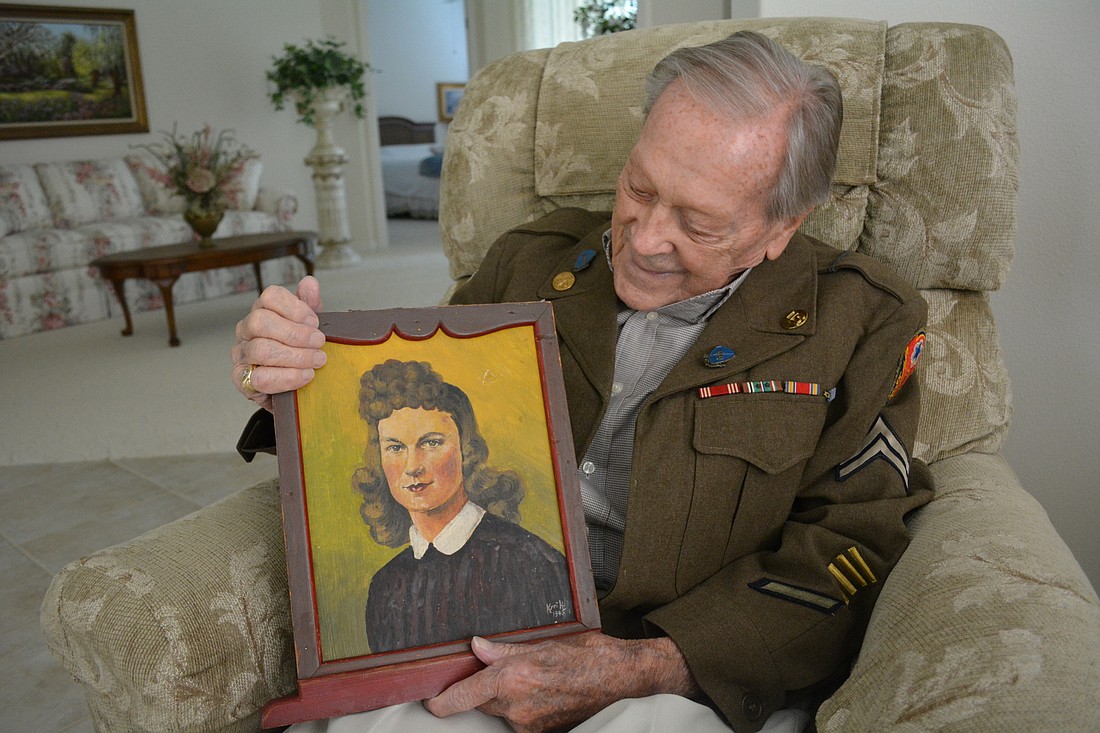
Using hands wrinkled by his 94 years, River Club’s ElRoy York picked up a painting he considers one of his most precious possessions.
The subject was his late wife, Agnes, as pictured in a 3-by-3-inch photograph York kept in his wallet while guarding prisoners during his service with the U.S. Army in World War II.
The painting reminds him humanity can exist, even with the world at war.
With Veterans Day on Nov. 11, York shared some of his most vivid military memories with the East County Observer.
Perhaps his most interesting time came at a prisoner of war camp, which kept moving just behind the front lines as the Allied forces advanced across France following the 1944 invasion at Normandy.
Although soldiers weren’t allowed to talk with their captives, York risked a conversation with a German prisoner he eventually knew as “Kyrih.” In broken English, Kyrih explained he was an artist and asked if York carried a photo of his wife.
York pulled the photo from his pocket and gave it to the prisoner.
Standing in his home more than 70 years later, York shrugged as he talked about handing over something so personal and important. To this day, he can’t really explain why he did it.
“He appeared to be a young German who didn’t like the war any more than I did,” York said. “He must have felt the same way.”
The next time York had guard duty, he and Kyrih found each other standing face-to-face on opposite sides of a 12-foot high, barbed-wire fence. Kyrih had a painting in his hand.
“I said, ‘Throw it over the top. I’ll catch it,’” York said. “I used to play baseball.
“He threw it. I didn’t think I would catch it, but I did.”
It was the painting of Agnes.
York thanked the German prisoner, walked away from the fence, and they never saw each other again.
“I often wondered how he got a piece of plywood and the paint,” said York, who only knew the artist’s name because it was etched into the bottom right-hand corner of the painting.
NO TIME TO SPARE
Born March 13, 1922, York grew up in Curtice, Ohio, the eldest of two children. As a young man, he worked on the 80-acre family farm owned by his father, Ernest York.
It was in Curtice where he met Agnes. With long brown hair and a petite 5-foot, 3-inch frame, he said she had a sweet disposition, a strong Christian faith and, along with her future husband, shared love of square dancing.
World War II, however, threatened the romance. York was drafted Jan. 19, 1943 to serve with the U.S. Army and upon receiving his draft order, set out in the family’s Model T to report.
He headed to Fort Vancouver Barracks in Washington state for basic training before continuing to San Bernardino, Calif., for further training.
Agnes was back at home, and Leroy missed her. During his training in California, York was convinced. He picked out an engagement ring.
“I knew I was going to propose,” he said.
During a 10-day furlough from California’s Fort Irwin National Training Center, York went home to Curtice and asked Agnes to marry him while at the square dance they attended on Saturday nights.
“We planned a wedding real quick,” York said. “I was only home 10 days. We did the invitations by post card.”
More than 500 people attended. Two days later, on Oct. 17, 1943, ElRoy York left.
Agnes trailed behind him a few months later, traveling across the country by herself until she landed in California. After her husband’s training there concluded, they transferred to Cheyenne, Wyoming. And, then, York was assigned to go to New York.
“When we left for New York, the wives all went home,” York said. “New York was the last stop to overseas.”
ENDURING LOVE
York’s ship to Normandy was part of the largest convoy to cross the Atlantic Ocean at the time. So many ships were ahead of his, that when he and his unit arrived at Normandy, they were rerouted to London for 10 days. After that, they returned to Normandy.
York’s unit followed as the Allies advanced.
Every time the front line troops advanced, so did his unit, to guard more prisoners.
Every night, York wrote to his beloved Agnes. The military would read each letter before it left camp to ensure he didn’t divulge sensitive information. She wrote him every day, as well, although York usually received her letters four at a time.
“I was hoping the war would end real soon so I could go home,” he said.
Then, it did — Sept. 2, 1945. York wrapped up his military service and was discharged March 16, 1946, at Camp Atterbury, in Indiana.
The government gave him a $300 check and thanked him.
York worked for an auto parts company and then for a Ford dealership.
He and Agnes had a daughter, Rebecca, who now is Rebecca Kohne of Bird Key.
The family enjoyed holiday fireworks and veterans parades. York hung up the family’s large, American flag on patriotic holidays.
“He would always stand straight,” Kohne said.
York has since given his grandson, Joel Kohne, his service medals, military uniform and other memorabilia.
He always will keep the painting of Agnes, who died July 11, 2005.
He said it reminds him to respect everything — the flag, the laws and people — as he was raised to do.