- March 30, 2026

-
-
Loading
Loading
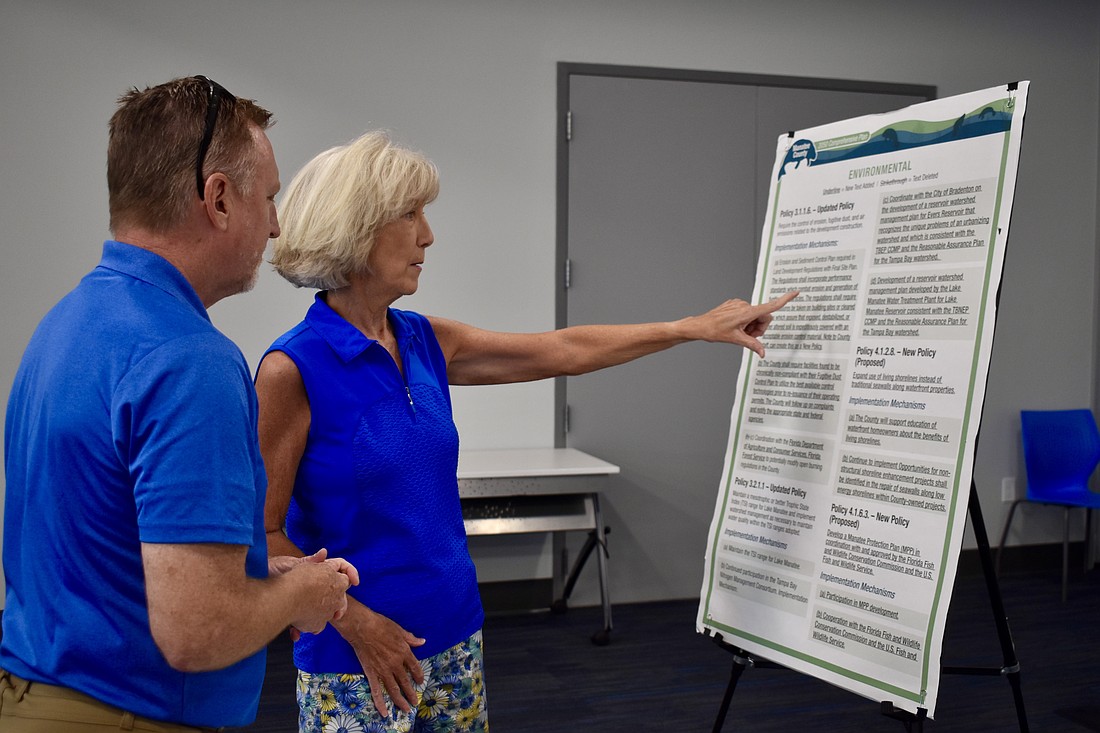
Indigo’s Suzanne Henke said riprap (crushed rocks used to prevent erosion) around the edge of a pond looks ugly; she wants to see more "living" shorelines around Manatee County ponds and lakes.
So Henke attended an Envision Manatee workshop March 28 at the Lakewood Ranch Library to present her input when it comes to formulating the county’s next comprehensive plan.
Engineering firm Kimley-Horn has been hired to update the plan and revisions have been underway for three years. The final draft is anticipated to go before commissioners this summer.
The series of Envision Manatee workshops aim to introduce the updated comprehensive plan to residents while seeking feedback on proposed policies and changes to existing policies.
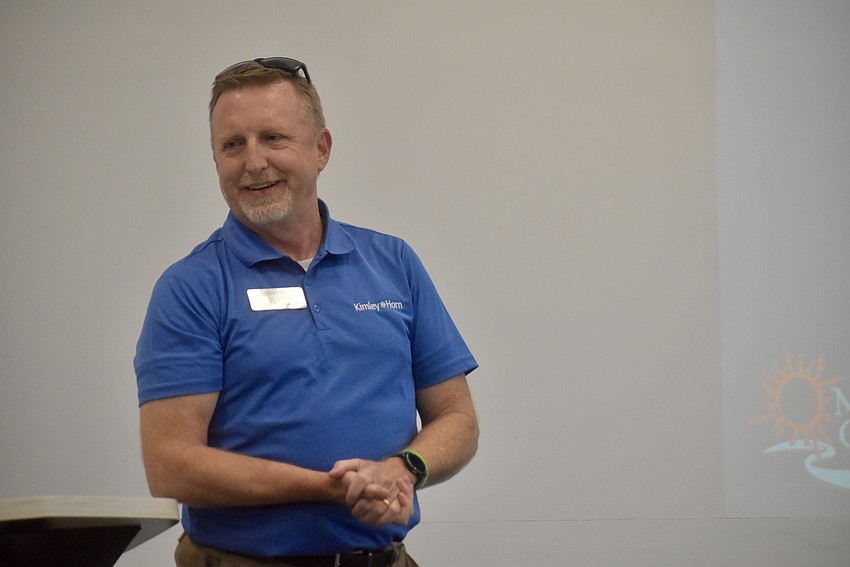
Kelley Klepper, a vice president and senior planner for Kimley-Horn, is heading the project.
Henke told Klepper that ponds and lakes should be included in the comp plan’s proposed Policy 4.1.2.8, which reads, “Expand use of living shorelines instead of traditional seawalls along waterfront properties.”
Klepper said the implementation mechanism of education that supports the policy could include ponds and lakes, but control of Manatee County ponds and lakes usually falls under the authority of community development districts, homeowners associations, and the Southwest Florida Water Management District.
The comprehensive plan doesn’t control all development within Manatee County.
The plan is a vision for the future, laying out guidelines for how the county will be developed over approximately next 20. Florida statute requires local governments to review their comprehensive plans every seven years.
The comprehensive plan works in conjunction with the land development code, which provides more specific regulations.
Senate Bill 180 has made efforts to update the comprehensive plan more difficult as almost any change could be considered “more restrictive and burdensome” to development, which is prohibited under Senate Bill 180.
So instead of adding restrictions to the plan, Klepper said the firm is working on adding more options as a way to “work in concert” with the bill.
Policies that were narrowly focused are being rewritten to provide more flexibility.
For example, the comprehensive plan used to dictate how many tennis and basketball courts needed to be provided according to the population. Moving forward, they’ll simply be called sports courts, so a pickleball court can be installed instead of a basketball court if that makes more sense for the community.
Klepper and his team also have plans to sit down with the Florida Department of Transportation, Florida Department of Environmental Protection, and Florida Commerce to pass on information that illustrates why certain policies are not more burdensome.
Another strategy to work with the bill's limitations is simple preparation and patience.
The team is putting policies in different “buckets." There’s a bucket for things that might be considered more burdensome now, but those policies can be ready to go when SB 180 sunsets in 2027.
Throughout the process, residents have been asked to provide input. Klepper said residents expressed five main areas of concerns: Growth and development, traffic, affordable housing, water quality, and retaining and expanding parks and open space.
Instead of covering the entirety of the plan, which would be impossible to do in 90 minutes, the workshop focused on those high priority areas. Big boards on the side of the meeting room illustrated some of the proposed policies and changes.
Policy 3.1.1.6 addresses “fugitive dust,” or construction dust. The policy includes updated, more specific language that, if approved by commissioners, would require “chronically non-compliant” facilities to “utilize the best available control technologies prior to re-issuance of their operating permits.”
Proposed Policy 2.2.1.249.7 establishes a new zoning category for land development — Mixed Use Community/Community Serving, which is intended to support medium to high density residential projects that include affordable housing components and integrate residential support uses, such as schools and parks.
Commercial uses would be permitted up to 150,000-square-feet, and residential uses would be permitted up to 16 net residential units per acre.
Beyond basic feedback, residents like John Taylor of Ralph Taylor’s Nurseries are also sources for data collection. Taylor attended the workshop at Mixon Farms March 25 and presented information on Florida Water Star, a building certification that saves water by using certain fixtures and landscape designs.
While the program could be deemed more restrictive on the surface, Taylor said there’s already a provision within state law that defines and permits the same type of water conservation, but it’s not called Water Star.
Klepper took that information straight back to county staff to discuss how it can be utilized moving forward.
"(Taylor) gave us empirical data and helped identify where in state law some of this is already permitted," Klepper said. "Those are the kind of partnerships that we truly appreciate."